Results of Minister for Economic Revitalization's Visit to the U.S.:
"U.S. Will Amend Presidential Executive Order"
Similar Tariff Rates as South Korea...
But Timing of Amendment Remains Uncertain
According to reports by the Asahi Shimbun and Mainichi Shimbun on August 10, a White House official has stated that the United States intends to extend the special measure of not imposing reciprocal tariffs on items with tariffs exceeding 15%?a policy previously applied to the European Union (EU)?to Japan as well.
According to these reports cited by Yonhap News Agency, the U.S. government will amend the presidential executive order to include Japan in the list of countries eligible for the special measure, which had previously been limited to the EU. However, the timing of this amendment has not yet been determined.
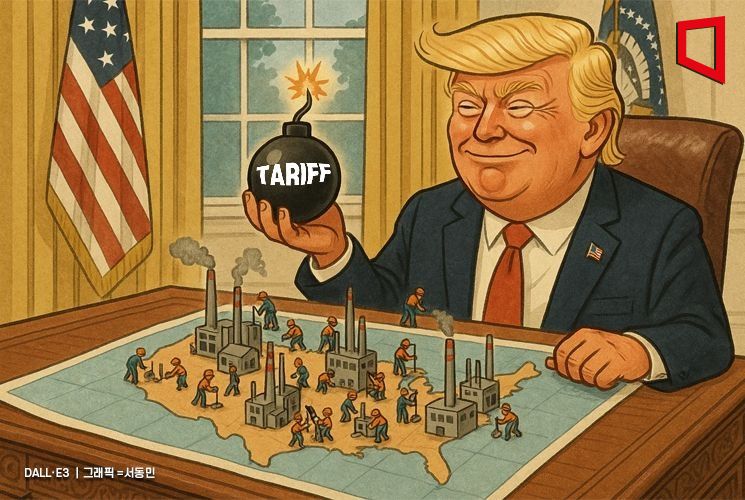
Previously, the Japanese government explained that immediately after concluding tariff negotiations with the United States in late July, the U.S. agreed to impose reciprocal tariffs of 15% on items with tariff rates below 15%, and not to add additional reciprocal tariffs on goods that already had tariff rates above 15%. However, the presidential executive order signed by U.S. President Donald Trump at the end of July, as well as the U.S. Federal Register published on August 6, mentioned only the EU. As a result, Japan and South Korea saw a uniform reciprocal tariff of 15 percentage points added to their existing tariffs. However, South Korea has been largely unaffected due to the Korea-U.S. Free Trade Agreement (FTA), which exempts most products from tariffs.
In response, Akazawa Ryosei, Japan's Minister for Economic Revitalization and chief tariff negotiator, visited the United States on August 5 and held talks with U.S. Secretary of Commerce Howard Lutnick and U.S. Secretary of the Treasury Scott Besant. As a result, according to Japanese media reports, the United States announced that it would amend the presidential executive order related to reciprocal tariffs at an appropriate time.
Although both the United States and Japan have confirmed their intention to apply the special measure for reciprocal tariffs, Japanese media reported that the timing for amending the presidential executive order remains unknown. A White House official told the Asahi Shimbun, "No specific schedule has been set yet." Akazawa, speaking to reporters at Tokyo Haneda Airport the previous day, noted that it took 54 days for the United States to implement related measures after reaching a tariff agreement with the United Kingdom, and added, "It will not be in half a year or a year."
The Asahi Shimbun predicted that when the United States amends the reciprocal tariff policy for Japan, the executive order will also include the reduction of automobile tariffs agreed upon last month. The United States has decided to lower tariffs on Japanese automobiles from the current 27.5% to 15%.
Meanwhile, Akazawa stated during his recent visit to the United States that, if the U.S. imposes tariffs on pharmaceuticals and semiconductors, Japan will receive the lowest tariff rates. However, he clarified that regarding semiconductor manufacturing equipment, "I understand that it is reasonably included (in the scope), but we have not explicitly discussed it." Japan exports more semiconductor manufacturing equipment to the United States than it does semiconductors or other electronic components.
© The Asia Business Daily(www.asiae.co.kr). All rights reserved.

















