Active Application of the Anti-Stalking Act
to Separate Perpetrators and Victims
In May, a violent crime stemming from dating violence occurred in Hwaseong Dongtan, followed by similar incidents in June in Daegu Seongseo and in July in Daejeon. These cases illustrate how dating violence is escalating into serious crimes. However, there have been instances where police intervention was hampered because victims said things like, "I screamed because I was scared at the time, but A apologized, so I don't want him punished. We've been getting along well since," or "We're going to break up anyway, so I don't want to provoke him." From now on, police will actively intervene to prevent crimes in such cases as well.
On August 10, the National Police Agency announced that it had created and distributed the first-ever 'Comprehensive Manual for Responding to Dating Violence' to frontline officers, enabling police to intervene ex officio in dating violence cases and proactively protect victims.
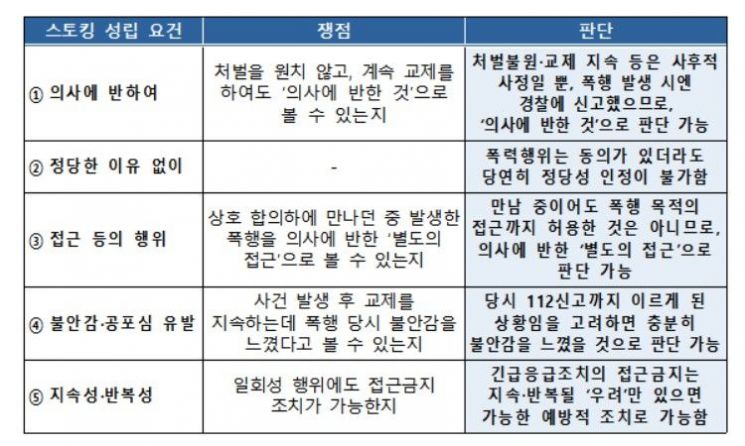
The police will actively apply the Anti-Stalking Act to dating violence cases, and will be able to issue emergency protective orders ex officio even for one-off acts of violence. These orders can prohibit the perpetrator from approaching within 100 meters of the victim's residence or from contacting the victim via electronic communications, allowing for the preemptive separation of the perpetrator and the victim. Until now, the application of the Anti-Stalking Act to dating violence in romantic relationships was inconsistent due to the lack of a standardized manual, causing confusion at the scene.
The Anti-Stalking Act can be applied when: ▲ the act is against the other person's will, ▲ there is no justifiable reason, ▲ the act involves approaching or similar behavior, and ▲ it causes anxiety or fear. The National Police Agency has issued guidelines stating that even if the victim does not wish to press charges and continues the relationship, this is a subsequent circumstance, and the occurrence of violence itself can be considered to have been against the victim's will. The police explained, "Even if people are in a romantic relationship, that does not mean they have consented to approaches made for the purpose of violence. Therefore, in cases of violence, such approaches can be regarded as 'separate approaches' against the victim's will, making the Anti-Stalking Act applicable."
The National Police Agency stated that it has worked to ensure nationwide consistency in legal interpretation by sharing actual investigative cases with the Supreme Prosecutors' Office, and has also consulted with experts and coordinated with the Ministry of Justice. The manual, completed with input from the Korean National Police University, the Korea Institute of Criminology and Justice, and the Korean Women Lawyers Association, details the signs of dating violence at each stage and presents practical ways to utilize the Anti-Stalking Act, enabling protective measures even when victims are uncooperative.
© The Asia Business Daily(www.asiae.co.kr). All rights reserved.

















