Expansion of Employer and Strike Scope in Article 2
"Unacceptable, Not Even Open for Compromise"
Alternative Proposal: Cap on Damages and Ban on Wage Garnishment

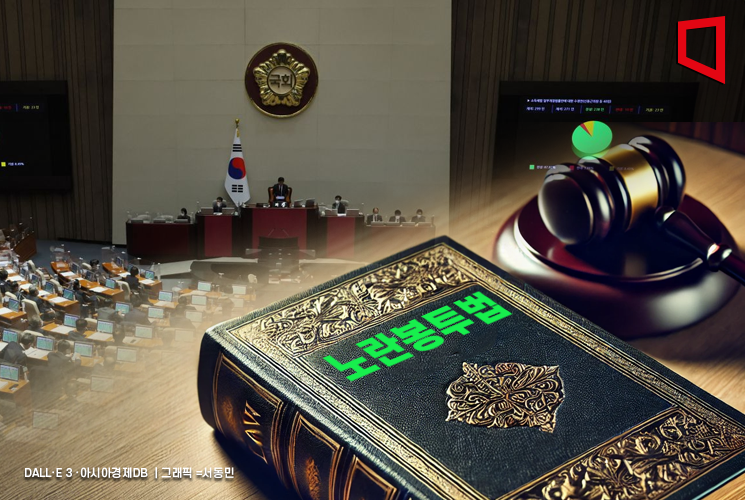
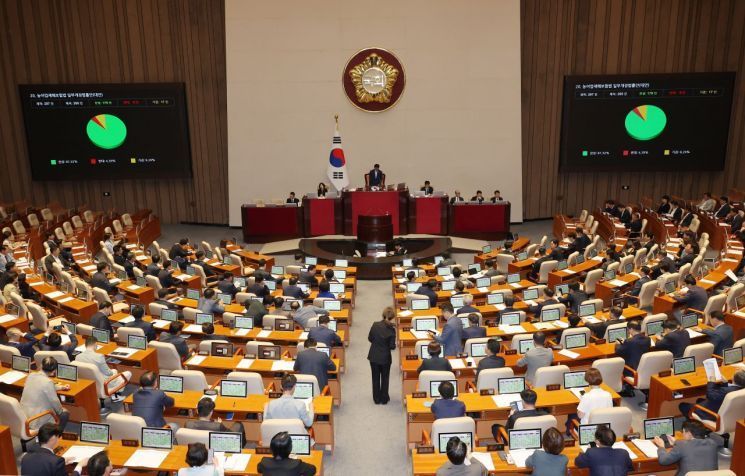
The business community is reportedly internally open to accepting certain provisions of the "Amendment to Articles 2 and 3 of the Trade Union and Labor Relations Adjustment Act" (commonly known as the Yellow Envelope Act). This consideration of a give-and-take approach comes as the ruling party has taken a hardline stance, declaring that it will pass the bill on the 21st.
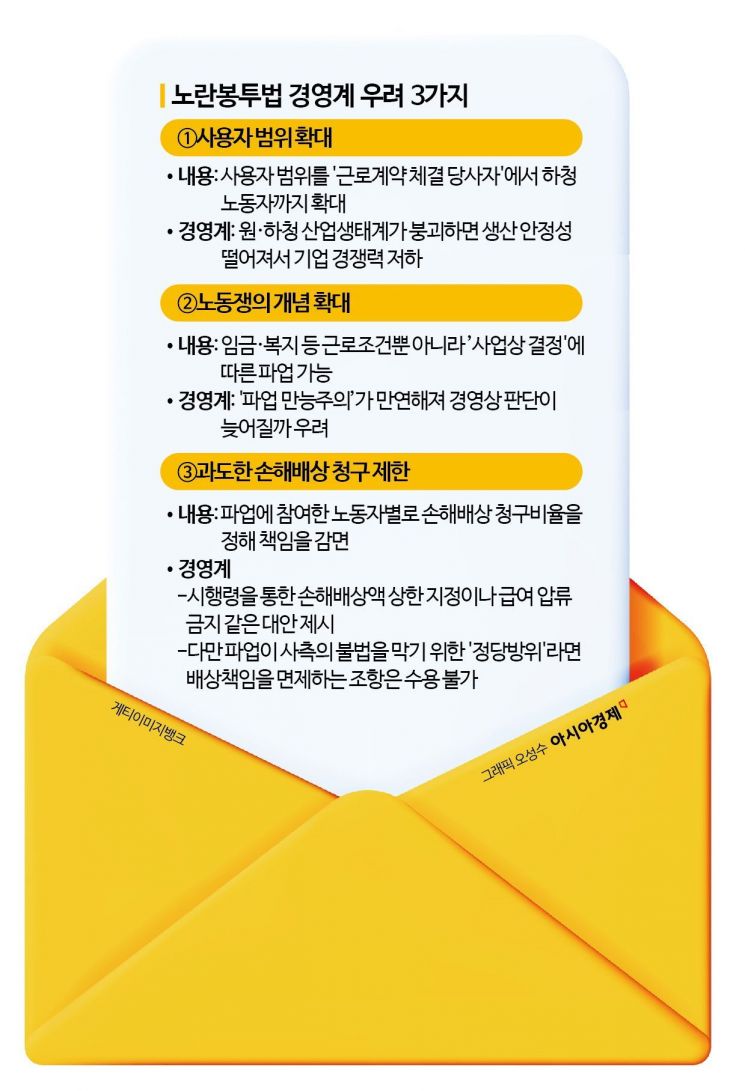
For example, business leaders are adamantly opposed to any significant expansion of the definition of "employer," which could subject companies to criminal penalties if they refuse to engage in collective bargaining with subcontractor unions. However, they have indicated a willingness to accept, on a broader, more constructive level, certain provisions that would reduce liability for damages resulting from illegal strikes, in line with the legislative intent. Nevertheless, with about ten days remaining until the deadline for the bill's passage, the business community maintains that its top priority is to block the bill in its entirety.
The aspect of the amendment that business leaders have shown a forward-looking willingness to accept is Article 3 of the revised labor law. This article stipulates that the proportion of damage claims can be determined for each worker participating in a strike, thereby reducing individual liability. Since the Yellow Envelope Act was prompted by excessive damage claims during the 2009 Ssangyong Motor mass layoff strike, the business community says it respects the intent behind the bill.
Kim Hongseong, head of the Labor Relations Legislation Team at the Korea Employers Federation, stated, "The Yellow Envelope Act was introduced to address the issue of excessive damage claims resulting from illegal strikes, which often led to wage garnishments that made it difficult for workers to maintain their livelihoods. The bill aims to improve this situation." He added, "While we believe Article 2 of the labor law should remain unchanged, for Article 3 we have proposed alternatives such as setting a cap on damage claims through an enforcement decree or prohibiting wage garnishments."
However, business leaders remain opposed to subparagraph 2 of Article 3, which exempts liability for damages if a strike is deemed "self-defense" against the employer's illegal acts. They argue that this could lead to frequent strikes justified by alleged employer misconduct, escalating labor-management conflicts. There are also concerns that ongoing debates over the scope of employer illegality could further increase confusion in the workplace.
"Strong Opposition to Expanding Corporate Liability to Subcontractors"
Despite the prevailing mood of strong opposition, some in the business community argue that compromise with reality is necessary. As a result, they are distinguishing between provisions of the bill they oppose and those they are willing to accept.
The provision that business leaders refuse to concede on is Article 2 of the labor law amendment. In particular, subparagraph 2 of Article 2, which expands corporate liability to subcontracted workers, is viewed as a "poison pill." The amendment would broaden the definition of "employer" from "the party to the employment contract" to include those with "substantial and specific control." Business leaders argue that this vague standard could turn primary contractors into potential criminals. One industry representative stated, "It is virtually impossible to accept a situation where a primary contractor would be held liable for subcontracted workers, even if it is only due to 'influence' and not direct involvement." Another added, "This is not an issue that can be resolved through compromise."
Another reason for their strong opposition is the fear that if the primary-subcontractor industrial ecosystem, which forms the foundation of Korea's manufacturing sector, collapses, it would significantly undermine not only corporate competitiveness but also national competitiveness. Jeong Seokjoo, Executive Director of the Korea Offshore & Shipbuilding Association, said, "The reason Korea's shipbuilding industry is more trusted than China's is its production stability. As negotiations with unions increase, the risk of production disruptions rises, and there are real concerns about losing the trust of foreign shipowners."
The construction industry is also pushing back strongly. A construction company official explained, "Apartment construction involves hundreds of specialized subcontractors in areas like electrical work, plumbing, and structural frameworks. If unions representing these subcontractors demand negotiations and go on strike against the primary contractor, even residents could be affected."
Worries Over 'Strike Omnipotence' If Scope of Labor Disputes Expands
The business community also opposes subparagraph 5 of Article 2 of the labor law amendment, which expands the grounds for strikes, arguing that it will become a future source of labor-management conflict. Under current law, only strikes over working conditions such as wages, working hours, welfare, and dismissals are considered legal. The amendment, however, would legitimize strikes over "business decisions" as well, including matters such as restructuring, investment decisions, and workplace relocations?areas that require high-level management judgment.
Business leaders worry that expanding the grounds for strikes will lead to the proliferation of "strike omnipotence." Kim Taejeong, Executive Director at Samsung Electronics, commented, "The semiconductor market is currently extremely competitive, making flexible decision-making crucial. If internal uncertainty is added from a labor-management perspective, there are concerns about how we will overcome an already unpredictable business environment." Another company official, speaking on condition of anonymity, said, "Since the advent of artificial intelligence (AI), the pace of change across all industries has accelerated significantly. If business decisions can also be subject to strikes, there are concerns that management decisions will be delayed."
Economic organizations, including the Korea Employers Federation, have launched a "final all-out effort" to block the Yellow Envelope Act by the 21st. Since even the enforcement decree could become disadvantageous, they are also considering filing a constitutional petition as a last resort. Lee Donggeun, Executive Vice Chairman of the Korea Employers Federation, said, "We do not know what decision the Constitutional Court will make, but a constitutional petition is the business community's last resort. If the enforcement decree does not reflect the position of the business community, we will proceed with a constitutional petition."
© The Asia Business Daily(www.asiae.co.kr). All rights reserved.



















