Some Local Politicians in Suncheon Raise Debate Over Shindae District Development
Demand for Profit Return from Developer Joongheung Construction Sparks Controversy
Donated Sites, Including Land for Foreign School, Not Recognized as Contributions
Pressure Mounts as Politicians Invoke Regulations That Did Not Exist at Project Approval
Construction Industry Voices Frustration: "Who Would Undertake Development Projects Under These Circumstances?"
Joongheung Construction States, "We Will Monitor the Situation Before Responding"
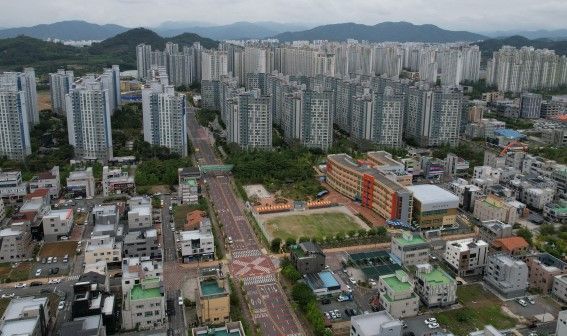
There is growing criticism that some local politicians are seriously distorting the facts regarding claims that the development of the Shindae District in Suncheon was used merely to enrich developers. Despite the fact that more than 100 billion won in social contribution funds, both tangible and intangible, were invested in the Shindae District project?sufficient to meet most social demands?the project is being portrayed as a case of “eating and running” (a slang term meaning to profit and then disappear). There are calls to thoroughly re-examine the excessive demands that have become customary toward developers.
According to political circles and the local construction industry, recently, local politicians including Seo Dongwook, a member of the South Jeolla Provincial Council, have called on Joongheung Construction, the developer of the Shindae District project in Suncheon, to return a portion of the development profits. They claim that despite earning massive profits, the company has contributed nothing to the local community.
These claims also include profits from apartment sales, which are separate from the profits generated by land development.
However, these arguments are in complete violation of current domestic laws, fueling further controversy.
The Shindae District development project began in earnest in October 2003, when the Gwangyang Bay Area was designated as a Free Economic Zone. The project, led by Suncheon City and the Gwangyang Bay Free Economic Zone Authority, aimed to develop a suburban complex (covering 2,997,095 square meters in Sindae-ri, Haeryong-myeon, Suncheon) under the pretext of attracting foreign investment.
Suncheon Ecovalley, a Joongheung Construction subsidiary (with Joongheung Construction holding 99% and Suncheon City holding 1% of shares), served as the project developer, while Joongheung Construction acted as the contractor.
Initially, in 2005, the Shindae District development project was undertaken by a consortium of Suncheon Leisure Sports Co., Samneung Construction, Songchon Construction, and Joongheung Construction. However, as the global financial crisis?centered around the United States?began to unfold, the domestic construction market deteriorated. During this period, Samneung Construction and Songchon Construction withdrew their investments and exited the consortium.
Left alone, Joongheung Construction also faced significant financial burdens internally but continued with the project out of necessity.
In particular, Joongheung Construction took a bold step by acquiring the apartment development site under challenging circumstances.
Although the Shindae District project appeared to be a public development on the surface, in reality, it was a dual-purpose project based on private investment. It was developed as an eco-friendly residential complex integrating housing, commercial, cultural, and public facilities, as well as parks and schools. The total project cost amounted to approximately 560 billion won.
This large-scale investment led to the complete sell-out of nine major complexes, starting with Joongheung 1st Complex in Shindae District.
Joongheung Construction returned a significant portion of the profits generated from the development of Shindae District to the local community through donations in kind.
These contributions totaled 136.1 billion won and included: land for a foreign school (137,596 square meters, valued at 66 billion won), land for medical facilities (75,468 square meters, valued at 36.2 billion won), 8.76 billion won for an elementary school site, 2.65 billion won in maintenance costs for Suncheon City (cash donation), 2.7 billion won for additional construction of on-site facilities, and 14.8 billion won for the relocation and design of Samsan Middle School.
The Shindae District development project was approved before the Enforcement of the Development Profit Recovery Act (December 2006). Nevertheless, Joongheung Construction made a major decision to share profits with the local community in the interest of public benefit.
Despite this, local politicians continue to insist that half of the approximately 80 billion won in land development profits earned by Joongheung Construction should be recovered. They also argue that the substantial profits from apartment sales should likewise be shared with the community.
At the same time, there are voices claiming that the previously donated land for medical facilities and the foreign school by Joongheung Construction should be excluded from the scope of profit recovery. They argue that, since these sites were transferred to Suncheon City free of charge, they should not be recognized as contributions.
In addition, local politicians are increasing pressure by invoking the development profit reinvestment rule (introduced in August 2011, requiring 10% reinvestment of development profits), targeting Joongheung Construction.
All of these laws did not apply at the time the project was approved, but politicians are now demanding retroactive application.
Essentially, the political sector is declaring a kind of war on private developers by seeking to forcibly reclaim profits that were hard-earned by private businesses.
Amid this atmosphere, the local construction industry is voicing its frustration, saying, "If things are so inconsistent, what local company would want to participate in any large-scale development project in the future? We must put an end to these habitual practices that only hold businesses back."
In response, Joongheung Construction has stated that it will monitor the situation for now. A Joongheung Construction representative said, "The implementation plan for the Shindae District development was approved before the enforcement of the enforcement ordinance on development profit recovery. Since we have already made significant public contributions to the local community, there are no legal obstacles whatsoever," adding, "We will review the situation and clarify our position accordingly."
© The Asia Business Daily(www.asiae.co.kr). All rights reserved.
![Clutching a Stolen Dior Bag, Saying "I Hate Being Poor but Real"... The Grotesque Con of a "Human Knockoff" [Slate]](https://cwcontent.asiae.co.kr/asiaresize/183/2026021902243444107_1771435474.jpg)
















