HUG's 'Unsold Housing Management Area' Criteria Under Scrutiny
Mass Removal from Management List Creates 'Illusion Effect' as Housing Inventory Rises
Reliance on Voluntary Reporting by Construction Companies Undermines Unsold Home Statistics
Actual Number of Malignant Unsold Homes Remains Unknown
Lawmakers Call for Mandatory Reporting to Enhance Transparency
The 'Unsold Housing Management Area' system, introduced by the Housing and Urban Guarantee Corporation (HUG) as a measure to stabilize the housing market, is now under scrutiny due to loopholes in statistical standards and controversies over data reliability. Despite the fact that the number of unsold homes remains critical, there have been numerous cases where areas are removed from the management list due to adjustments in the statistical denominator, leading to criticism that the system is merely a formality. Additionally, there are concerns that the current structure for tallying unsold homes, which relies on voluntary reporting by construction companies, encourages concealment.
Inventory Increase Leads to Automatic Removal... The Reality Behind the 'Management Area Illusion'
 Apartment complexes in downtown Seoul. Photo is unrelated to the article content. Photo by Yonhap News.
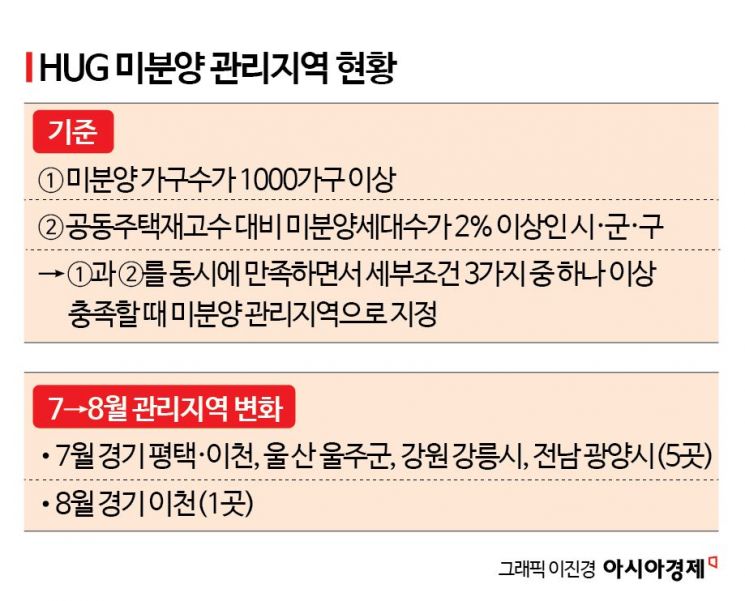
According to HUG on August 10, only one location?Icheon in Gyeonggi Province?was designated as an 'unsold housing management area' for August. In July, there were five such areas (Pyeongtaek and Icheon in Gyeonggi, Ulju in Ulsan, Gangneung in Gangwon, and Gwangyang in South Jeolla), but four have now been removed from the list. When an area is designated as a management area, all applications for pre-sale guarantees or project financing (PF) guarantees in that area must undergo a preliminary review.
The main reason for the sharp decrease in management areas is the 'increase in housing inventory.' HUG designates as management areas any cities, counties, or districts with more than 1,000 unsold units and an unsold rate (number of unsold units/number of multi-unit housing inventory) of 2% or higher. In the '2024 National Housing Census' released at the end of July, the inventory of multi-unit housing increased, which in turn raised the denominator. As a result, the unsold rates in four areas, including Pyeongtaek and Gwangyang, fell below the threshold and were removed from the management list.
This outcome is far removed from the reality on the ground. In Pyeongtaek?often called the 'graveyard of unsold homes' in Gyeonggi Province?there were 3,996 unsold units as of the end of June. Although this is about a 10% decrease from the previous month's 4,442 units, it still accounts for more than one-third of the total unsold homes (11,093 units) in Gyeonggi Province. In Gwangyang, where there were 1,081 unsold units at the end of June, the number of unsold homes has decreased by only 176 units over the past two years and five months. Despite little change in the volume of unsold homes, these areas were removed from management simply because 'statistical criteria' changed.
A representative from a construction company commented, "It is problematic that areas with thousands of unsold units are being removed from management. Areas with severe absolute numbers should continue to be managed under separate criteria." There is also criticism that the same criteria are applied across cities, counties, and districts, even though their housing inventories vary widely. In response, a HUG official stated, "We are currently monitoring the unsold housing management areas, but no direction for institutional reform has been decided yet."
'Blind Spot' in Unsold Home Statistics Due to Voluntary Reporting
There is ongoing criticism that the unsold home statistics from the Ministry of Land, Infrastructure and Transport, which serve as a basis for designating or removing management areas, are riddled with flaws. The current tally of unsold homes relies on voluntary reporting by construction companies. In particular, unsold homes after completion (so-called 'malignant unsold homes') are seen as a sign of financial distress, creating strong incentives for underreporting or concealment. There are even reports that some sites resort to tactics such as 'fake contracts,' where contracts are signed and then canceled, to manipulate the numbers.
According to government statistics, there were 26,716 unsold homes after completion as of the end of June. This is the first decrease in 23 months compared to the previous month. However, industry experts believe that the actual number is much higher. Malignant unsold homes are particularly risky and have a high potential for guarantee accidents, but the gap between the statistics and the real numbers is a serious issue. This discrepancy poses a risk that real estate policies based on inaccurate statistics may be flawed.
In an effort to correct these faulty statistics, lawmakers have also stepped in. Lee Yeonhee, a member of the Democratic Party of Korea, recently proposed an amendment to the Housing Act. The core of the amendment is to make it mandatory for construction companies to report the status of unsold homes to local governments and to systematically tally and manage this data. Lee explained, "We have found cases of underreporting. The aim is to enhance the effectiveness of policies such as tax and loan regulations by basing them on reliable statistics."
© The Asia Business Daily(www.asiae.co.kr). All rights reserved.


















