Taegukgi from the 1899 Paris Exposition Unveiled
Over 200 Items Including National Flag Cases on Display
Special Exhibition "Taegukgi" at the National Museum of Korean Contemporary History Marks 80th Anniversary of Liberation
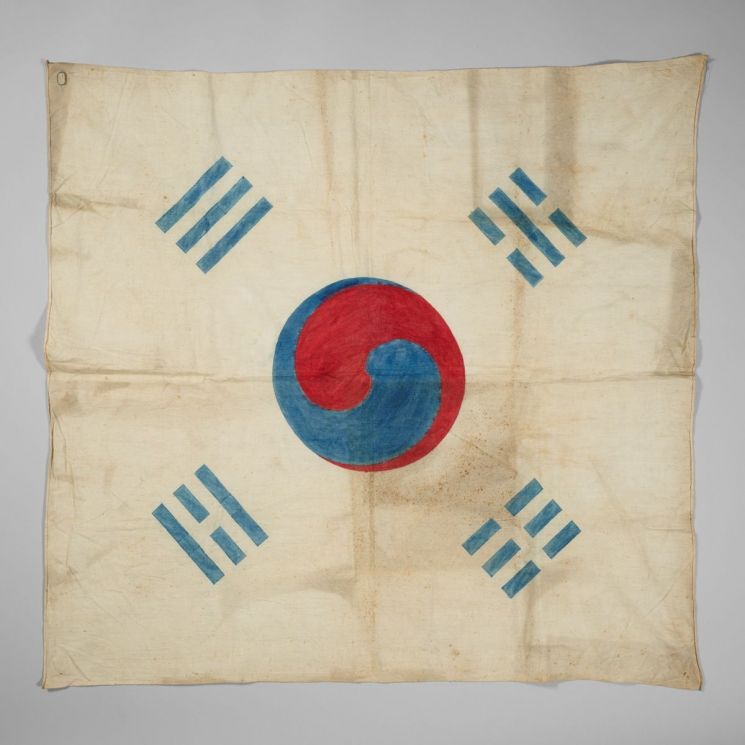 Taegukgi presumed to have been exhibited at the 1900 Paris Exposition, held by the National Museum of Asian Arts Guimet in France. National Museum of Korean Contemporary History
An early-style Taegukgi, presumed to have been exhibited at the 1900 Paris Exposition about 125 years ago, is being unveiled to the public for the first time. The rectangular cloth features a vivid Taeguk pattern in red and blue, as well as the four trigrams representing Geon, Gon, Gam, and Ri.
On August 8, the National Museum of Korean Contemporary History announced that it would hold a special exhibition titled "Taegukgi: Days We Have Shared" on the third floor of its museum in Jongno-gu, Seoul, to commemorate the 80th anniversary of Liberation. The exhibition will feature about 200 Taegukgi flags and related materials from Korea's modern and contemporary history. The exhibition runs until November 16.
A museum official stated, "In celebration of the 80th anniversary of Liberation, we have highlighted historic moments in Korea's modern and contemporary history through the Taegukgi, which has accompanied Koreans through hardship, adversity, and moments of joy."
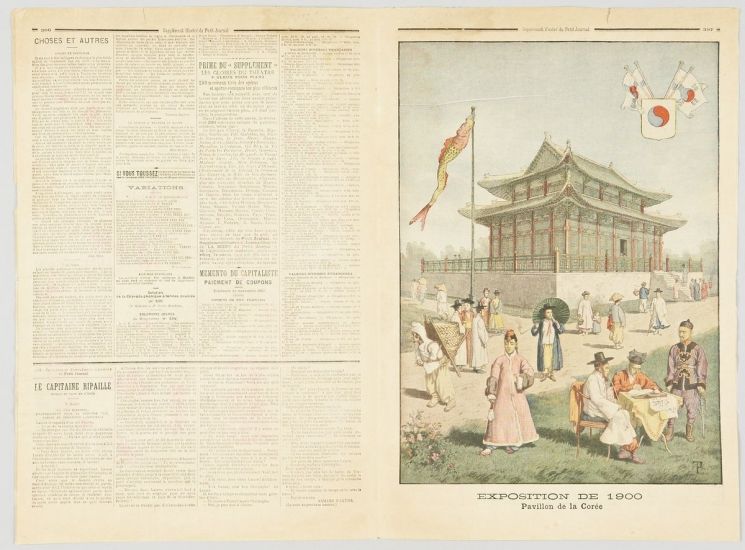 French weekly magazine introducing the Korean Empire Pavilion at the Paris Exposition. National Museum of Korean Contemporary History
The exhibition introduces the journey of the Taegukgi, from its proclamation as the national flag of Joseon in 1883 to its status today as a symbol of the Republic of Korea. Particularly noteworthy is a Taegukgi from France, whose existence was confirmed in the 1990s during an overseas Korean cultural heritage survey conducted by the National Research Institute of Cultural Heritage (then the National Research Institute of Cultural Properties).
The National Museum of Asian Arts Guimet, located in central Paris, houses cultural heritage collected in Korea by figures such as Victor Collin de Plancy (1853-1922), the first French minister to Korea, and explorer Charles Varat (1842-1893). This is the first time the Taegukgi held by the National Museum of Asian Arts Guimet has been brought to Korea.
A museum official explained, "This is an early style, with the Taeguk and four trigrams painted in blue and red on cotton cloth. We presume it was exhibited at the Paris Exposition." The official added, "It is a material that shows the Korean Empire's intent to assert itself as an independent nation."
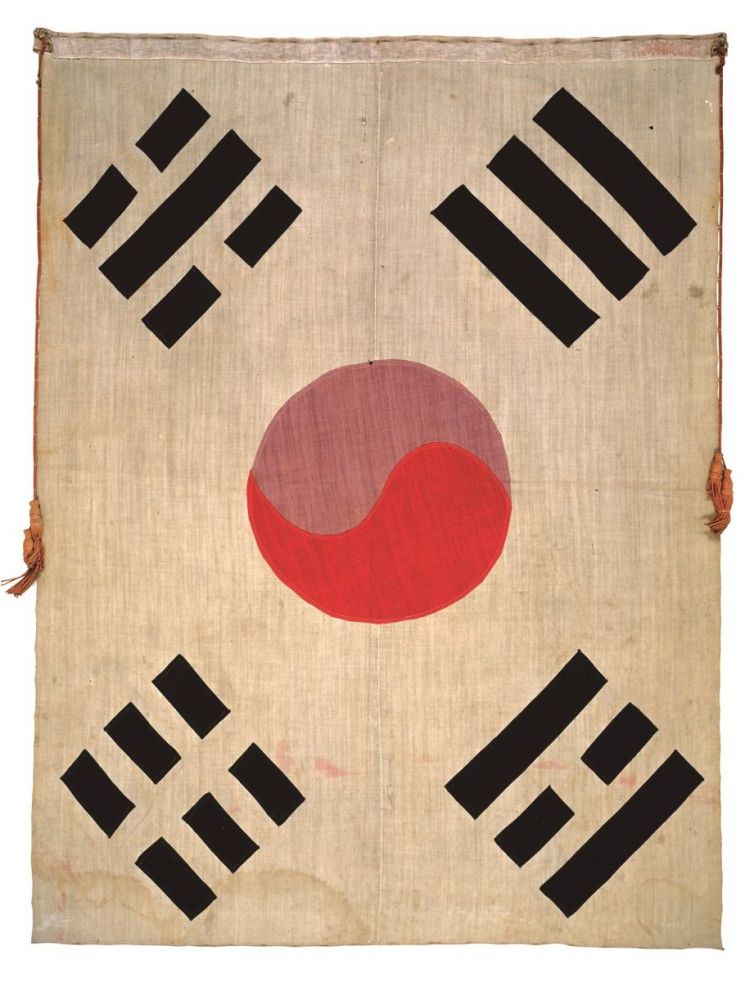 The "Provisional Assembly Taegukgi of the Republic of Korea" registered as a National Registered Cultural Heritage. National Museum of Korean Contemporary History
The exhibition hall features various Taegukgi flags that have evolved throughout history. Not only their different shapes, but also the stories and history they embody, are noteworthy. For example, the "Provisional Assembly Taegukgi of the Republic of Korea," registered as a National Registered Cultural Heritage and believed to have been made in the 1920s, was hung at the provisional government assembly established in Shanghai, China.
The museum explained, "It is said that independence activist Kim Bungjun, who served as the chair of the Provisional Assembly, and his wife Noh Youngjae made it around 1923, personally purchasing the fabric and sewing it by hand."
The "Gwangjeho Taegukgi," which was flown on the modern warship Gwangjeho, was taken down the day before the loss of national sovereignty in 1910, secretly kept, and has survived to this day. The Taegukgi that hung at Soongsil School in Pyongyang during the March 1st Movement in 1919 was preserved despite severe Japanese oppression, was later moved to the United States, and returned to Korea in 1974.
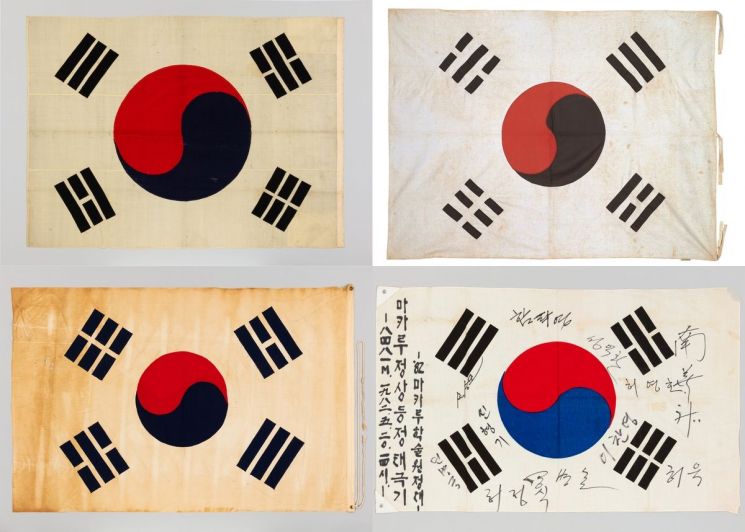 Various Taegeukgi flags exhibited at the National Museum of Korean Contemporary History. From the top left clockwise: Gwangjeho Taegeukgi, Soongsil School Taegeukgi, MacArthur Academic Expedition Taegeukgi, Daehanminguk National Association Taegeukgi. National Museum of Korean Contemporary History
A Taegukgi discovered in the attic of the Korean National Association Hall in San Francisco during its restoration in 2003 is also being unveiled. The Korean National Association was an independence movement organization established in the United States in 1910.
Han Soo, director of the National Museum of Korean Contemporary History, stated, "I hope this exhibition provides an opportunity for us to reflect on the times we have gone through together with the Taegukgi, and to consider with what spirit we prepare for tomorrow."
© The Asia Business Daily(www.asiae.co.kr). All rights reserved.
![Clutching a Stolen Dior Bag, Saying "I Hate Being Poor but Real"... The Grotesque Con of a "Human Knockoff" [Slate]](https://cwcontent.asiae.co.kr/asiaresize/183/2026021902243444107_1771435474.jpg)


















