Hyundai Motor, Toyota, and Others Hit Hard by Tariffs
Top 10 Global Automakers to See 25% Drop in Net Profit This Year
Price Hikes and Production Relocation Difficult in the Short Term
The impact of U.S. President Donald Trump's high-tariff policy has materialized as declining profits for global automakers. While companies need to offset tariff burdens by relocating production bases or raising prices, it is difficult to implement these measures in the short term, so sales are expected to continue to be affected for the time being.
The Wall Street Journal (WSJ) reported on August 7 (local time) that major global automakers have already suffered a total loss of $11.8 billion (approximately 16.4 trillion won) due to President Trump's tariff policy.
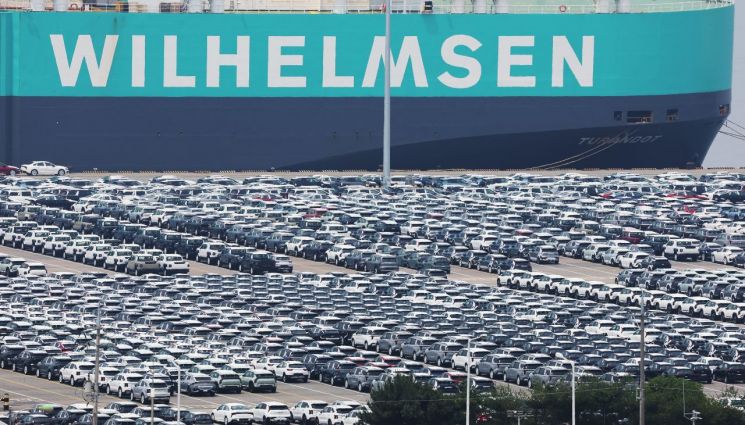
According to the WSJ, which compiled the recently announced second-quarter earnings of global automakers, this loss figure has been confirmed. The newspaper added, "The more alarming reality is that these losses may only be the beginning."
The company that suffered the greatest loss was Toyota. In its earnings announcement, Toyota stated that U.S. tariff measures had a negative impact, reducing its second-quarter operating profit by $3 billion (about 4.2 trillion won). Volkswagen followed with $1.51 billion in losses, then GM with $1.1 billion, Ford with $1 billion, Honda with $850 million, BMW with $680 million, Hyundai Motor with $600 million, Kia with $570 million, Mazda with $470 million, and Nissan with $470 million. The combined tariff-related losses for Hyundai Motor Group (Hyundai Motor and Kia) reached $1.17 billion (about 1.6 trillion won).
The WSJ predicted that the net profit of the top 10 global automakers, excluding China, will decrease by about 25% this year compared to the previous year. This would be the largest decline since 2020, when factories were shut down due to the pandemic.
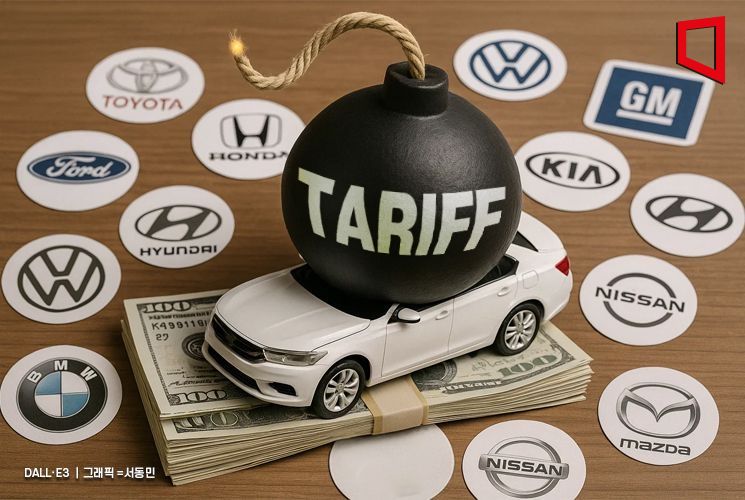
The tariff shock is expected to persist for some time. Toyota estimated that cumulative losses from tariffs in the current fiscal year, which ends in March next year, will reach $9.5 billion (about 13 trillion won), and that annual net profit will decrease by 44% compared to the previous year.
Raising prices and relocating production to the United States are commonly cited as ways to reduce tariff burdens, but the WSJ analyzed that it is difficult to implement these measures in the short term. The WSJ pointed out, "Both responses are difficult to execute immediately, and as a result, automakers are likely to bear the burden of tariffs for years to come."
Philippe Houchois, an analyst at Jefferies, explained the reason automakers are reluctant to raise prices: "No company wants to move first before others do. Everyone is wary of receiving negative comments from President Trump on social media."
While President Trump has been strongly pressuring automakers to expand production in the United States, the WSJ analyzed that if companies actually decide to increase U.S. production facilities, this is more likely a strategic decision based on high demand in the U.S. market than simply a move to avoid tariffs. Automakers have already been increasing production in the U.S., the world's largest market, and this trend would have continued even without tariffs.
However, the WSJ added that since most manufacturers do not produce the same vehicle model at multiple plants, there are practical limitations to relocating production solely to avoid tariffs without facility redeployment. For example, Hyundai Motor Group announced a $21 billion investment plan in the U.S. in March, and President Trump touted this as a result of his tariff policy. However, Hyundai Motor had already been pursuing expanded production in the U.S. from the outset.
Despite some skepticism, the WSJ assessed that the U.S. tariff policy is likely accelerating automakers' "local production strategies." The world's three largest auto markets?North America, Europe, and China?are seeing increasing divergence in regulations, technological standards, and consumer preferences. As a result, automakers are strengthening their "local-for-local" strategies, designing and producing vehicles for each market.
Hakan Samuelsson, CEO of Volvo Cars, said, "The era led by globalization and a single car model accepted worldwide is now over, and we are entering a more localized world."
© The Asia Business Daily(www.asiae.co.kr). All rights reserved.


















