Despite Loan Regulations, Home Prices Rise... Seoul Apartments See a "Quiet Increase"
Rate of Increase Rebounds After Six Weeks Since June 27 Loan Regulation
Transactions Drop by 75%... 16 Out of 25 Districts See Expanded Gains
Mayongseong Leads the Uptrend, Nationwide Remains Steady, Daegu Falls for 89th Week
Despite a sharp decline in transactions, apartment prices in Seoul are rising again. After President Lee Jaemyung referred to the June 27 mortgage loan regulation announcement as "just a preview," the market entered a wait-and-see mode, causing the rate of increase in Seoul apartment prices to slow. However, after six weeks, the rate of increase has rebounded. Notably, price gains are prominent not only in the three Gangnam districts but also in key areas of northern Seoul such as Mapo, Yongsan, and Seongdong (commonly referred to as Mayongseong).
According to the "Weekly National Apartment Price Trends" released by the Korea Real Estate Board on August 7, apartment prices in Seoul rose by 0.14% in the first week of August (as of the 4th), up from 0.12% the previous week. This marks a rebound in the rate of increase after six weeks since the June 27 loan regulation announcement. The Korea Real Estate Board explained, "Transactions at higher prices were concluded as purchase inquiries increased, especially in preferred areas such as complexes with reconstruction potential, locations near subway stations, and school districts."
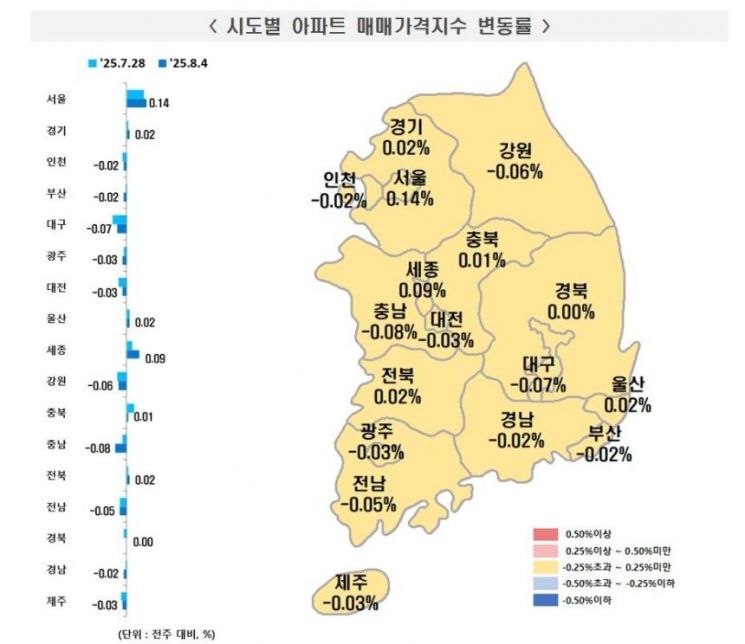 Apartment Price Change Rates in 17 Cities and Provinces Nationwide for the First Week of August (As of the 4th). Korea Real Estate Board.
In reality, the volume of apartment transactions in Seoul has dropped significantly. According to data analyzed by the real estate platform Dabang from the Ministry of Land, Infrastructure and Transport's official transaction disclosure system, the number of apartment transactions in Seoul last month was 2,973. This represents a 75% decrease compared to the previous month (11,933 transactions). Compared to the same month last year (9,236 transactions), it is a 67.8% decrease.
Nevertheless, apartment prices in Seoul rebounded in terms of the rate of increase, especially in major areas. In 16 out of 25 districts in Seoul, the rate of increase expanded compared to the previous week. Four districts maintained the same rate, while only five districts, including Seocho and Songpa, saw a decrease in the rate of increase.
This upward trend is spreading beyond the Gangnam area to major regions in northern Seoul. Seongdong District recorded the largest increase, rising by 0.33%, which is 0.11 percentage points higher than the previous week (0.22%). Yongsan District (0.22%) and Mapo District (0.14%) also saw their rates of increase expand compared to the previous week. In Gwangjin District, prices rose by 0.24%, mainly in school districts such as Guui and Gwangjang-dong. Among the three Gangnam districts, Gangnam District rose by 0.15%, up from 0.11% the previous week, while Seocho District (0.16%) and Songpa District (0.38%) saw a slight slowdown.
In the metropolitan area, Bundang District in Seongnam City (0.47%) and Gwacheon City (0.34%) stood out. In non-metropolitan areas, apartment prices in Sejong City rose by 0.09%, with the rate of increase expanding from 0.04% the previous week. The overall apartment sale price in non-metropolitan areas fell by -0.03%, a slightly larger drop than the previous week's -0.02%. As a result, the nationwide average apartment price change rate remained at 0.01%, the same as the previous week. Daegu continued its decline for the 89th consecutive week, falling by -0.07%.
© The Asia Business Daily(www.asiae.co.kr). All rights reserved.

















