Busan City Selected for Ministry of Science and ICT Project
Proactive Data Management for International Battery Trade Regulations
34.6 Billion Won Invested This Year, Three Pilot Services Planned
Busan City is set to establish a "Battery Passport Platform" that will manage all data related to electric vehicle batteries using blockchain technology.
On August 7, Busan City announced that it had been finally selected for the "2025 Blockchain Public Sector Intensive Project," organized by the Ministry of Science and ICT and the Korea Internet & Security Agency.
With the selection of the city's proposed "Blockchain-Based Battery Passport Platform Construction" project, Busan will begin in earnest to create a circular ecosystem based on battery lifecycle data.
This project is a government initiative to incorporate blockchain technology into public services closely related to citizens' daily lives. Since proposing the project in November last year, Busan City underwent two rounds of evaluations and four rounds of consultations before being finally selected.
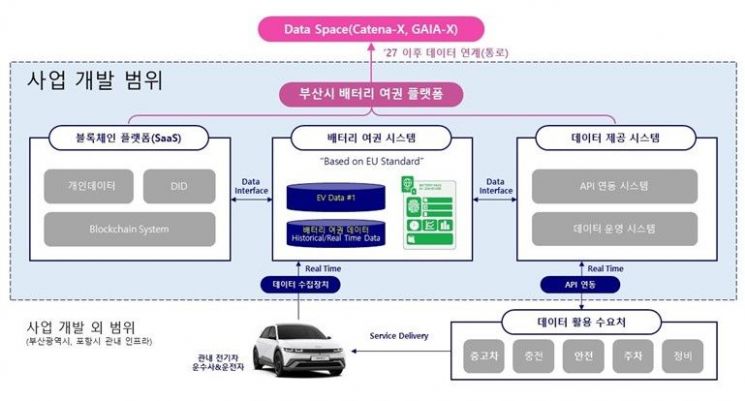
The "Battery Passport Platform Construction" project is a system that collects and manages full-cycle data on electric vehicle batteries?including charging and safety, performance inspection, and history management?using blockchain technology. The project will be jointly carried out by Busan City, the Busan Institute for Industry-University Convergence, Pohang City, the Korea Electric Vehicle Industry Association, and a consortium of private companies led by PMGrow Co., Ltd.
Through this project, the city plans to conduct a pilot program involving 2,500 local electric vehicles and establish a distribution and trading system based on battery information to build a circular ecosystem.
As the need for battery history management systems grows in response to international trade regulations such as the European Union's upcoming Digital Product Passport (DPP), this project stands out as a leading initiative among local governments in Korea.
With the spread of electric vehicles, the number of used batteries is expected to surge from about 8,000 units in 2025 to more than 100,000 units by 2030. Busan, leveraging its port and logistics infrastructure, is emerging as a key hub for battery distribution and trading.
The total project budget amounts to 3.46 billion won, with 2.6 billion won in national funding and 860 million won from the private sector. The pilot service will be divided into: ▲ management based on charging, safety, and parking; ▲ performance diagnostics; and ▲ integrated lifecycle history management. The system will issue a "battery passport" based on data collected through battery information collection devices.
Park Heongjoon, Mayor of Busan, emphasized, "As a city specialized in blockchain and a strategic hub for the battery industry, Busan will use this project to enhance the competitiveness of local industries and lay the foundation to lead the future-oriented industrial ecosystem."
© The Asia Business Daily(www.asiae.co.kr). All rights reserved.

















