"It Seems Likely to Proceed as Stated in the US Federal Register"
Yomiuri: "Some Tariffs May Exceed 40%"
Akazawa: "Details Differ... Calls for Revision"
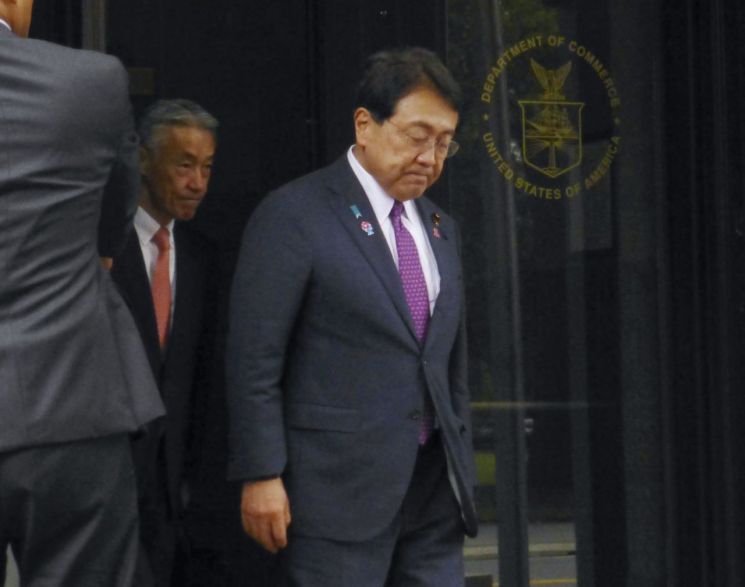 Ryosei Akazawa, Japan's Minister for Economic Revitalization and Japan's representative in the US-Japan tariff negotiations. Photo by Yonhap News
Kyodo News reported that the Donald Trump administration has decided to exclude Japan from the list of countries eligible for special tariff rates in its reciprocal tariff measures, unlike the European Union (EU). The plan is to add an additional 15% tariff on top of existing tariff rates.
According to Kyodo News on August 7, a senior White House official, speaking on condition of anonymity, stated that the 15% tariff on Japanese goods would be imposed in addition to existing rates. The United States and Japan have expressed differing positions regarding the 15% reciprocal tariff, and the official reaffirmed that the details published in the US Federal Register on August 6 are correct.
The Japanese government explained that, in last month's tariff negotiations with the United States, both sides agreed to apply a 15% reciprocal tariff to items with an existing tariff rate below 15%, while items with an existing tariff rate of 15% or higher would not be subject to the additional reciprocal tariff and would only be subject to the existing rate.
However, the presidential executive order signed by President Donald Trump at the end of last month, as well as the US Federal Register published on August 6, mentioned that this approach would apply only to the EU. Japan was not included.
In this case, some Japanese exports to the United States could face tariffs in the 40% range, according to the Yomiuri Shimbun. For example, Japanese textiles, which previously faced a 7.5% tariff, will now be subject to a total tariff of 22.5% after the additional 15% reciprocal tariff is imposed. Japanese beef, which previously had a tariff rate of 26.4%, is expected to face a tariff of 41.4%.
The US reciprocal tariffs took effect at 1:01 p.m. Korea Standard Time (12:01 a.m. Eastern Time in the United States) on the day of publication. The reciprocal tariffs apply to most items, excluding categories such as automobiles, aluminum, and steel.
The Japanese government has also become increasingly concerned. Ryosei Akazawa, Japan's Minister for Economic Revitalization and the country's chief trade negotiator, is reported to have visited Washington, DC since August 5 to urge the implementation of the agreed terms. After entering the United States, Minister Akazawa told reporters that "the content of the US reciprocal tariffs is different from what was communicated by US officials," and said he would call for revisions.
© The Asia Business Daily(www.asiae.co.kr). All rights reserved.

















