Climate Change and Ultraviolet Surge Caused by the "Laschamps Event"
Modern Humans Survived by Blocking Ultraviolet Rays
Homo sapiens, the direct ancestors of modern humans, began migrating from Africa to the Eurasian continent about 70,000 years ago. There were already other human species that had settled in Eurasia first?our cousins, the Neanderthals and Denisovans. These two archaic human species coexisted with Homo sapiens for 30,000 to 40,000 years until their extinction around 40,000 years ago. In particular, Neanderthals left Africa and settled in Eurasia about 400,000 years ago. Denisovans, named after the Siberian cave where their bones were first discovered in 2008, are believed to have branched off from Neanderthals about 350,000 years ago and spread throughout Asia.
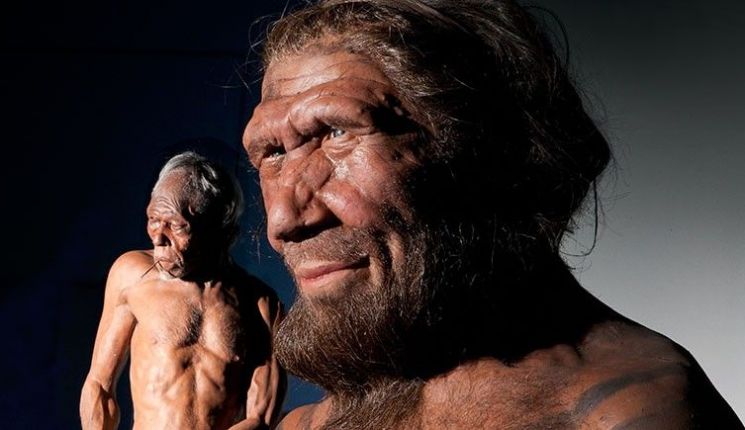
Around 41,000 years ago, near the end of the last Ice Age, there was a sudden surge in ultraviolet and cosmic radiation reaching the Earth's surface. About 1,000 years later, the Neanderthals (Homo neanderthalensis) disappeared and became extinct. Meanwhile, Homo sapiens survived and flourished. There are numerous factors and hypotheses regarding why their fates diverged. Among them, a recent study draws interest by suggesting that whether or not these species took measures to block ultraviolet rays may have played a significant role.
On August 7, Yonhap News quoted a report from the Washington Post (WP), introducing a paper published in the scientific journal Science Advances. The article stated, "One of the keys to Homo sapiens' survival may have been sunscreen and tailored clothing." The researchers of the paper, titled "The Wandering of the Aurora 41,000 Years Ago," studied regional changes in Earth's geomagnetic field during an event known as the Laschamps geomagnetic excursion, which began about 41,000 years ago and ended around 39,000 years ago.
The Earth's geomagnetic field is generated by the convection of high-temperature, high-pressure liquid iron and nickel in the planet's outer core, which produces electric currents. Throughout Earth's history, geomagnetic excursions?periods when the direction of the magnetic field changes and its strength weakens?have occurred roughly every few thousand years. Complete geomagnetic reversals, where the magnetic poles switch places, have happened at least 183 times over the past 83 million years. The most recent geomagnetic excursion, known as the Laschamps event, lasted about 2,000 years.
Cave Dwelling and Tailored Clothing Proved Effective for Survival
Modern humans who migrated to Eurasia about 70,000 years ago coexisted with Neanderthals for a time. However, during the Laschamps event, around 40,000 years ago, the Neanderthals went extinct, resulting in a "population replacement" where only Homo sapiens remained. In a press release issued by the University of Michigan at the time of the paper's publication in mid-April, the researchers explained that during the Laschamps event, the strength of Earth's magnetic field dropped dramatically to just one-tenth of its current level. As a result, there were massive climate changes, with auroras visible not only at the poles but also across Europe and North Africa. The weakened geomagnetic field, which normally acts as a shield, allowed intense cosmic and ultraviolet radiation to bombard the surface.
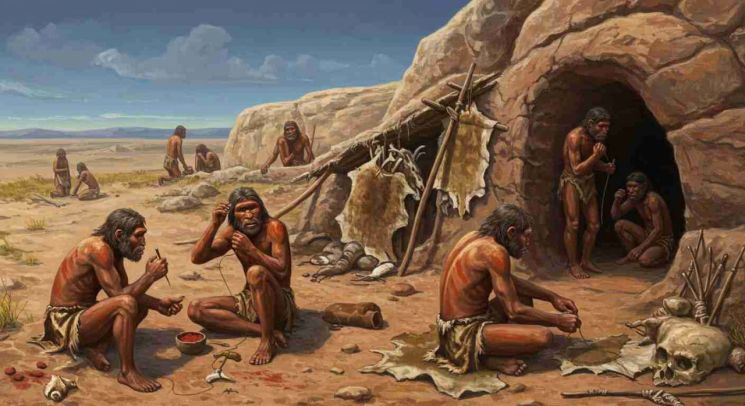 Living in caves and applying 'sun screen' made from loess to the skin were representative survival techniques for blocking ultraviolet rays. Naturally, living in caves was advantageous for blocking ultraviolet and cosmic radiation, and applying loess containing iron oxide to the skin provided a protective effect against sunlight. Forward Pathway
The authors of the paper estimated that the effects of the Laschamps event?weakening of the geomagnetic field and increased levels of ultraviolet and cosmic radiation?were especially severe in regions up to 40 degrees latitude in both the Northern and Southern Hemispheres. These areas included much of Europe, including Spain, where Neanderthals and modern humans coexisted and where the "population replacement" occurred. During the same period, not only Neanderthals but also other species experienced frequent extinctions in this region. Alongside the population replacement, Homo sapiens began to change their lifestyles by using available technologies to block sunlight and ultraviolet rays more frequently.
Living in caves and applying "sun screen" made from loess to the skin were representative survival techniques for blocking ultraviolet rays. Naturally, living in caves was advantageous for blocking ultraviolet and cosmic radiation, and applying loess containing iron oxide to the skin provided a protective effect against sunlight. Raven Garvey, a professor of anthropology at the University of Michigan and co-author of the paper, also explained that in these regions, modern humans increasingly used awls and needles to make "tailored clothing" that fit their bodies. This likely protected them not only from cold, external shocks, and heat, but also from sunlight, cosmic radiation, and ultraviolet rays. Professor Garvey pointed out that this analysis is a correlation rather than a causation analysis, and that it is a kind of meta-analysis that synthesizes previous studies. However, she added, "I think looking at these data in the context of the Laschamps excursion offers a fresh perspective."
Research Also Suggests Brain Enzyme Genes Determined the Fate of Modern Humans
In addition to the above research, a recent joint study by the Okinawa Institute of Science and Technology in Japan and the Max Planck Institute for Evolutionary Anthropology in Germany discovered two distinct mutations in enzyme genes involved in brain function that clearly differentiate modern humans from the two archaic human species. The findings were published in the Proceedings of the National Academy of Sciences (PNAS). The researchers suggested that these small changes may have altered the fate of modern humans compared to the two archaic species.
The researchers first focused on a small change in the adenylosuccinate lyase (ADSL) enzyme, which affects brain function. This enzyme is a protein involved in the synthesis of purines, which are the basic building blocks of biomolecules such as DNA and RNA. Among the four bases that make up DNA and RNA, adenine and guanine belong to the purine group.
In particular, the researchers noted that the 429th amino acid of the ADSL protein was "alanine" in Neanderthals and Denisovans, but changed to "valine" in modern humans. To determine how this amino acid substitution affected behavior, the researchers conducted an experiment in which mice were given water in response to audiovisual cues. The results showed that female mice with the substituted amino acid drank water more frequently when thirsty than other mice. The researchers interpreted this as evidence that reduced enzyme activity increases the desire and behavior to obtain scarce resources. Based on this, they concluded, "The amino acid substitution may have provided an evolutionary advantage compared to the two archaic human species."
© The Asia Business Daily(www.asiae.co.kr). All rights reserved.


















