Production and Investment Remain Weak... Partial Improvement in Consumption
"Effects of Falling Market Interest Rates and Consumption-Boosting Policies"
Livelihood Recovery Consumption Coupons Distributed Since Last Month
Uncertainty Eased by Conclusion of Trade Negotiations
"Downward Pressure on Exports Due to Tariff Imposition Remains"
Concerns Over Diminishing Effects of Preemptive Semiconductor Exports
The Korea Development Institute (KDI), a government-funded research institute, has assessed that the issuance of livelihood recovery consumption coupons and the conclusion of tariff negotiations with the United States have had a partially positive impact on the Korean economy. However, KDI pointed out that sluggish domestic demand and downward pressure on exports due to high tariffs remain as concerns. The institute also projected that exports, particularly those of semiconductors, could slow down in the future.
Production and Investment Remain Weak... Partial Improvement in Consumer Sentiment
In its "Economic Trends for August 2025" report released on August 7, KDI stated, "Recently, the Korean economy has continued to show low production growth, mainly due to the sluggish construction sector," adding, "Consumer conditions are partially improving."
This assessment was similar to last month's economic trends diagnosis, which stated, "With the continued sluggishness of the construction sector and worsening external conditions, the economy remains at a similarly low level as the previous month."
However, with the livelihood recovery consumption coupons, which began to be distributed in the previous month, now reflected in the indicators, KDI added, "Consumer conditions are improving due to the continued decline in market interest rates and consumption-boosting policies."
In the previous month, KDI had offered a more optimistic outlook, stating, "Consumer sentiment is recovering, suggesting the possibility of improved domestic conditions."
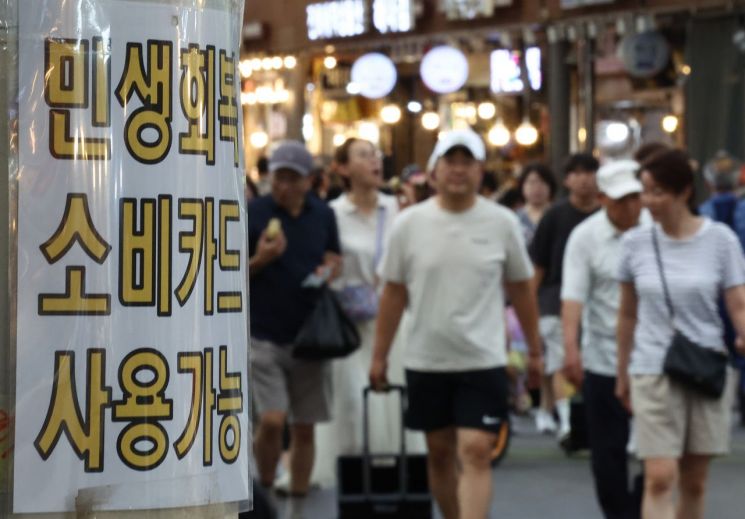 A notice related to the livelihood recovery consumption coupon is posted at Cheongnyangni General Market in Dongdaemun-gu, Seoul. Yonhap News
Regarding consumption, KDI noted that retail sales in June remained at a low growth rate of around 0%, mainly due to weakness in sectors other than passenger cars. Service consumption was also sluggish in major industries such as accommodation and food services (-2.7%).
However, the Consumer Sentiment Index for the previous month stood at 110.8, significantly above the baseline of 100 and higher than the previous month's 108.7, and household loan interest rates continued to decline, leading KDI to conclude that consumer conditions are gradually improving.
In the areas of production and investment, a gloomy assessment persisted. KDI stated, "Construction investment continues to decline sharply, and the growth in facility investment is also being adjusted."
Construction completions in June (-12.3%) continued to show a sharp decline, following the previous month's -19.8%. In the same month, facility investment (2.1%) saw its growth slow compared to the previous month's 6.7%, as both machinery and transportation equipment were adjusted.
Total industrial production in June (0.8%) remained at a low growth rate, mainly due to the construction sector. Construction production (-12.3%) reduced its rate of decline compared to the previous month's -19.8%, but still failed to break out of poor performance indicators.
Export Concerns Remain... "Semiconductor Export Growth May Be Adjusted"
With the conclusion of the Korea-US tariff negotiations on July 31, export uncertainty has somewhat eased. However, concerns over high tariffs persist, and there are worries that the recent strong performance in semiconductor exports may slow down in the future.
KDI explained, "Trade uncertainty has eased due to the conclusion of trade negotiations between the United States and major countries, but downward pressure on exports due to tariff imposition remains." The institute also stated, "Business sentiment remains at a low level."
KDI further noted, "While exports have maintained a moderate growth trend, there is a high risk that export growth will slow in the future, especially for semiconductors, as the effects of preemptive exports diminish and the impact of tariff increases becomes more pronounced."
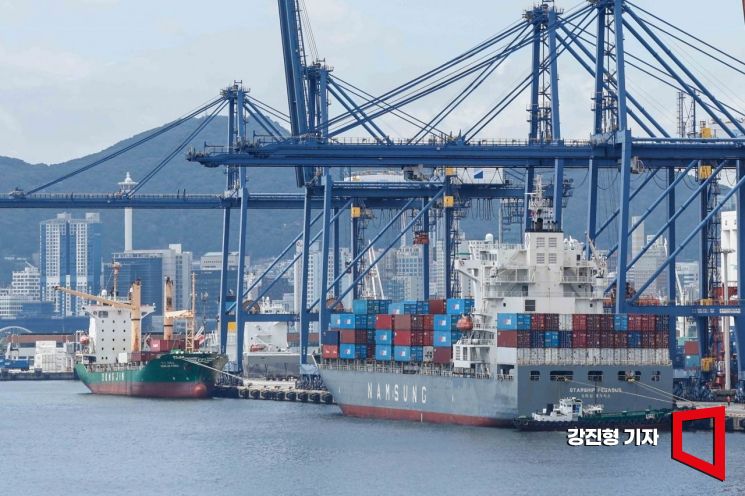
Exports in the previous month (5.9%) increased compared to the previous month (4.3%). By item, semiconductors (31.6%) continued their strong performance on a daily average basis, and ships (107.6%), which are highly volatile, also saw a sharp increase in exports due to base effects.
For semiconductors, not only investment demand related to artificial intelligence (AI) but also increased exports of intermediate goods to Taiwan and ASEAN countries contributed to the continued strong performance.
Taiwan and ASEAN countries, which export semiconductors to the United States, increased their exports to the US in advance in anticipation of higher tariffs. As a result, Korean semiconductor exports, which serve as intermediate goods to these countries, also increased.
However, if preemptive exports in response to tariffs are adjusted in the future, Korean semiconductor export performance will also be affected. KDI stated, "As the effects of preemptive exports diminish in the future, there is a possibility that the high growth rate of semiconductor exports will be adjusted."
KDI also explained, "Given the global value chain, future US semiconductor tariffs could negatively affect not only exports to the United States but also exports to other countries."
© The Asia Business Daily(www.asiae.co.kr). All rights reserved.


















