Opposition Judiciary Committee Members Hold 'Prosecution Reform Season 2' Seminar on August 7
"We will destroy the prosecution in one stroke... The rule of law will collapse"
On August 7, the People Power Party once again condemned the Democratic Party's push to fast-track prosecution reform bills before Chuseok, stating, "If the abolition of the Prosecution Service is carried out to cover up political power-related crimes, the rule of law will collapse."
Members of the People Power Party on the National Assembly Legislation and Judiciary Committee held a seminar at the National Assembly Members' Office Building under the theme "Prosecution Reform Season 2: What Are the Issues with the Public Prosecution Office and the Serious Crime Investigation Agency Bills?" At the event, they pointed out issues with the four prosecution reform bills being promoted by the Democratic Party: the abolition of the Prosecution Service, the establishment of the Public Prosecution Office, the creation of the Serious Crime Investigation Agency, and the establishment of the National Investigation Commission.
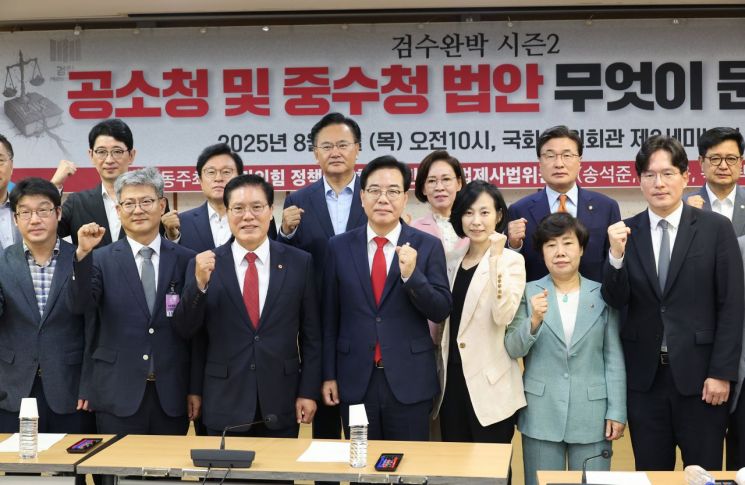 On the 7th, at the National Assembly Members' Office Building in Yeouido, Seoul, Song Eonseok, Emergency Response Committee Chairman and Floor Leader of the People Power Party, is taking a commemorative photo with participants at the discussion forum titled "Prosecution Reform Season 2, What Are the Issues with the Public Prosecution Office and the Central Investigation Office Bills?" hosted by the People Power Party Policy Committee and the People Power Party Legislation and Judiciary Committee. Photo by Yonhap News.
The previous day, the Democratic Party launched the "Special Committee for Normalizing the Prosecution in Accordance with Popular Sovereignty" and officially began the process to complete prosecution reform legislation by the end of August. Since the inauguration of Representative Jung Cheongrae, the party has been accelerating prosecution reform legislation, including nominating Democratic Party lawmaker Choo Mi-ae, who previously pushed for "Prosecution Reform Season 1," as Chairperson of the Legislation and Judiciary Committee. Starting that day, the special committee planned to activate a consultative body among the party, government, and presidential office to begin working-level meetings on prosecution reform.
Kim Jungjae, Policy Committee Chairperson of the People Power Party, argued, "If the Prosecution Service is abolished for political reasons and these actions are taken to cover up political power-related crimes, the rule of law will ultimately collapse." He added, "The criminal justice system is the last bastion to protect the lives and property of the people, as well as justice and human rights. I am frustrated that they are pushing this through unconditionally without gathering social consensus or public opinion."
He further questioned, "Is it really right to say, 'We will establish the Public Prosecution Office and the Serious Crime Investigation Agency and get everything done in just three months,' or 'We will destroy the prosecution, which has existed for 76 years, in one stroke'?"
Song Seokjun, an opposition lawmaker on the National Assembly Legislation and Judiciary Committee who hosted the seminar, strongly criticized in his opening remarks, "It has not even been two months since the Lee Jaemyung administration took office, and already a tremendous storm is blowing. I wonder if this is really a country." Song urged, "Under the name of 'Prosecution Reform Season 2,' they are trying to fundamentally change the prosecution system ahead of the 77th anniversary of the founding of the Republic of Korea. We must reveal the illusions of excessive prosecution reform and work with the public to block misguided institutional changes."
Attorney Moon Sujeong, who delivered the main presentation at the seminar, pointed out the unconstitutionality and problems within the criminal justice system of the bills to establish the Public Prosecution Office and the Serious Crime Investigation Agency, which are part of the four prosecution reform bills. She explained that if the Public Prosecution Office and the Serious Crime Investigation Agency are established, there will be a lack of institutional connectivity and continuity of work, with no clear plan to secure personnel and expertise.
She further argued, "Instead of prosecutors selected through an objective process, it is the intention of the executive branch and certain civic groups to ultimately control investigations. The purpose is not democratic oversight, but rather a reorganization for the benefit of the Democratic Party."
Attorney Jung Jaegi, who also attended the seminar, criticized the bill to establish the National Investigation Commission, stating, "By allowing the appointment of commission members who suit only the tastes of the president and the ruling party, all investigative agencies will be controlled through the National Investigation Commission, making the independence and political neutrality of investigative agencies a distant goal."
He also expressed concern about the four prosecution reform bills, stating, "These laws greatly increase the possibility that investigations and trials can be overturned by commissioners selected by a specific political group, and that investigations into certain politicians can be officially blocked. As a result, the legal system will be controlled not by the rule of law, but by political power, and suspects will be able to halt investigations into their own crimes through various means."
Meanwhile, the core of the four prosecution reform bills is to abolish the existing Prosecution Service and establish the Public Prosecution Office and the Serious Crime Investigation Agency. The authority to indict will be transferred to the Public Prosecution Office, while the Serious Crime Investigation Agency will take over the prosecution's role in investigating serious crimes. The National Investigation Commission, under the Prime Minister's Office, will be tasked with overseeing investigative agencies such as the police, the Serious Crime Investigation Agency, and the Corruption Investigation Office for High-ranking Officials.
© The Asia Business Daily(www.asiae.co.kr). All rights reserved.

















