Seoul Metro Vows to Hold Fare Evaders Fully Accountable
Civil and Criminal Lawsuits, Scientific Crackdowns
Strong Measures Against Climate Companion Card Misuse
# A woman in her 30s, identified as Ms. Park, used a preferential subway card registered under her 67-year-old father's name approximately 470 times over a six-month period starting in January 2018, commuting between Sindorim Station, where her home is located, and Hapjeong Station, where she works. After analyzing electronic records, station staff discovered discrepancies between the preferential card usage data (for a 67-year-old male) and the person captured on closed-circuit television (CCTV) footage. As a result, Ms. Park was apprehended as a fare evader and was charged an additional fare of 19.75 million won for about 470 instances of fare evasion.
On August 7, Seoul Metro announced that it is holding fare evaders fully legally accountable in order to establish fair usage practices on the subway. According to the company, since its integration it has handled over 130 lawsuits related to fare evasion, finalized 22 civil cases last year, and carried out more than 40 compulsory executions. As of the end of July this year, 12 civil lawsuits and 20 compulsory executions have been completed.
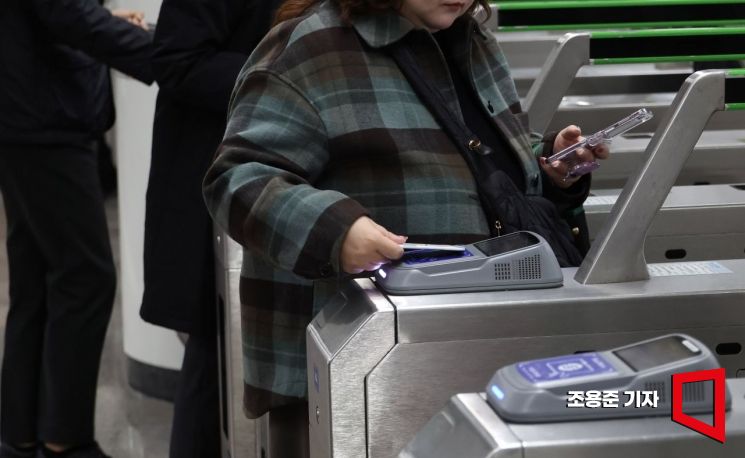 Seoul Metro announced that it will hold subway fare evaders legally accountable to the end. Photo by Jo Yongjun.
The largest additional fare lawsuit to date was the 2018 Sindorim Station fare evasion case, in which the court recognized an additional fare of 19.75 million won. Including delayed interest, the amount increased to 25 million won. The fare evader has repaid 16.86 million won and agreed to pay the remaining balance in monthly installments of about 600,000 won until the end of next year.
Seoul Metro has established an internal system that systematically manages all procedures for collecting additional fares, including enforcement, litigation, and compulsory execution. If a fare evader fails to pay the additional fare, the company proceeds with criminal charges for offenses such as computer fraud and unlawful use of facilities under the Criminal Act, and in practice, fines have been imposed.
To prevent fare evasion, Seoul Metro is conducting various preventive activities, such as campaigns, sending letters to education offices and schools, and installing banners and signs inside stations. Over the past three years, it has detected an average of 56,000 cases of fare evasion annually and collected 2.6 billion won. As of the end of July this year, 32,325 cases have been detected and 1.577 billion won has been collected.
The company has built a scientific enforcement system that utilizes advanced technologies, such as a fare evasion detection system based on big data analysis and smart station CCTV, in addition to in-person enforcement. It also operates continuous monitoring systems, including a transportation card usage inquiry system and pop-up alerts for suspected misuse of preferential transportation cards.

In particular, Seoul Metro is focusing on preventing the misuse of the recently expanded Climate Companion Card. Considering the high rate of misuse among young people, the company has introduced purple markings and a "youth discount" voice announcement at major station gates, with plans to expand this system to all stations. As of the end of July this year, there have been 5,033 cases of Climate Companion Card misuse (247 million won), a significant increase compared to last year.
To prevent "sharing" misuse, where one card is used by multiple people, the company is also preparing additional measures such as restricting repeated use at the same station, strengthening CCTV monitoring, and distinguishing users by color coding based on gender.
Ma Haekeun, head of the Operations Division at Seoul Metro, stated, "Fare evasion is a crime and an act of shifting responsibility onto others. We will hold offenders legally accountable to the end and do our utmost to eradicate fare evasion."
© The Asia Business Daily(www.asiae.co.kr). All rights reserved.
![Clutching a Stolen Dior Bag, Saying "I Hate Being Poor but Real"... The Grotesque Con of a "Human Knockoff" [Slate]](https://cwcontent.asiae.co.kr/asiaresize/183/2026021902243444107_1771435474.jpg)

















