High Hopes for Foundry Operations with Local Production
Sensor Chip Order from Apple Follows Tesla Deal
Samsung Electronics Signals a Turnaround
Negative Outlook for Memory Chips with High Domestic Production
Potential for High Tariffs on HBM Products
Government: "Such Measures Are Unlikely"
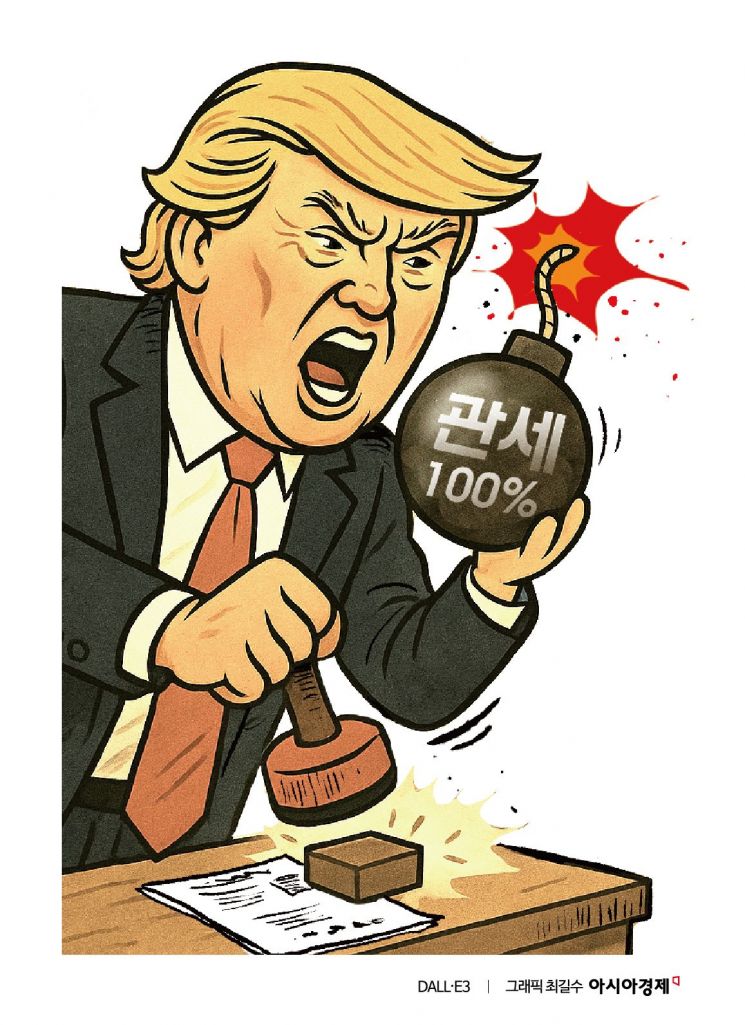
On the day the United States announced its plan to impose tariffs of up to 100% on semiconductors, Samsung Electronics delivered positive news by securing another foundry (semiconductor contract manufacturing) order within the US. There is a consensus that this is symbolic, as companies with local production facilities are expected to benefit more as the US raises its tariff barriers. Regarding the 100% tariff plan, the government stated that "there is no way that such a measure would be implemented."
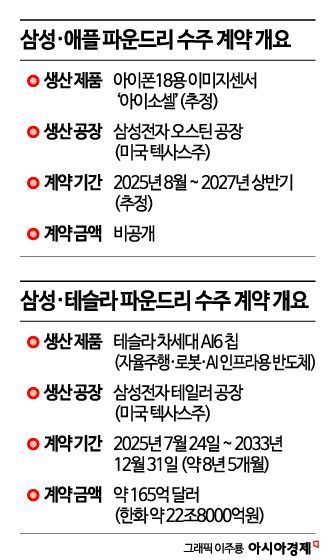
According to the semiconductor industry on August 7, Samsung Electronics, after securing an order worth 22.7648 trillion won from Tesla, officially confirmed an order for image sensor chips from Apple on the same day. In a press release, Apple stated, "We are developing innovative chip manufacturing technology, being used for the first time globally, together with Samsung at its semiconductor plant in Austin, Texas."
All of these orders will be produced and supplied from within the United States. Samsung Electronics operates a foundry plant in Austin, Texas, and is constructing a new plant in Taylor, aiming for completion next year.
The successive foundry orders for Samsung Electronics are seen as a sign of recovery from previous sluggishness, while also indicating that the company is less affected by US tariffs. An industry insider said, "President Donald Trump's statement regarding a 100% semiconductor tariff is so broad that many possibilities remain open," but added, "If we look only at foundry operations, this is not necessarily bad news." The source continued, "Companies are closely monitoring the official announcement scheduled for next week."
However, there are concerns that memory semiconductors, the mainstay of domestic semiconductor companies, could be affected. This is because the high proportion of domestic production means that if these products are subject to tariffs, the negotiation burden could increase. Since most memory products are produced in Korea and China and exported to the US, tariff costs could have a direct impact. Samsung Electronics manufactures memory products in Xi'an and Suzhou, while SK hynix produces in Wuxi and Dalian, with significant production also taking place domestically. In particular, for high-value-added products such as high bandwidth memory (HBM), there is a possibility that these could be subject to high tariffs if the US government imposes item-specific tariffs. Major suppliers of HBM, including SK hynix, Samsung Electronics, and Micron, are currently negotiating HBM4 supply, and there are expectations that price negotiations with customers could become complicated over whether the tariff burden will be passed on. Some analysts also suggest that there could be a standoff between suppliers and customers over who will bear the tariff costs in supply contracts.
The Korean government is hoping that the actual tariff rate will be set low, based on the US's previous position of granting "most-favored-nation" (MFN) status to Korea. In this regard, Yeo Han-koo, head of trade negotiations at the Ministry of Trade, Industry and Energy, stated on the same day, "If the MFN tariff rate for US semiconductors is set at 15%, then we will also be subject to 15%. It will not matter whether it becomes 100% or 200% in the future." Appearing on a radio program, Yeo was asked what would happen if a 100% tariff was imposed on semiconductors, as President Trump mentioned on August 6 (local time), and he replied, "The US has agreed to grant MFN status in the semiconductor and bio sectors."
Experts also believe that, based on Korea's recent trade agreement with the US, it is highly likely that only the MFN tariff rate of 15% will be applied to Korean semiconductor products. Korea demanded that its treatment for semiconductors and pharmaceuticals not be less favorable than that of other countries, and the US accepted this demand.
Some cautiously suggest that building factories within the US could be recognized as grounds for tariff exemption. Considering President Trump's statement that "there will be no tariffs if a semiconductor plant has been promised or is under construction in the US," there are expectations that expanded investment in the US could have some impact. An industry insider said, "Even Apple, an American company, has not moved its core processes from India or China to the US, but has secured tariff exemptions by committing to significant investment while producing some components in the US," adding, "We should take note of such cases."
Jang Sangshik, President of the International Trade and Commerce Research Institute at the Korea International Trade Association, said, "Given that the US agreed with the European Union (EU) to impose only a 15% tariff on semiconductor products, it would be reasonable for Korea to receive the same 15% rate under MFN treatment," but added, "This assumes that the Trump administration does not overturn and properly upholds the trade agreement."
© The Asia Business Daily(www.asiae.co.kr). All rights reserved.


















