Face-to-Face Summit with President Trump 82 Days After Taking Office... U.S. Visit Scheduled for June 24-26
Presidential Office: "Discussions Will Include Cooperation on Peace and Denuclearization of the Korean Peninsula"
Talks Expected to Cover Economic Cooperation in Semiconductors, Batteries, and Shipbuilding
President Lee Jaemyung will meet with President Donald Trump on the 25th, holding his first summit 82 days after taking office. Since his first phone call with President Trump on June 6, President Lee had sought to arrange a face-to-face meeting with Trump on the sidelines of the Group of Seven (G7) summit and the North Atlantic Treaty Organization (NATO) summit. However, these attempts repeatedly fell through due to rapidly changing circumstances in the Middle East, including the Israel-Iran military conflict.
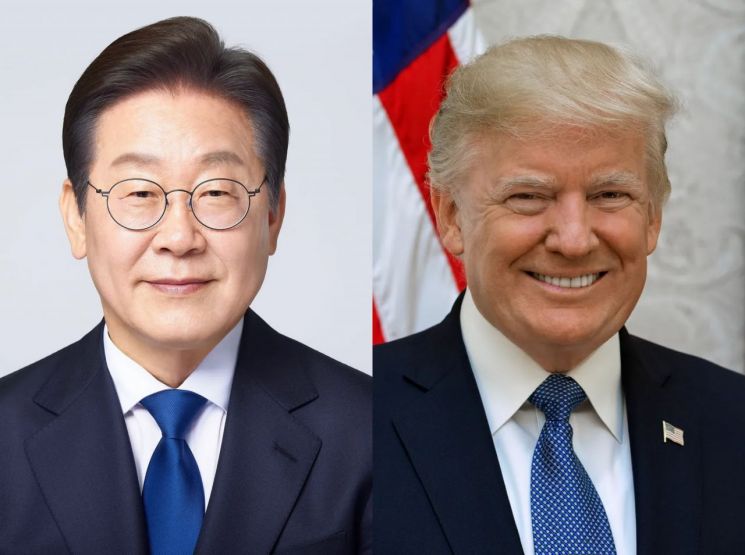
On the 12th, the presidential office announced that President Lee has agreed to hold a summit with President Trump on the 25th. Kang Yujeong, spokesperson for the presidential office, stated in a briefing, "President Lee plans to visit the United States from the 24th to the 26th at President Trump's invitation," adding, "This summit will be the first in-person meeting between the leaders of South Korea and the United States. The two presidents are expected to discuss ways to develop the South Korea-U.S. alliance into a future-oriented comprehensive strategic alliance in response to the changing international security and economic environment."
Spokesperson Kang further explained, "While further strengthening the robust South Korea-U.S. combined defense posture, the two leaders will also discuss ways to cooperate on establishing peace and denuclearization on the Korean Peninsula." She added, "Based on the recently concluded tariff negotiations, the presidents are also expected to discuss measures to further strengthen bilateral economic cooperation, including in manufacturing sectors such as semiconductors, batteries, and shipbuilding, as well as economic security partnerships for critical advanced technologies and minerals." She noted that details regarding other events, such as a working luncheon outside of the Trump summit at the White House, would be announced once finalized.
It has not yet been decided whether the two countries will issue a joint statement at this South Korea-U.S. summit, but the South Korean government plans to continue consultations with the U.S. government up until the summit with the aim of producing an agreement. If a joint statement is issued, it is likely to cover a wide range of security issues, including details of the 'mutual tariff negotiations' dramatically concluded on July 31, the South Korea-U.S. alliance, and South Korea-U.S.-Japan security cooperation.
On trade, the mutual tariff negotiations may include more concrete details on the $350 billion (approximately 485 trillion won) U.S. investment fund proposed by the South Korean government. In addition to the U.S. investment fund, existing and new investment plans by private companies are also expected to be disclosed. President Trump announced the conclusion of the trade negotiations on his social media, stating, "The amount of South Korea's investment in the United States will be announced at the bilateral summit at the White House within two weeks."
Defense and security issues?including increasing defense spending, the Special Measures Agreement (SMA) on cost-sharing for U.S. Forces Korea, and strategies regarding China?were not addressed during the trade negotiations and are therefore likely to be discussed at the upcoming summit. In particular, there is speculation that President Trump will highlight these security issues under the theme of 'modernizing the South Korea-U.S. alliance.' The modernization of the alliance encompasses a range of topics, including changes to the size and role of U.S. Forces Korea, increased defense spending, and the transfer of wartime operational control.
The South Korean government plans to gradually address the various issues included under the theme of alliance modernization, prioritizing the national interest. Internally, the presidential office appears determined to use increased South Korean contributions as leverage to assert its position on a range of issues during negotiations. Given the differing perspectives within the U.S. on changes to the size and role of U.S. Forces Korea, the South Korean government is expected to respond flexibly while monitoring developments.
Meanwhile, former President Yoon Sukyeol met with former U.S. President Joe Biden just 11 days after taking office on May 21, 2022. Former President Moon Jaein visited the United States to hold a summit with President Trump on June 30, 2017, 51 days after his inauguration. Previous presidents, including Park Geunhye (71 days), Lee Myungbak (54 days), and Roh Moo-hyun (79 days), also visited the U.S. president relatively early in their terms.
© The Asia Business Daily(www.asiae.co.kr). All rights reserved.

















