Use of 'Sea of Japan (East Sea)' in Google Weather Service
Professor Seo Kyungduk Criticizes: "Even Violating Its Own Principles"
Controversy has arisen after it was revealed that Google, the world's largest search engine, used the term "Sea of Japan (East Sea)" in its domestic weather service.
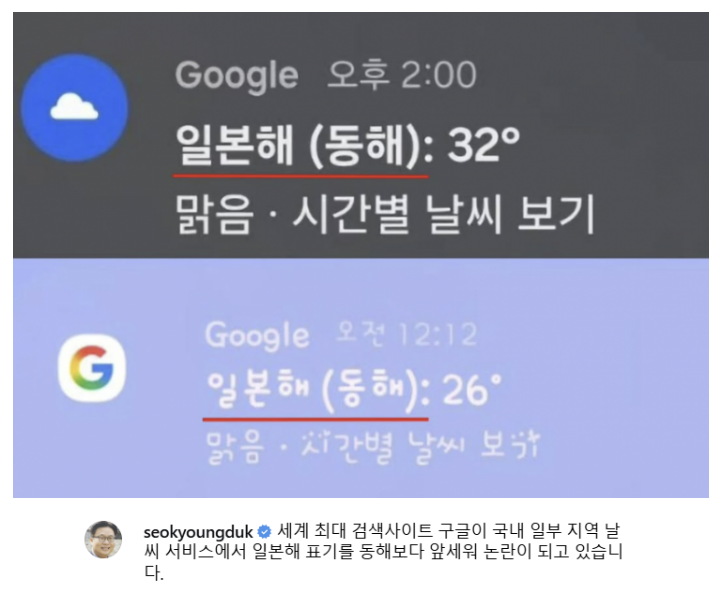 Google has sparked controversy by labeling the East Sea as "Sea of Japan (East Sea)" in its weather service. Photo by Professor Seo Kyungduk Instagram
Seo Kyungduk, a professor at Sungshin Women's University, stated on his social media account on August 7, "I learned about this issue thanks to numerous reports from internet users during the recent vacation season," adding, "People who traveled to the East Coast for vacation discovered the 'Sea of Japan (East Sea)' label in Google's weather alert service."
The problematic aspect is that this labeling contradicts Google's own naming policy. Google has previously operated under a policy of following the local naming conventions of the country from which a user accesses its services, especially for place names that are disputed between countries. In the case of the East Sea, Google Maps has labeled it as "East Sea" for users in Korea and "Sea of Japan" for users in Japan. However, this time, even users accessing from Korea saw the label "Sea of Japan (East Sea)," which violates Google's established practice.
Professor Seo pointed out, "If Google is truly a global company, it should be able to understand the basic sentiments of each country," criticizing the company for ignoring this principle. He added, "In the past, there was controversy because searching for 'Dokdo' on Google Maps yielded no information, and currently, when searching for 'Dokdo' from countries other than Korea and Japan, it is labeled as 'Liancourt Rocks,' among other issues. I believe it is now time for our government to take strong action against Google," he emphasized.
© The Asia Business Daily(www.asiae.co.kr). All rights reserved.

















