Cradle of Innovation: Sogang-Pangyo Digital Innovation Campus Opens on the 13th
Coexistence of Innovative Companies and University... Joint Research Initiatives
Fostering Over 100 Startups in AI, Semiconductors, and More
From a University Focused on AI to an AI University
Supporting Free Access to AI Infrastructure for All Students
"When philosophy and science, vision and technology are in harmony, society moves forward."
Religion is often misunderstood as something speculative. However, the Jesuits, who traveled between Europe and Asia centuries ago, spreading knowledge of astronomy, geography, cartography, and engineering, always pursued "knowledge that changes reality." Shim Jonghyuk, president of Sogang University, continues this tradition as both a priest and educator, leading efforts to nurture talent in cutting-edge scientific and technological fields such as artificial intelligence (AI) and semiconductors. Wearing his clerical attire neatly in the president's office of Sogang University's main building in Mapo-gu, Seoul, he greeted the press with a gentle smile. His eyes quietly sparkled, and his tone was calm. The following is a Q&A with President Shim.
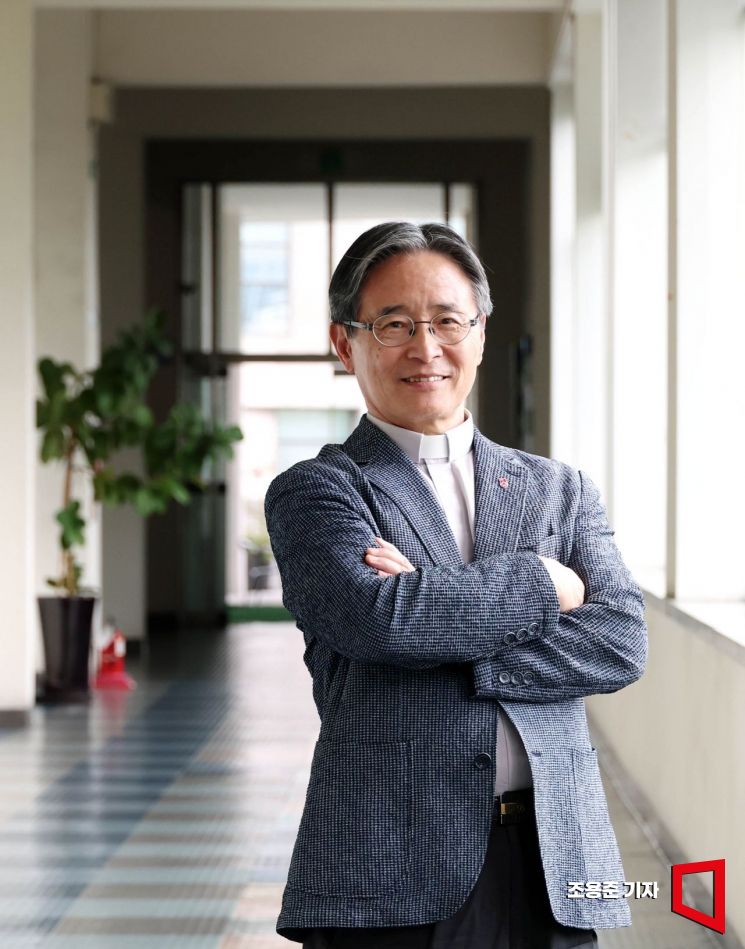 Shim Jonghyuk, president of Sogang University, is posing during an interview with Asia Economy at the main building of Sogang University in Mapo-gu, Seoul. Photo by Jo Yongjun
Cradle of Innovation: 'Sogang-Pangyo Digital Innovation Campus'
-The opening ceremony for the 'Sogang-Pangyo Digital Innovation Campus' will be held on the 13th.
▲Sogang University has established the Sogang-Pangyo Digital Innovation Campus (hereafter referred to as the Digital Campus) in Pangyo, the center of Korea's high-tech industry, bringing together startups, companies, researchers, investors, and students. At the Digital Campus, universities and companies jointly pursue research and talent development in advanced science and technology fields such as AI and semiconductors. The key is to create a startup ecosystem where industry, education, and investment are organically connected in one space, rather than operating independently. Through this, the university aims to produce next-generation talent, while companies generate profits, creating a win-win structure for both parties. There are also plans to directly invest in more than 100 startups over the next 10 years.
-Is it the university's role to invest directly in startups?
▲In rapidly changing times, universities must go beyond their traditional roles. Sogang University plans to form funds in collaboration with global startup organizations and support high-tech companies in the preparation or early stages of founding, either through joint or direct investment. The goal is to attract private investment totaling around 100 billion won in the future. The university has already selected more than 10 companies, including Aha Labs, MP Wave, and Edgecare in the AI field, as well as EWS in the mobility sector, and is preparing for startups in robotics as well. Sogang has also begun collaborating with the Korea Fabless Industry Association to foster system semiconductor startups.
The university also supports on-campus startups. Sogang University plans to support faculty startups through its own assets, including faculty-founded companies, subsidiaries of its technology holding company, and joint commercialization corporations. The university will provide consulting from the discovery of technology-based startup items to the commercialization of humanities and social science ideas, laying the foundation for growth into unicorn companies.
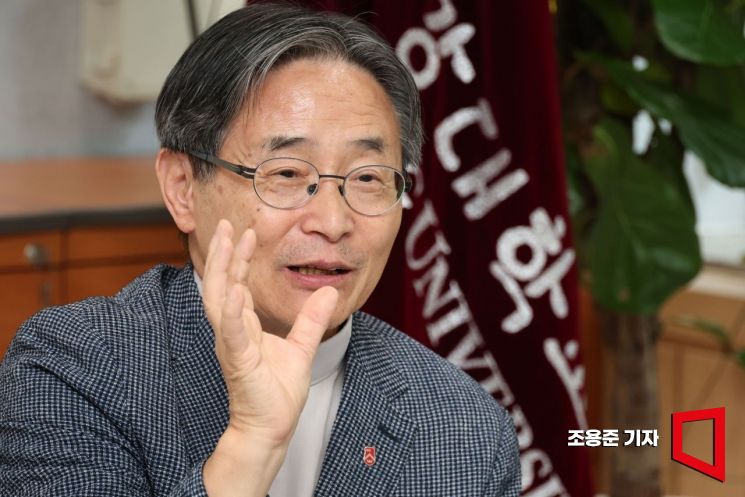 Shim Jonghyuk, president of Sogang University, is being interviewed by Asia Economy in the president's office of the main building at Sogang University in Mapo-gu, Seoul. Photo by Jo Yongjun
-What is the talent recruitment strategy for the Digital Campus?
▲Based on startup and joint research programs within the Digital Campus, we plan to provide internship and startup opportunities to young talent from Korea and abroad. In particular, together with the Korea Fabless Association, we are establishing a system semiconductor design education center to nurture practical talent. Last month, in cooperation with Seongnam City, we launched a hands-on system semiconductor design course, and those who complete the program are supported in finding employment at startups or specialized companies through the Fabless Association. We also plan to expand this to customized training for current employees in the future.
Nurturing Talent for the AI Era... Practice is the Key
-What kind of education is needed in the rapidly changing AI era?
▲"Learning by doing"?in other words, learning through practice?is essential. AI has become a fundamental tool in all fields, including society, science, economics, and business. Now, people from various fields, not just engineers, must be able to utilize AI. In this era, it is more important for students to take on challenges and achieve results themselves than to passively attend lectures. Accordingly, we have established the first undergraduate research institute in Korea to realize project-based education that transcends grades and departments. Students from diverse majors, such as humanities, social sciences, and engineering, collaborate to gain hands-on problem-solving experience. The Digital Campus is also designed to maximize practical learning through industry-academia cooperation.
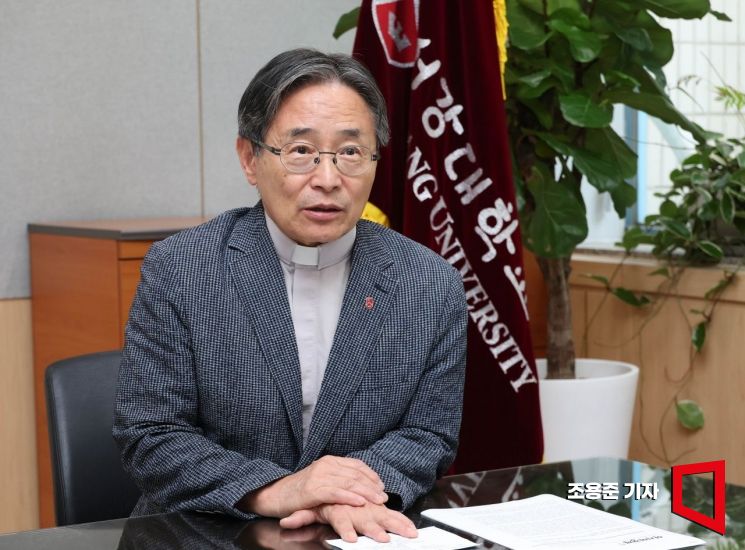 Shim Jonghyuk, president of Sogang University, is being interviewed by Asia Economy in the president's office of the main building at Sogang University in Mapo-gu, Seoul. Photo by Jo Yongjun
-What is Sogang University's AI-related infrastructure like?
▲We are building infrastructure so that all students can freely use generative AI tools like ChatGPT. Currently, AI-related departments can use these tools at the lab level, but this year, we aim to make them available to half of all members. By next year, we plan to support all members in freely using and developing AI tools through the university's infrastructure. Sogang University has already established undergraduate programs such as the Department of Artificial Intelligence and the Department of System Semiconductor Engineering, as well as Korea's first graduate schools specializing in the metaverse and AI convergence. The advancement of AI technology is directly connected to the activation of the metaverse.
-You also launched the graduate EIC (Expert Incubation Curriculum) program.
▲The EIC is a graduate program designed to nurture practical experts capable of utilizing advanced technologies in the AI era. Some still think of graduate education as purely academic, but in today's world, studying only academic subjects does not enable the use of advanced technologies. With the goal of nurturing practical professionals, we educate a variety of professionals?including professors?across six majors, such as counseling psychology, global legal affairs, and real estate. This is a practical education model aimed at fostering talent with real-world application skills, not just academic knowledge.
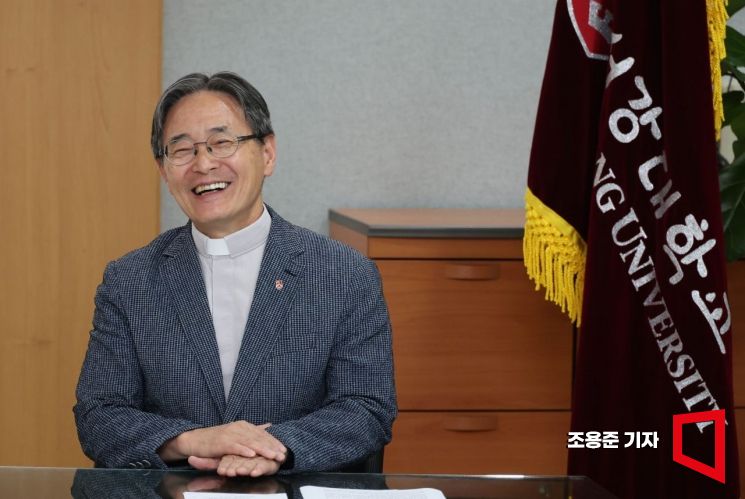 Shim Jonghyuk, president of Sogang University, is being interviewed by Asia Economy in the president's office of the main building at Sogang University in Mapo-gu, Seoul. Photo by Jo Yongjun
'From a University Good at AI' to 'An AI University'
-Sogang University is actually famous for its English education.
▲Universities must adopt new paradigms that fit the times. In the past, Sogang University gained a reputation for its English education, but today's focus is on AI. It is important to nurture professionals by developing AI talent. To this end, we have established an Education Innovation Team under the University Innovation Promotion Group to introduce new teaching methods for professors and create an environment where students can learn independently. Although this year's university innovation support project budget has not yet been finalized, we secured more than 7 billion won last year and are investing it in educational innovation.
-As you were reappointed as president, you presented two visions: the 16th 'VISION 2030' and the 17th 'VISION2030+'.
▲Both visions focus on nurturing innovative talent capable of taking on challenges in various fields based on digital expertise. During my 16th term, we laid the groundwork for this, and from this year, my 17th term, I see it as the time to produce tangible results. The Digital Campus is the starting point.
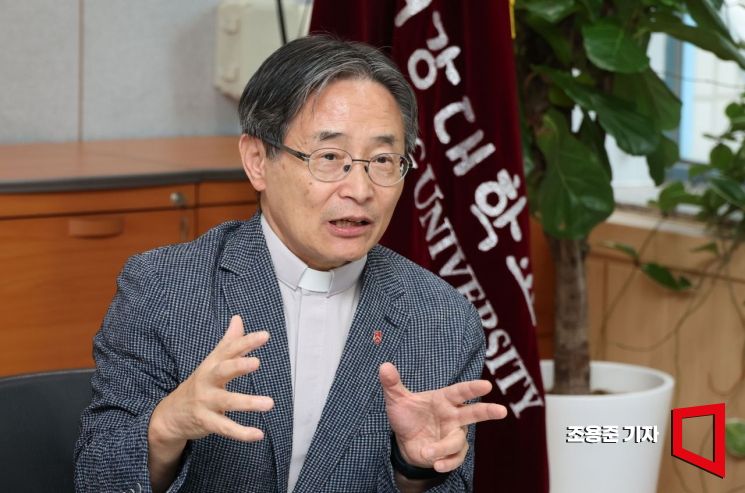 Shim Jonghyuk, president of Sogang University, is being interviewed by Asia Economy in the president's office of the main building at Sogang University in Mapo-gu, Seoul. Photo by Jo Yongjun
-What goals do you hope to achieve during your remaining term?
▲To ensure the success of 'VISION2030+', I aim to further enhance Sogang University's future value and competitiveness. First, I want to accumulate outstanding research capabilities through interdisciplinary research and international cooperation. In addition, we will strengthen advanced educational programs, such as revitalizing undergraduate research institutes and making AI-based education mandatory, so that all students acquire the competencies needed in the digital era. Furthermore, based on the Digital Campus, we will lead the way in building an innovative ecosystem for new technologies and new businesses, establishing Sogang as a platform for nurturing unicorn companies.
About Shim Jonghyuk, President of Sogang University
During his high school years, President Shim was a boy who wanted to become both a priest and a scientist. He was so deeply immersed in physics that he wanted to study it for life, but he decided to become a priest out of a desire to serve the world. The reason he could pursue both paths?as a physicist and a priest?was the influence of a priest who taught ethics at the time. During class, the teacher introduced President Shim to Pierre Teilhard de Chardin, the author of "The Phenomenon of Man." Chardin, both a priest and a scientist, established an integrated theory of creationism and evolution, that is, the integration of religion and science. President Shim said he was deeply fascinated by Chardin's theory at the time, and it gave him the courage to pursue both priesthood and science.
He had always shown a keen interest in the Jesuits and entered Sogang University, which is run by the order. He chose his major based on his teacher's advice that "to study physics, you must study mathematics." Later, while at Weston School of Theology in Boston, he struggled between pursuing a doctorate in physics and a doctorate in theology. However, since mathematical knowledge was essential to pursue a doctorate in physics and he had taken a break from studying mathematics, he ultimately chose theology. He then went to Rome, Italy, earned his doctorate in theology, and became a professor at Sogang University.



















