First Economic Ministers’ Meeting Presided Over by Deputy Prime Minister Koo
"Prompt Measures Needed to Revitalize Regional Consumption"
The government recently assessed that private consumption is showing signs of a rebound, but diagnosed that the gap in recovery speed between the Seoul metropolitan area and non-metropolitan regions remains pronounced. It expressed concern that the recovery of consumer sentiment in regional areas is relatively sluggish, leading to a widening consumption gap between regions.
On August 7, the Ministry of Economy and Finance held its first Economic Ministers’ Meeting at the Seoul Government Complex, presided over by Deputy Prime Minister and Minister of Economy and Finance Koo Yooncheol, and reported on the “Recent Consumption Trends.” This meeting was the first economic ministers’ meeting since Deputy Prime Minister Koo’s inauguration and included discussions on the new government’s economic growth strategy and measures to revitalize regional consumption.
The government believes that consumption has been gradually recovering since June this year. Both retail sales and service sector output have rebounded, resulting in a turnaround in private consumption growth in the second quarter.
Retail sales in June increased by 0.5% compared to the previous month, overcoming the declines of April (-1.0%) and May (-0.1%). Service sector output also rose by 0.5% during the same period. Thanks to these trends, private consumption in the second quarter grew by 0.5% compared to the previous quarter. In the previous quarter, the first quarter, it had declined by 0.1%, marking negative growth.
Consumer sentiment indicators are also supporting the recovery trend. According to the Bank of Korea, the Consumer Composite Sentiment Index (CCSI) stood at 110.8 in July, up 2.1 points from the previous month. This is the highest level in four years and one month since June 2021 (111.1). The CCSI is calculated based on six key indices that make up the Consumer Sentiment Index (CSI), and a value above the baseline of 100 indicates optimistic consumer sentiment.
The Consumer Sentiment Index rose to 101.8 in October last year but plummeted to 88.2 in December due to the declaration of martial law and the impeachment crisis. Since then, it has continued to improve, remaining above the 100 mark for three consecutive months since May this year.
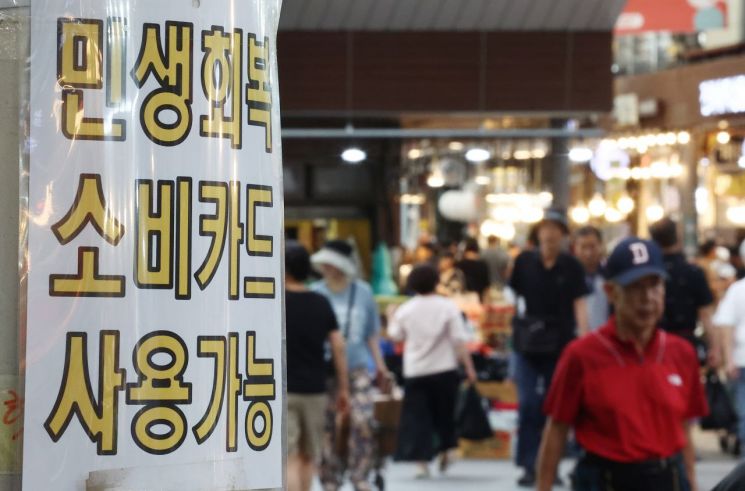 Traditional Market with Notice for Minsheng Recovery Consumption Coupon Usage (Seoul=Yonhap News) Reporter Kim Sungmin = In the third quarter, consumption is expected to increase due to the end of the longest domestic demand slump and the distribution of Minsheng Recovery Consumption Coupons. The Consumer Sentiment Index plummeted to 88.2 in December last year during the emergency martial law situation but has recently risen for four consecutive months from 93.4 in March to 93.8 in April, 101.8 in May, 108.7 in June, and 110.8 in July. On the 3rd, a notice related to the Minsheng Recovery Consumption Coupon was posted at Cheongnyangni General Market in Dongdaemun-gu, Seoul. 2025.8.3 Photo by Kim Sungmin ksm7976@yna.co.kr (End)
 Actual household consumption, as shown by card usage, is also on the rise. According to Statistics Korea’s Nowcast, household credit card spending increased by 5.2% year-on-year during the first to third weeks of July. This figure is 0.5 percentage points higher than June’s 4.7%. In the first quarter, the increase was only 3.1%.
The government believes that policy support measures are also contributing to the recovery in consumption. The “Minsheng Recovery Consumption Coupon” is a representative example. As of August 5, the coupon had been distributed to 47.36 million people, accounting for 93.6% of the total population.
However, this recovery trend is not appearing evenly across the country. In particular, the recovery of consumption in non-metropolitan areas is relatively delayed, and structural consumption polarization is persisting.
According to the government, private consumption in non-metropolitan regions has consistently recorded a lower growth rate than in the Seoul metropolitan area since 2002. As of 2023, private consumption in the metropolitan area increased by 72.6% compared to 2002, while in non-metropolitan regions, it rose by only 52.9%. This means the consumption growth rate gap has widened by about 20 percentage points over the past 20 years.
A government official said, “Structural factors such as population decline, aging, and industrial contraction in regional areas are restricting the recovery of consumer sentiment. The improvement in regional consumer sentiment is diverging from the metropolitan area, and the difference in recovery speed between regions is clear.”
Based on this awareness, the meeting included “Revitalizing Regional Areas” as one of its main agenda items. The government plans to strongly promote a “Regional Revitalization Consumption Boom-Up” campaign in cooperation with all ministries, aiming to quickly spread the momentum of consumption recovery, which has been revived through measures such as the Minsheng Recovery Consumption Coupon, nationwide.
© The Asia Business Daily(www.asiae.co.kr). All rights reserved.

















