Joint Research Team from Seoul National University and APCTP Publishes Paper in Prestigious Journal "Nature"
First Experimental Verification of the "Multiscale Coupling Phenomenon" in Plasma Physics
A team of Korean researchers has demonstrated the 'multiscale coupling phenomenon,' a longstanding challenge in plasma physics.
The Ministry of Science and ICT announced that a joint research team from Seoul National University and the Asia Pacific Center for Theoretical Physics (APCTP) has verified the multiscale coupling phenomenon?one of the major challenges in plasma physics?through a convergence study that combined nuclear fusion experiments and theories of space plasma.
For physicists studying plasma, which is often called the fourth state of matter beyond gas, liquid, and solid, multiscale coupling?where microscopic phenomena lead to macroscopic changes in plasma structure?has long been a difficult problem.
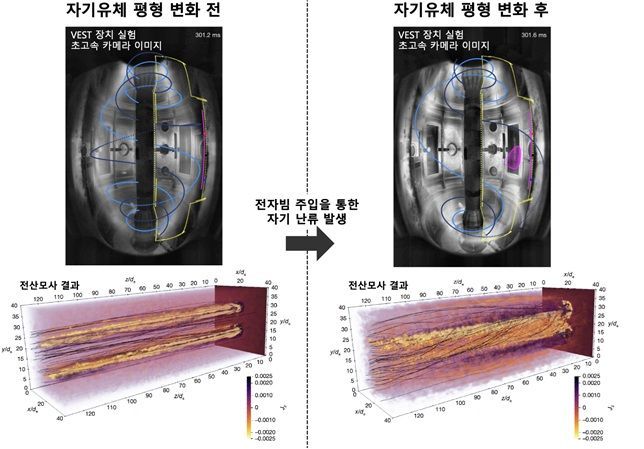 A diagram illustrating changes in magnetohydrodynamic equilibrium through self-generated turbulence and three-dimensional magnetic reconnection. Provided by the Ministry of Science and ICT.
Because plasma is not only the medium for nuclear fusion reactions but also the predominant state of matter in the universe, multiscale coupling in plasma has been regarded as a key topic for both nuclear fusion technology development and fundamental research into the origins of the universe.
The research team led by Park Jongyun of Seoul National University and Yoon Youngdae of APCTP validated their findings through analysis of experimental data from a nuclear fusion device at Seoul National University and particle simulations using the KAIROS supercomputer at the Korea Institute of Fusion Energy.
Through this work, the team demonstrated that when microscopic magnetic turbulence is generated, 'magnetic reconnection' occurs effectively, converting magnetic field energy into plasma thermal energy, which in turn can cause macroscopic structural changes in the plasma.
This research is the first experimental demonstration and verification of multiscale dynamics in which intentionally generated microscopic magnetic turbulence by a strong electron beam increases plasma resistivity, effectively induces magnetic reconnection, and ultimately leads to macroscopic structural changes in plasma. In particular, it is significant as an example of interdisciplinary convergence research, combining nuclear fusion operation experiments at Seoul National University with theoretical simulations at APCTP.
Park Jongyun stated, "This achievement was made possible by experts in nuclear fusion and theoretical physics, who started from different interests and, after countless discussions and debates, were able to reach a consensus. It is especially meaningful as it offers new clues about the onset of magnetic reconnection, which plays a crucial role in cosmic phenomena such as solar flares and geomagnetic storms."
Yoon Youngdae of APCTP said, "I hope that this research will not only expand the framework for interpreting plasma physics but also serve as a foundation for the development of new nuclear fusion technologies."
This research, supported by the Ministry of Science and ICT's Basic Research Program (Mid-career Researcher, Excellent Young Researcher), the APCTP Support Program, and the National Science Challenge Cooperation Support Group, was published in the international journal 'Nature' on August 7, 2025 (local time: August 6, 16:00). (Paper title: Kinetic turbulence drives MHD equilibrium change via 3D reconnection)
© The Asia Business Daily(www.asiae.co.kr). All rights reserved.

















