Enhancing Operational Safety of Fusion Reactors
by Suppressing Tungsten Impurity Generation on the Inner Wall
South Korea and the United States have jointly secured a core technology for the commercialization of fusion energy through collaborative research.
On August 6, the Ministry of Science and ICT announced that the Korea Institute of Fusion Energy and the Princeton Plasma Physics Laboratory in the United States have secured a key technology to enhance plasma operational stability through joint research utilizing the Korea Superconducting Tokamak Advanced Research (KSTAR), known as "Korea's artificial sun."
The inner wall of a fusion device is directly exposed to ultra-high-temperature plasma, making tungsten, which is highly heat-resistant, a promising next-generation inner wall material. In 2023, KSTAR replaced its core internal component, the "divertor," with tungsten, and the International Thermonuclear Experimental Reactor (ITER) is also pursuing the application of a tungsten inner wall.
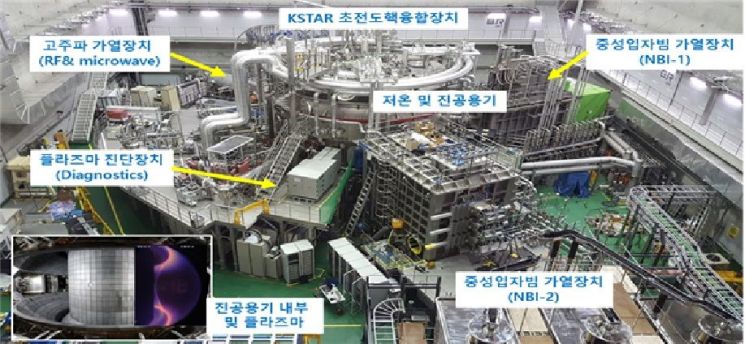 Status of the main device and major auxiliary devices of the 'KSTAR (Korea Superconducting Tokamak Advanced Research)'. Provided by the Ministry of Science and ICT
However, if tungsten particles enter the plasma during high-temperature plasma operation, this can affect both the operational stability of the device and the performance of the plasma. For this reason, technology to control this phenomenon has been an important international research challenge.
The newly secured technology enables the active control of the inner wall condition in real time by injecting boron powder into the ultra-high-temperature plasma without interrupting operation.
For the first time in the world, the research team observed a reduction in the generation of tungsten impurities from the fusion reactor's inner wall through boron injection, and confirmed the potential to control the core plasma more stably. This achievement is regarded as a significant advancement in real-time plasma?inner wall interaction control technology.
Furthermore, this outcome is the result of close international collaboration between South Korean and U.S. researchers based on KSTAR. Since the signing of the "Korea-U.S. Fusion Research Cooperation Implementation Agreement" in 2010, the two countries have continued joint research in various fields, including tokamak physics and plasma?inner wall interaction control.
The results of this study demonstrate that KSTAR, with its precise operational capability and high reliability, has established itself as a central platform for international collaborative research.
Jung Taekryeol, Director-General of Public Convergence Research Policy at the Ministry of Science and ICT, stated, "The government will continue to secure experimental results by utilizing domestic infrastructure such as KSTAR, and will actively support these achievements so that they can lead to the acceleration of fusion energy realization and the acquisition of core technologies necessary for South Korea to play a leading role in future fusion research."
Meanwhile, the results of this study were published in Volume 65 (August issue) of "Nuclear Fusion," a prestigious international journal in the field of fusion research, and have been recognized for their significance and excellence by the academic community. (Paper title: Wall conditioning effects of boron powder injection in KSTAR with a tungsten divertor)
© The Asia Business Daily(www.asiae.co.kr). All rights reserved.

















