Additional Key Bills, Including the Second Broadcasting Act, Yellow Envelope Act, and Commercial Act,
to Be Addressed in August National Assembly Session
The Democratic Party of Korea, led by newly appointed leader Jeong Cheongrae, is expected to push for the passage of the remaining four key bills, excluding the Broadcasting Act, during the August extraordinary session of the National Assembly.
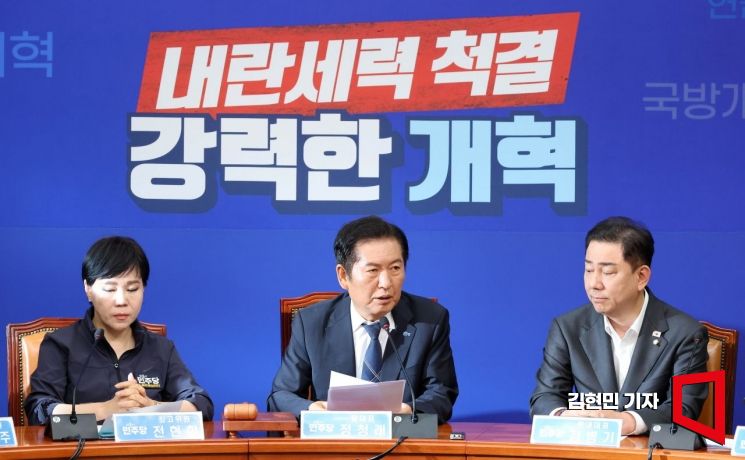 Jeong Cheongrae, leader of the Democratic Party of Korea, is speaking at the Supreme Council meeting held at the National Assembly on August 6, 2025. Photo by Kim Hyunmin
At the Supreme Council meeting held at the National Assembly in Yeouido, Seoul on August 6, Jeong emphasized the significance of the passage of the Broadcasting Act amendment on August 5, stating, "The amendment to the Broadcasting Act, aimed at ensuring the independence and transparency of public broadcasters, passed the National Assembly plenary session yesterday."
Jeong also stated, "The Democratic Party will responsibly fulfill the remaining tasks of media reform, one by one, to ensure the public's right to know and the realization of democracy," adding, "We will also push forward with livelihood reform legislation at a rapid pace." Jeong further pledged, "We will ensure the passage of the Labor Standards Act amendment to protect workers' rights, as well as the amendment to the Commercial Act to establish a fair and transparent market order, during the August session of the National Assembly."
Previously, on August 5, the National Assembly passed the Broadcasting Act amendment?one of the three broadcasting-related bills (Broadcasting Act, Foundation for Broadcast Culture Act, and Korea Educational Broadcasting System Act)?during a plenary session. The Democratic Party had initially planned to pass the three broadcasting bills, the Yellow Envelope Act (amendments to Articles 2 and 3 of the Trade Union and Labor Relations Adjustment Act), and the Commercial Act amendment during the July extraordinary session. However, the schedule was delayed due to the People Power Party's filibuster tactics. The Broadcasting Act amendment, which changes the governance structure of the Korean Broadcasting System (KBS), was put to a vote after the Democratic Party forcibly ended the filibuster in accordance with parliamentary rules, and it passed the plenary session with 178 votes in favor and 2 against out of 180 members present. Immediately after the passage of the Broadcasting Act, when the Democratic Party brought the Foundation for Broadcast Culture Act (FBC Act) to the floor, the People Power Party resumed its filibuster. However, the filibuster automatically ended at midnight on August 5, as the July session concluded. The People Power Party has also announced plans to filibuster the remaining key bills.
In response to the People Power Party's filibuster strategy, the Democratic Party plans to hold plenary sessions from August 21 to 24 to sequentially process the remaining bills. According to parliamentary rules, a filibuster can be ended if a motion to end it is submitted with signatures from at least one-third of the members, and after 24 hours, it can be terminated with the approval of at least three-fifths of the members. The Democratic Party and its allied bloc hold a total of 189 seats, meeting the requirement to end a filibuster. In the case of the FBC Act, since the session ended during the filibuster, parliamentary rules deem the filibuster concluded, allowing the bill to be put to a vote immediately in the next session. Therefore, the Democratic Party plans to process each of the remaining three bills within four days.
© The Asia Business Daily(www.asiae.co.kr). All rights reserved.
![Clutching a Stolen Dior Bag, Saying "I Hate Being Poor but Real"... The Grotesque Con of a "Human Knockoff" [Slate]](https://cwcontent.asiae.co.kr/asiaresize/183/2026021902243444107_1771435474.jpg)
















