Four Fatal Accidents This Year: POSCO Faces "Safety Warning"
Performance Plummets: Bonuses Canceled, Second Quarter Turns to Loss
Reputation Damage Hurts Redevelopment Bids
"Other Construction Companies Are Not Exempt"... Calls to Review Cost-Cutting Practices
Special Act on Construction Safety Gains Traction... Concerns Over Rising Sales Prices
Jeong Heemin, CEO of POSCO E&C, abruptly resigned on the 5th, taking responsibility for a series of fatal accidents. His resignation came just five hours after the presidential office stated that President Lee Jaemyung would address the situation after his vacation, following an electric shock accident involving a foreign worker the previous day. Jeong stepped down only eight months after taking office. Song Chiyoung, Executive Vice President at POSCO Holdings and head of the Safety Special Inspection Task Force, has been nominated as his successor. All current POSCO E&C executives have also tendered their resignations, signaling a complete overhaul of the company's leadership.
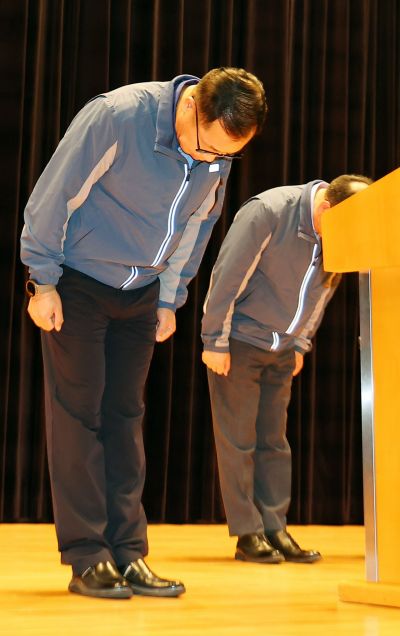 Jeong Heemin, CEO of POSCO E&C, delivering an apology statement on the 29th of last month. After this press conference and an electric shock accident, he eventually resigned. Photo by Yonhap News.
Administrative Sanctions, Poor Performance, Low Morale, and Uncertainty in Orders: A Fourfold Crisis
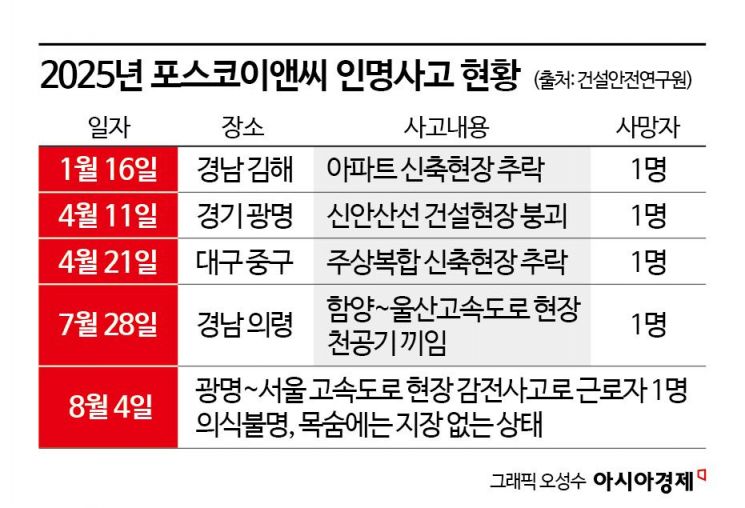
POSCO E&C has seen four fatal accidents at construction sites across the country just this year. In January in Gimhae, in April in Gwangmyeong, in April in Daegu, and in July in Uiryeong, workers died due to falls, collapses, and equipment entrapments. President Lee criticized the company, asking whether these incidents amounted to "murder by willful negligence." After his remarks, all sites nationwide were temporarily halted and then resumed. Just three days after POSCO Group launched its Safety Special Inspection Task Force, the electric shock accident occurred. The foreign worker injured in this accident has yet to regain consciousness.
There is growing speculation that the company will face comprehensive government audits, sanctions, and restrictions on public contracts. In addition to these major accidents, POSCO E&C is also grappling with worsening business performance, internal unrest, and declining external trust, placing the company in its worst crisis in its 43-year history. In the second quarter, the company posted an operating loss of 91 billion won and sales of 1.866 trillion won, marking a return to the red for the first time in two quarters. For the first time since its founding, no performance bonuses were paid out in the first half of the year. Most observers expect that bonuses for the second half will also be canceled.
The company’s financial burden is also increasing. The cost of reconstructing the Sinansan Line, which collapsed in April, is expected to reach several hundred billion won and will begin to impact earnings in the second half. The damage to the company’s reputation from the accident has also hurt its competitiveness in redevelopment project bids. In June, POSCO E&C lost the bid for the Yongsan Maintenance Depot Zone 1 project to HDC Hyundai Development Company by a large margin. Industry insiders cite the aftermath of the accident as a major reason. Uncertainty is also rising for large-scale bids in the second half, such as the Gaepo Woosung 4th project.
"Other Construction Companies Are Not Exempt" ... Industry Calls for Review of Cost-Cutting Practices
However, many in the construction industry believe it is unreasonable to place all the blame solely on POSCO E&C. An official at a major construction firm said, "Large companies have similar staffing and systems, so similar accidents could easily occur at other sites as well." In particular, language barriers among the estimated 400,000 foreign workers?including undocumented workers?are also cited as a significant safety risk at construction sites.
Experts agree that rather than focusing solely on crackdowns and punishments, it is essential to ensure safety at the design stage, secure management’s commitment, and provide education for on-site workers. Choi Myungki, Vice President of the Korean Society of Construction Safety, said, "Accidents often happen when companies try to save on safety costs and time. If cost-cutting takes precedence over safety and the attitude of 'this is how we've always done it' persists, accidents will continue to occur."
There is also criticism that while safety regulations are sufficient, the structure for reflecting these costs in construction budgets is lacking. Lee Eunhyeong, a research fellow at the Korea Institute of Construction Policy, said, "We already have most of the necessary safety measures in place, such as the Industrial Safety and Health Act, the Serious Accidents Punishment Act, and stricter supervision responsibilities." "The problem is not creating new regulations,""but creating an environment where stronger materials and more personnel can be used, and where these costs can be reflected in construction budgets."
The recent crisis at POSCO E&C has also increased the likelihood that the Special Act on Construction Safety, currently pending in the National Assembly, will gain momentum. The proposed law would allow for up to one year of business suspension and fines of up to 3% of sales in the event of a serious accident, and also includes provisions expanding the responsibility of prime contractors. The industry acknowledges that "safety management is now a matter of survival, not just a cost," but also expresses concern that this could inevitably lead to reduced profitability, increased sales prices, and delays in project schedules.
© The Asia Business Daily(www.asiae.co.kr). All rights reserved.


















