People Power Party Holds Emergency Meeting with Business Groups to Discuss Response
Likely to Propose Revised Yellow Envelope Act and Commercial Act Amendments for Negotiations
Song Eonseok: "Anti-Business Laws... Need to Prepare Effective Countermeasures"
The People Power Party is considering creating a revised version of the Yellow Envelope Act (amendments to Articles 2 and 3 of the Trade Union and Labor Relations Adjustment Act) and the second amendment to the Commercial Act, reflecting the voices of the business community, in order to negotiate with the Democratic Party. While focusing on blocking the passage of bills led by the ruling party, the party is also pursuing a strategic response that takes into account the limitations of its parliamentary seats.
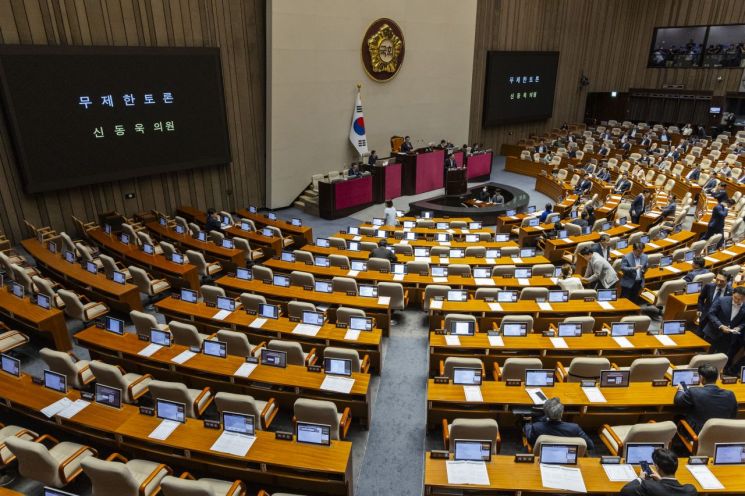 On the 4th, during the plenary session of the National Assembly, Shin Dongwook, a member of the People Power Party, began unlimited debate (filibuster) regarding the submission of the "Broadcasting Three Acts (Amendments to the Broadcasting Act, Broadcasting Culture Promotion Agency Act, and Korea Educational Broadcasting System Act)" to the plenary session. Except for some members of the People Power Party and the Democratic Party, other members are leaving the plenary hall. Photo by Yonhap News
On the morning of August 5, the People Power Party held an emergency meeting at the National Assembly with the five major economic organizations?Korea Enterprises Federation, Korea Chamber of Commerce and Industry, Korea Employers Federation, Korea Listed Companies Association, and Korea Automobile Mobility Industry Association?under the title "Problems with Anti-Business Laws and Future Response." They discussed response strategies to the Yellow Envelope Act and the "stronger" amendment to the Commercial Act. The meeting was attended by interim leader and floor leader Song Eonseok, policy committee chair Kim Jeongjae, and other party leaders.
Song, the interim leader, expressed concern, saying, "If anti-business laws are pushed through, it is inevitable that the overall economy will suffer severe shocks, such as weakened corporate competitiveness, overseas relocation, withdrawal of foreign investment, and a decrease in youth employment." He added, "Now is the time to pursue policies that ease regulations and expand support so that companies can secure competitiveness," and emphasized, "We need to closely examine the problems of anti-business laws and prepare effective response measures."
Previously, on August 4, the Democratic Party submitted an amendment to the Broadcasting Act, one of the "three broadcasting laws," to the plenary session of the National Assembly, and as of the morning of August 5, a filibuster (unlimited debate) is underway. The passage of the Broadcasting Act in the plenary session on August 5 is highly likely. Since the July extraordinary session of the National Assembly ends at midnight on this day, the remaining Yellow Envelope Act and Commercial Act amendments being pushed by the Democratic Party are expected to be submitted to the August extraordinary session, which is anticipated to begin after August 21.
The reason the People Power Party is considering a revised bill that reflects the voices of the business community is that, given its limited number of seats, it is realistically difficult to block the passage of bills led by the Democratic Party. Since there is still time for additional negotiations before the next plenary session, there remains an opportunity to change the course. The Democratic Party also has no choice but to take public opinion trends into account. Both parties are expected to engage in fierce debates over the handling of key bills until late August, while monitoring public sentiment.
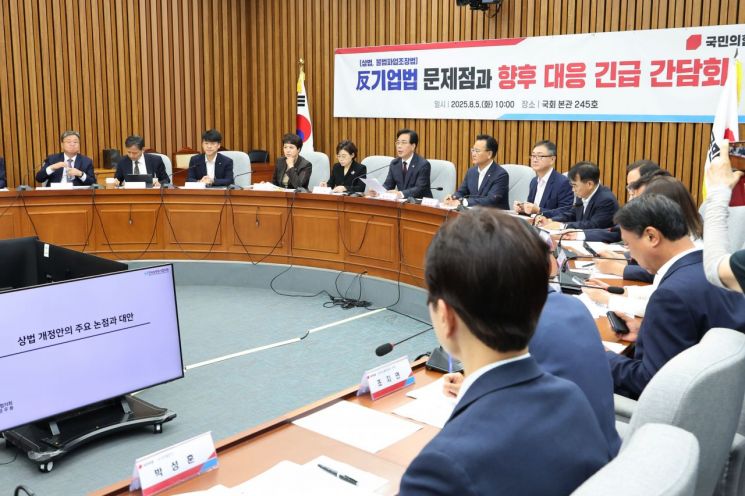 People Power Party's Song Eonseok, Emergency Response Committee Chairman and Floor Leader, is speaking at the "Urgent Meeting on the Issues and Future Responses to Anti-Business Laws (Commercial Act, Illegal Strike Promotion Act)" held at the National Assembly in Yeouido, Seoul, on the 5th. Photo by Yonhap News
A People Power Party official in the National Assembly said in a phone call, "At present, we oppose all three broadcasting laws, the Yellow Envelope Act, and the Commercial Act," but added, "If the business community suggests that we accept a partially revised version of the Yellow Envelope Act and the Commercial Act, we can do so." Previously, on July 31, Song and other party leaders held a closed-door meeting with Lee Donggeun, standing vice chairman of the Korea Employers Federation, and Kim Changbeom, standing vice chairman of the Korea Enterprises Federation, to gather opinions on the Yellow Envelope Act and the Commercial Act.
Within the People Power Party, there are strong voices insisting that at least the Yellow Envelope Act?which restricts damage claims for strikes and grants bargaining rights to subcontracted workers against the original contractor?must be blocked. A senior lawmaker from the People Power Party said, "If the scope of employers is expanded so that subcontractors can hold the original contractor responsible, the industrial ecosystem will collapse and jobs could be drastically reduced," and added, "It will create an environment where entrepreneurs find it difficult to do business, negatively affecting the economy."
However, the Democratic Party maintains that passing the Yellow Envelope Act is essential to improve workers' rights, making it unlikely that the two parties will easily find common ground. Heo Young, senior deputy floor leader for policy of the Democratic Party, reaffirmed the party's firm stance on August 3, saying, "If the bill passes, the responsibility structure between original contractors and subcontractors will become clearer, and the bargaining process will better reflect reality."
Meanwhile, at the leadership meeting on August 5, the People Power Party continued to express concerns about the handling of the Broadcasting Act. Song said at the floor countermeasures meeting that "the three broadcasting control laws are, in effect, laws that will cause the demise of public broadcasting," and warned, "If the Democratic Party ultimately ignores bipartisan consensus and pushes the bills through, the People Power Party will mobilize all available legal means, including filing a constitutional complaint, to fight back."
© The Asia Business Daily(www.asiae.co.kr). All rights reserved.
![Clutching a Stolen Dior Bag, Saying "I Hate Being Poor but Real"... The Grotesque Con of a "Human Knockoff" [Slate]](https://cwcontent.asiae.co.kr/asiaresize/183/2026021902243444107_1771435474.jpg)

















