Danuri to Enter 'Frozen Orbit' in September
High-Resolution Images of 2032 Lunar Lander Candidate Sites
Observation Data Shared via KPDS for Global Lunar Research
Danuri's Extended Mission Lays Groundwork for Future Exploration
Kang Kyungin: "Danuri Data to Boost Korean Role in Lunar Studies"
Launched on August 5, 2022, South Korea's first lunar orbiter 'Danuri', which has had its mission extended twice, is scheduled to transition to a 'frozen orbit' on September 24 next month. At that time, it will capture images of candidate landing sites for the lunar lander scheduled for launch in 2032.
On August 5, the Korea Aerospace Administration marked the third anniversary of Danuri's launch by presenting its observation achievements and making this announcement. Danuri was launched on August 5, 2022, successfully completed its initial mission, and has since had its mission extended twice. It is now set to continue observations until 2027.
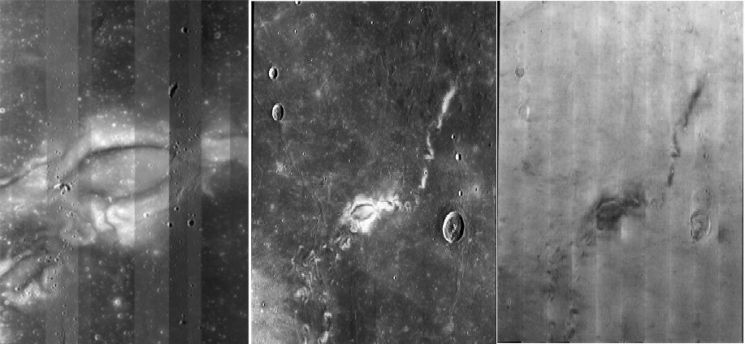 Photo of the lunar surface taken by Danuri. The image shows Reiner Gamma, a candidate landing site for South Korea's lunar lander scheduled for launch in 2032, captured in 2023 (left, imaging area size: 65x90km). Photometric (center) and polarimetric (right) observation images of the Reiner Gamma Swirl. Differences in photometric and polarimetric characteristics have been confirmed, indicating that the soil density in the area is higher than the surroundings and that the soil's microstructure may differ due to the magnetic field properties of the region. Provided by the Korea Aerospace Research Institute.
On February 19, Danuri lowered its altitude to 60 km to conduct observations closer to the lunar surface. On September 24, it is scheduled to transition to a 'frozen orbit', which allows for long-term orbital maintenance without additional fuel consumption.
The high-resolution camera (LUTI) aboard Danuri has been capturing images of candidate landing regions for the 2032 Korean lunar lander, including the Reiner Gamma region and the area near Shackleton Crater. These images will be used as reference data when selecting the final landing site.
The wide-angle polarimetric camera (PolCam) has completed a global map of the Moon and is currently producing a polarization map of the lunar surface. The gamma-ray spectrometer (KGRS) has created maps of naturally occurring radioactive elements (uranium, thorium, potassium) across the entire lunar surface, as well as neutron maps and estimated water distribution maps for the polar regions. It is also producing maps of major elements such as oxygen, iron, aluminum, and calcium, which are key components of the lunar surface.
The magnetometer (KMAG) has completed a world-class, high-precision magnetic field map of the Reiner Gamma region and other areas where the lunar surface magnetic field is particularly strong. Based on this, studies are underway using magnetic field observation data to explore the space environment, dynamo formation and evolution, and the internal structure of the Moon.
NASA's ShadowCam has, for the first time in the world, successfully captured images of the permanently shadowed regions at the lunar north and south poles, which are of international interest and have a high potential for the presence of ice.
These observation data from Danuri are being made publicly available through the KPDS (KARI Planetary Data System), the science data management and disclosure system of the Korea Aerospace Research Institute. The data are being actively used in lunar research both domestically and internationally.
The three years of observation data collected through Danuri's mission extensions are being used as foundational resources for research on lunar topography, environment, and resources. To date, more than 30 academic papers have been published both in Korea and abroad, demonstrating the leading role of Korean researchers utilizing Danuri data.
Kang Kyungin, Director of Space Exploration at the Korea Aerospace Administration, stated, "By utilizing the observation data obtained through Danuri, the role of Korean researchers is expected to grow further in selecting the landing site for the lunar lander, deepening our understanding of the lunar environment, and establishing a foundation for international joint research." He added, "We plan to further expand the field of space exploration by leveraging the scientific achievements gained through the extension of Danuri's mission."
© The Asia Business Daily(www.asiae.co.kr). All rights reserved.

















