Record Number of Tropical Nights in Seoul: 23 Days
Historic 240mm Downpour Hits in Mid-July
The nationwide average temperature in July this year was 27.1 degrees Celsius, making it the second highest on record after the hottest year, 1994.
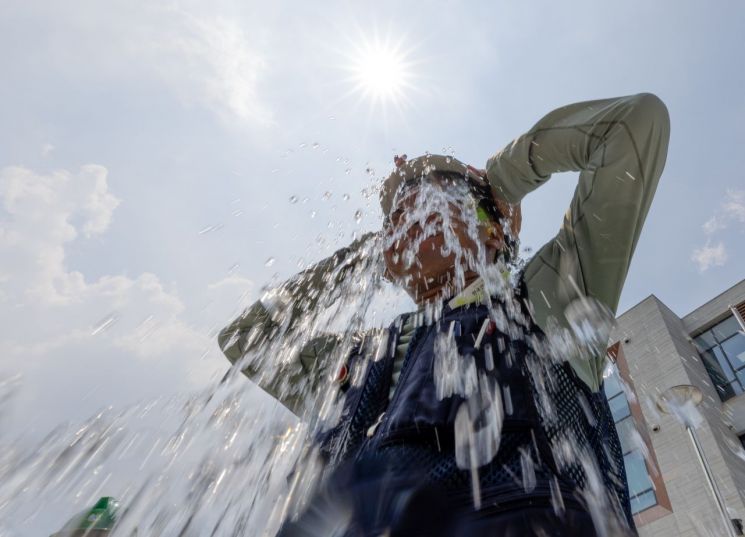 After the press conference on the reality of heatwaves held by the Construction Workers' Union of the Korean Confederation of Trade Unions in front of the National Policy Planning Committee in Jongno-gu, Seoul, a participant performs by pouring ice water over themselves. Photo by Yonhap News
According to the Korea Meteorological Administration's "July Climate Characteristics Analysis" released on the 5th, the nationwide average temperature last month was 27.1 degrees Celsius. The average maximum temperature and average minimum temperature for July were 32.0 degrees Celsius and 23.0 degrees Celsius, respectively, ranking second and third highest on record. The number of heatwave days (days with a maximum temperature of 33 degrees Celsius or higher) was 14.5 days, the third highest after July 1994 (17.7 days) and July 2018 (15.4 days).
The number of tropical nights (nights with a minimum temperature of 25 degrees Celsius or higher) was 6.7 days, the fourth highest on record. The years with more frequent tropical nights in July than this year were 2024 (8.8 days), 1994 (8.5 days), and 2018 (7.1 days).
Last month, the sea surface temperature around the Korean Peninsula was 24.6 degrees Celsius, the highest in the past 10 years. This was 1.3 degrees Celsius higher than the recent 10-year average (23.3 degrees Celsius).
In early July, the nationwide average temperature was 28.2 degrees Celsius, the highest on record for that period. The average maximum temperature (33.1 degrees Celsius) and average minimum temperature (24.1 degrees Celsius) were also the highest ever recorded. In late July, the nationwide average temperature and average maximum temperature were 28.4 degrees Celsius and 33.9 degrees Celsius, respectively, the second highest on record for late July. On the 26th of last month, the daytime temperature in Daegwallyeong, which is at an elevation of 772 meters, reached 33.1 degrees Celsius, marking the first heatwave ever recorded there since meteorological observations began in 1971.
In mid-July, heavy rainfall occurred. The nationwide precipitation last month was 249.0 mm, which is 85.8% of the average July precipitation (296.5 mm). Precipitation in early and late July was extremely low, at 3.9 mm and 6.1 mm respectively, ranking lowest and third lowest on record for early and late July. However, in mid-July, 239.4 mm of rain fell, more than twice the average precipitation for that period (106.5 mm). The precipitation in mid-July was the fourth highest on record for that period.
From the 16th to the 20th of last month, a total of 161 emergency disaster text alerts for heavy rain were sent out. On the 17th, Seosan in South Chungcheong Province (114.9 mm), Sancheong in South Gyeongsang Province (86.2 mm), and Gwangju (76.2 mm) recorded the highest hourly precipitation for July. On the 19th, Hapcheon in South Gyeongsang Province (78.6 mm) also set a new record for the highest hourly precipitation in July.
© The Asia Business Daily(www.asiae.co.kr). All rights reserved.

















