Discussion on AI Technology and Infrastructure Cooperation Ahead of Korea-US Summit
Expectations for Development into a 'Korea-US Strategic Technology Initiative'
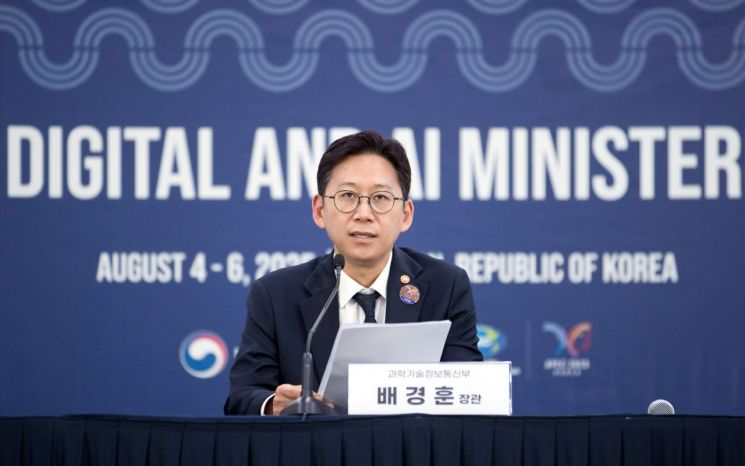
The South Korean government has begun exploring ways to cooperate with the United States regarding the expansion of artificial intelligence (AI) infrastructure. As securing graphics processing units (GPUs), which form the foundation of the national AI ecosystem, has emerged as a key issue in the global technology race, high-level discussions have taken place ahead of the upcoming Korea-US summit.
On August 5, the Ministry of Science and ICT announced that Minister Baek Kyunghoon held a bilateral meeting with Michael Kratsios, Director of the White House Office of Science and Technology Policy (OSTP), who is visiting Korea to attend the APEC Digital·AI Ministerial Meeting. During the meeting, they discussed ways to cooperate on strategic technologies, including AI technology and infrastructure.
During the meeting, both sides shared their policy directions, including the US 'AI Action Plan.' In particular, they exchanged views on the necessity of cooperation on AI infrastructure, such as high-performance computing resources (GPUs), which serve as the backbone of the AI ecosystem.
Currently, South Korea faces structural limitations in securing GPUs, which are essential resources for building the national AI infrastructure. There have been ongoing concerns about the country's heavy reliance on US company Nvidia, which controls over 80% of the world's AI computing resources, and the lack of large-scale computing infrastructure needed to train AI models or operate AI services.
The government is pursuing the adoption of domestically produced AI semiconductors and the expansion of national AI computing centers as part of its 'AI Highway Construction' initiative. However, securing GPUs in the short term remains a challenge. Other countries, including Japan, Singapore, and the United Arab Emirates (UAE), are also actively seeking cooperation with the United States or building independent semiconductor ecosystems to secure AI infrastructure.
In addition to AI, both sides discussed cooperation on a wide range of strategic technologies, including quantum science and technology, advanced biotechnology, and next-generation nuclear power. They also reached a consensus on the importance of research security. The two countries agreed to share systems and best practices to foster trust-based cooperation in science and technology.
The Ministry of Science and ICT intends to develop these discussions into a 'Korea-US Strategic Technology Initiative' in conjunction with the Korea-US summit, and has proposed convening the Korea-US Joint Committee on Science and Technology for working-level talks.
© The Asia Business Daily(www.asiae.co.kr). All rights reserved.
![Clutching a Stolen Dior Bag, Saying "I Hate Being Poor but Real"... The Grotesque Con of a "Human Knockoff" [Slate]](https://cwcontent.asiae.co.kr/asiaresize/183/2026021902243444107_1771435474.jpg)
















