Japan's Food Exports Rise 15% in First Half of Year
Sales to South Korea Surge 22% on Strong Japanese Beer Demand
Japan's agricultural, forestry, fishery, and food exports in the first half of the year surpassed 800 billion yen (approximately 7.5 trillion won) for the first time, with exports to South Korea also reported to have surged by 22.3% compared to the same period last year.
On August 4, NHK, citing an announcement from the Ministry of Agriculture, Forestry and Fisheries, reported that Japan's agricultural, forestry, fishery, and food exports in the first half of the year totaled 809.7 billion yen (about 7.6 trillion won), a 15.5% increase from the same period last year. This marks the first time Japan's food exports in the first half of the year have exceeded 800 billion yen (about 7.5 trillion won). The Ministry of Agriculture, Forestry and Fisheries stated, "By product category, beef, green tea, and yellowtail all reached record highs."
By region, export values to South Korea, the United States, and Taiwan in the first half of the year reached all-time highs. In the case of South Korea, the value of Japanese agricultural, forestry, fishery, and food exports was 50.7 billion yen (approximately 475 billion won). This figure represents a sharp 22.3% increase from the same period last year, with the increase amounting to 9.3 billion yen (about 87.1 billion won). The Ministry of Agriculture, Forestry and Fisheries analyzed that sales of instant coffee, beer, and sardines in South Korea performed well.
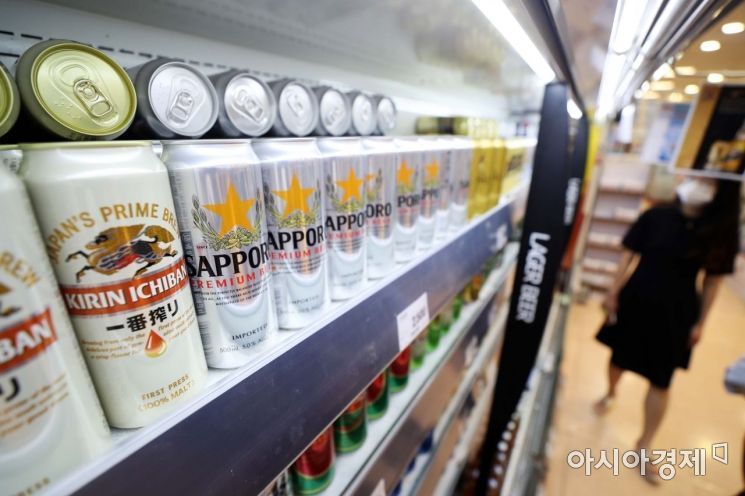
According to export-import trade statistics from the Korea Customs Service, Japanese beer imports in South Korea in the first half of this year (January to June) amounted to 35.31 million dollars (about 48 billion won), a 9.4% increase from the same period last year. This is more than twice the size of beer imports from the United States, which ranked second at 15.72 million dollars.
Japanese beer struggled in 2020, as the import value dropped to 5.67 million dollars (about 7.8 billion won) due to the spread of a boycott against Japanese products following the Japanese government's export restrictions on South Korea in 2019. However, as anti-Japanese sentiment has waned and travel to Japan has increased, the desire of domestic consumers to experience local products has led to a resurgence in consumption, with some analysts saying Japanese beer is now experiencing a second heyday.
The United States was the largest importer of Japanese food products in the first half of the year, with imports totaling 141 billion yen (about 1.3 trillion won), a 22.0% increase from the same period last year. This was followed by Hong Kong at 106.8 billion yen (about 1 trillion won) and China at 90.2 billion yen (about 850 billion won). The growth rates were 3.4% and 15.0%, respectively. China had banned imports of Japanese seafood in response to the discharge of contaminated water (referred to as "treated water" by the Japanese government) from the Fukushima Daiichi Nuclear Power Plant in August 2023, but decided to resume imports this past June.
The Ministry of Agriculture, Forestry and Fisheries explained, "The main factors behind the increase in food exports are the growing number of restaurants selling Japanese food, expanding interest in Japanese cuisine, and improved recognition." The ministry also noted that interest in green tea has risen, with Western media highlighting it, and added, "Sales have increased, particularly for powdered teas used as ingredients in lattes, snacks, and other foods."
© The Asia Business Daily(www.asiae.co.kr). All rights reserved.
![Clutching a Stolen Dior Bag, Saying "I Hate Being Poor but Real"... The Grotesque Con of a "Human Knockoff" [Slate]](https://cwcontent.asiae.co.kr/asiaresize/183/2026021902243444107_1771435474.jpg)
















