The amendment to the Elementary and Secondary Education Act, which downgrades the legal status of the AI Digital Textbook (AIDT) from "textbook" to "educational material," passed the National Assembly plenary session on August 4, 2025. As a result, starting from the upcoming second semester, AI textbooks can only be used as educational materials. Schools that applied to use AI textbooks in the second semester are expected to experience confusion.
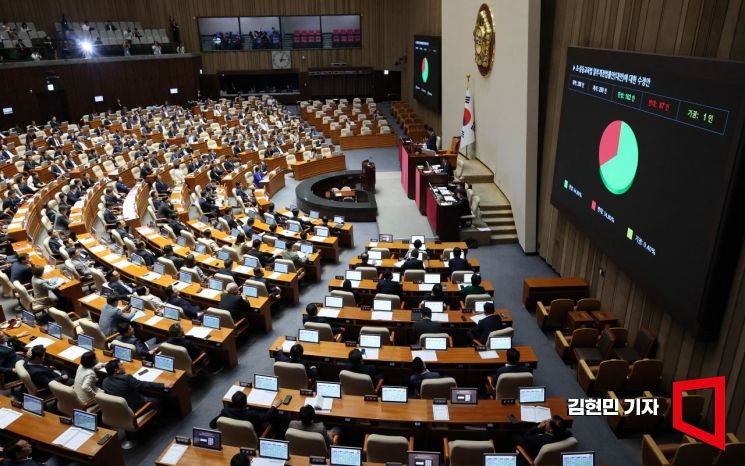 On the 4th, at the plenary session held in the National Assembly, an amendment to the Partial Revision of the Elementary and Secondary Education Act (alternative bill) was passed. 2025.8.4 Photo by Kim Hyunmin
The amendment to the Elementary and Secondary Education Act, passed by the National Assembly plenary session on August 4, 2025, explicitly defines the term "textbook" in the law and limits the scope of textbooks to printed books and e-books. "Learning support software utilizing intelligent information technology," such as AI textbooks, is defined as educational material rather than a textbook.
The amendment will take effect immediately upon promulgation.
Originally, when the Democratic Party was the opposition party, it passed a bill in the plenary session to downgrade AI textbooks to "educational material," and thus they became "educational material." However, during the Yoon Suk-yeol administration, then acting President and Deputy Prime Minister and Minister of Economy and Finance Choi Sangmok exercised the right to request reconsideration (veto), which led to the bill's repeal, and AI textbooks were officially used as "textbooks" in the first semester of this year. However, due to public backlash, the policy was changed from "mandatory adoption" to "voluntary adoption." Currently, the adoption rate of AI textbooks in schools nationwide is around 30%. Publishers believe that if AI textbooks are classified as "educational material," this rate will drop even further.
AI textbooks, which were introduced in the first semester for third and fourth grade elementary English and math, and for first-year middle and high school English, math, and information subjects, are effectively being abolished after just four months of implementation.
Regarding future measures following the passage of the amendment, the Ministry of Education stated, "We will cooperate with each city and provincial office of education to ensure there is no confusion in the field," and added, "We plan to provide prompt guidance through frequently asked questions (FAQ) and other means to prevent any disruption to the academic operation of the second semester."
Schools that applied to use AI textbooks in the upcoming second semester are expected to face confusion. Although the Ministry of Education closed applications for second semester AI textbooks on June 30, 2025, the Seoul Metropolitan Office of Education and others stated that they would accept applications after the legal status of AI textbooks was determined, so the actual demand for AI textbooks in the second semester remains unclear. A Ministry of Education official said, "The status of second semester AI textbook applications has not yet been compiled," and added, "We will disclose this information later."
On the same day, the amendment to the Local Education Finance Grant Act, which requires the central government, education offices, and local governments to share the costs of free high school education until the end of 2027, also passed the plenary session. The central government will cover up to 47.5% of the costs for free high school education, while city, provincial, and district governments will cover 5%. The amendment takes effect immediately upon promulgation and will remain in force until December 31, 2027.
© The Asia Business Daily(www.asiae.co.kr). All rights reserved.

















