Inspection of City and Affiliated Organizations Reveals Privacy Violations
Mayor Kang Reports to President, Who Orders "Central Government Review"
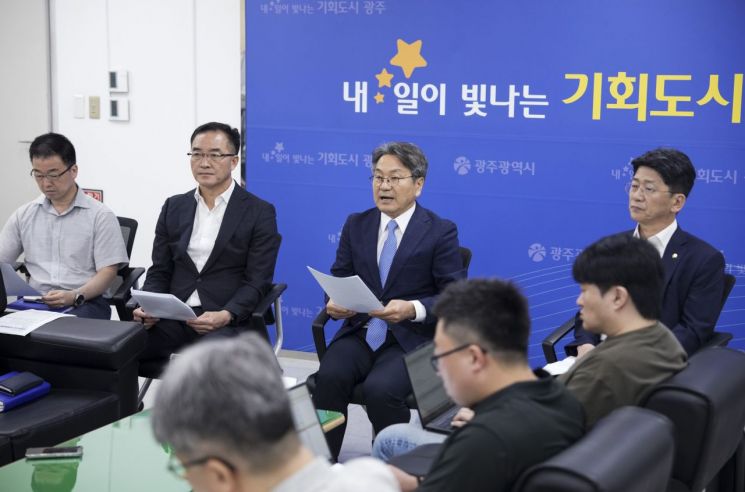 Kang Kijeong, mayor of Gwangju, held a tea meeting with attending reporters in the press room on the 5th floor of the city hall on the morning of the 4th, explaining the results of an investigation to enhance human rights sensitivity and other major city administration issues. Provided by Gwangju City
The city of Gwangju has decided to implement improvements after conducting an urgent survey on human rights sensitivity throughout its administration, prompted by the recent controversy over the color of consumer coupons. The survey uncovered 42 cases of human rights violations across 5 categories.
During a recent national meeting of provincial governors, Mayor Kang Gijung reported these findings to President Lee Jaemyung. President Lee responded by stating, "If you submit this to the Ministry of the Interior and Safety, we will also take action at the central government level," indicating that efforts to improve human rights sensitivity in administration are expected to expand nationwide at the state level.
On August 4, the city announced that from July 24 to 31, it had conducted a comprehensive review of human rights violations that occurred during administrative processes within the city government and its affiliated organizations.
As a result of the survey, the city found 42 cases of human rights violations in 5 categories and decided to implement comprehensive improvements. By category, the cases included: exclusion of certain individuals due to unnecessary qualification requirements, such as omitting alternative school students from population education programs for schools; invasion of privacy by attaching notices of impending water service suspension due to unpaid bills to residents' doors or mailboxes; limiting access to public facilities by restricting children's reading areas within libraries to designated children's reading rooms only; and stigmatizing users by explicitly including the term "low-income group" in the names of welfare programs.
The survey also identified new human rights issues arising from changes in the social environment, such as the need to protect the health rights of outdoor workers during heat waves and to safeguard the housing rights of energy-vulnerable groups, including non-housing residents (such as those living in jjokbang), in response to the climate crisis and digital environment.
The city plans to strengthen the human rights perspective in policy planning, institutional operations, and all aspects of public administration, focusing on these cases. In particular, the findings from this review will be shared with the Ministry of the Interior and Safety and other central government agencies, with the aim of promoting nationwide institutional improvements at the state level.
This move follows Mayor Kang's request to President Lee at the national meeting of provincial governors held at the Presidential Office on August 1, where he asked for a nationwide review of cases similar to those identified in Gwangju. President Lee replied, "If you provide the data to the Ministry of the Interior and Safety, we will also take action at the central government level," suggesting that institutional improvements will proceed at the state level.
Mayor Kang also proposed the enactment of a "Basic Human Rights Act" to systematize human rights administration and strengthen the human rights capacity of local governments. Gwangju has taken the lead in promoting human rights and fulfilling its role as a human rights city, having declared an "Human Rights Charter" in 1998 (the first in Asia), enacted the "Democracy·Human Rights·Peace City Promotion Ordinance" in 2007 (the first ordinance in Korea to include 'human rights' in its name), and launched the World Human Rights Cities Forum in 2011.
The city plans to continue expanding human rights impact assessments and strengthening participatory human rights education that reflects the entire career cycle of public officials, thereby continuously promoting practical human rights policies in daily life.
Mayor Kang Gijung emphasized, "Gwangju is a city with great pride and self-respect as a human rights city," and added, "Through this review, we will strengthen human rights standards throughout everyday administration and do our utmost to realize a human rights city where every citizen is respected in daily life."
© The Asia Business Daily(www.asiae.co.kr). All rights reserved.
![Clutching a Stolen Dior Bag, Saying "I Hate Being Poor but Real"... The Grotesque Con of a "Human Knockoff" [Slate]](https://cwcontent.asiae.co.kr/asiaresize/183/2026021902243444107_1771435474.jpg)











