Passed at the National Assembly Plenary Session on August 4
Support for Conversion to Alternative Crops to Minimize Surplus Rice
Government Purchases Only in Unavoidable Cases
The partial amendment to the Grain Management Act (Grain Act Amendment), which focuses on strengthening proactive supply and demand control for major agricultural products including rice and increasing government responsibility for price declines, as well as the partial amendment to the Act on Distribution and Price Stabilization of Agricultural and Fishery Products (Agricultural Products Act Amendment), were passed at the National Assembly plenary session on August 4.
The Ministry of Agriculture, Food and Rural Affairs announced on this day that the Grain Act Amendment and the Agricultural Products Act Amendment were approved at the National Assembly plenary session.
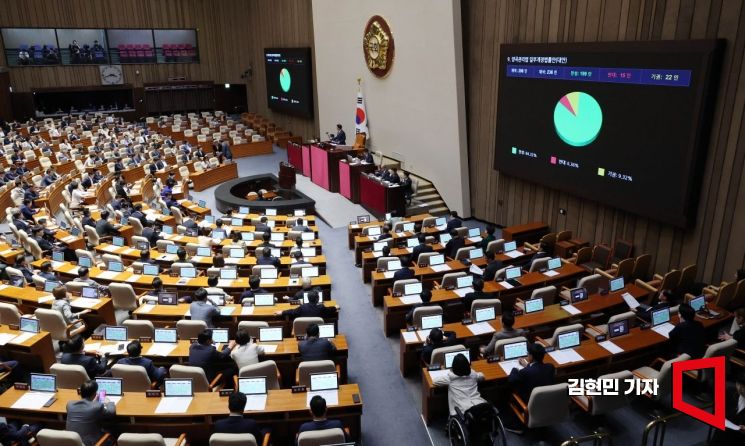 On the 4th, the partial amendment bill of the Grain Management Act was passed at the plenary session of the National Assembly. 2025.8.4 Photo by Kim Hyunmin
The Grain Act Amendment stipulates that the government must systematically plan the area for rice supply and demand balance and the target area for paddy field crop conversion in advance, and provide sufficient support to farmers so that the conversion to alternative crops can be implemented effectively. If, despite these measures, an unavoidable surplus occurs, the 'Grain Supply and Demand Management Committee,' in which at least one-third (five or more) of producer organizations participate, will review countermeasures appropriate to the supply and demand situation, and the government will be obligated to implement these measures. However, the criteria for the government's post-measures will be determined by the committee within the scope set by the government. The Ministry of Agriculture, Food and Rural Affairs expects that if a systematic supply and demand policy is implemented through the amendment, the current rice surplus will decrease and the budget required for supply and demand stabilization will also be reduced.
The Grain Act Amendment had previously been discarded twice due to presidential vetoes during the Yoon Suk-yeol administration. The key difference between this amendment and previous versions is whether 'proactive supply and demand management' is included. As before, the government is required to purchase surplus rice in cases of oversupply, but the current amendment additionally mandates preemptive financial support to prevent overproduction. The government is obligated to purchase surplus rice only when unexpected overproduction occurs despite measures such as the strategic crop direct payment system to maintain supply and demand balance. The government expects that by strengthening proactive supply and demand management, the need for post-purchase will be reduced, thereby lowering the budget required.
The Agricultural Products Act Amendment requires the government and local governments to systematically establish a 'Plan for the Supply and Demand of Agricultural Products' for major items and to build a proactive supply and demand management system for stable production and supply, including management of cultivation area, pest and disease control, and expansion of disaster prevention facilities from the cultivation stage to the shipment stage. In cases of supply and demand instability, it stipulates that post-measures such as government purchases should be strengthened. If, despite these efforts, the average price of agricultural products in the relevant year falls below the reference price, a new 'Agricultural Product Price Stabilization System' will be introduced to pay all or part of the difference. However, the target items will be determined after deliberation by the Agricultural Product Price Stabilization Review Committee, and the reference price will be set by presidential decree considering production costs and supply and demand conditions.
The Ministry of Agriculture, Food and Rural Affairs plans to establish the level of support and implementation standards through consultations with related ministries and research studies before the amendments to the two laws take effect in August next year, and to complete amendments to subordinate regulations.
Minister of Agriculture, Food and Rural Affairs Song Miryung stated, "Going forward, we will closely communicate with the agricultural sector, the National Assembly, and experts to effectively implement proactive supply and demand control, while operating the system so that farmers can cultivate crops, including rice, with peace of mind despite price fluctuations of agricultural products."
© The Asia Business Daily(www.asiae.co.kr). All rights reserved.

















