Employment instability and rising prices cited as main reasons for early withdrawals
Over 300,000 exit despite interest benefits as early termination rate climbs from 8.2% to 15.3%
The early termination rate of the "Youth Leap Account," which was ambitiously launched with the goal of helping young people build assets, has been steadily increasing. The harsh economic reality faced by young people, who are struggling with employment instability and rising prices, appears to be the biggest obstacle to maintaining long-term savings plans.
Employment is difficult, living expenses are tight... Increase in early withdrawals
 Young adults consulting officers at the non-face-to-face consultation center for the Youth Leap Account in Jung-gu, Seoul are providing consultations.
According to the "2024 Government Fiscal Year Settlement Report" released by the National Assembly Budget Office on August 3, the early termination rate for the Youth Leap Account rose from 8.2% in its first year, 2023, to 14.7% last year, and further to 15.3% as of April this year. This means that out of a total of 1,966,000 cumulative subscribers during this period, 301,000 gave up the additional benefits provided at maturity and opted for early termination.
The main reason is, as expected, "money." In the "Youth Financial Status Survey" released in March, 39.0% of respondents cited "unemployment or decreased income" as the reason for terminating their Youth Leap Account. As immediate expenses become urgent, it becomes impossible to maintain long-term savings. Rising prices were also cited as a factor increasing the termination rate. In the same survey, about half of respondents (49.9%) pointed to "increased living expenses" as the greatest source of financial pressure. In the face of the triple burden of high prices, high interest rates, and high fixed costs, some analysts say that a "five-year maturity savings plan" may actually feel like a luxury to young people.
The Youth Leap Account is a policy implemented by the Yoon Suk-yeol administration starting in July 2023. It is structured so that young people with annual personal income of 75 million won or less and household income at or below 250% of the median can deposit up to 700,000 won per month, with the government matching their contributions. If the five-year maturity is reached, the account offers a maximum annual return of 9.54%, including interest and tax exemption, which generated high expectations.
However, it was not easy to attract subscribers from the beginning. Strict income requirements and the psychological barrier of "money tied up for five years" were significant obstacles. After six months, the number of subscribers stood at 510,000, only one-sixth of the expected 3.06 million. The government had allocated a budget of 344 billion won for this, but 300.8 billion won remained unused and was carried over. Last year as well, only 284.3 billion won out of 359 billion won was executed, resulting in a cumulative reserve of 319.48 billion won for 2023?2024.
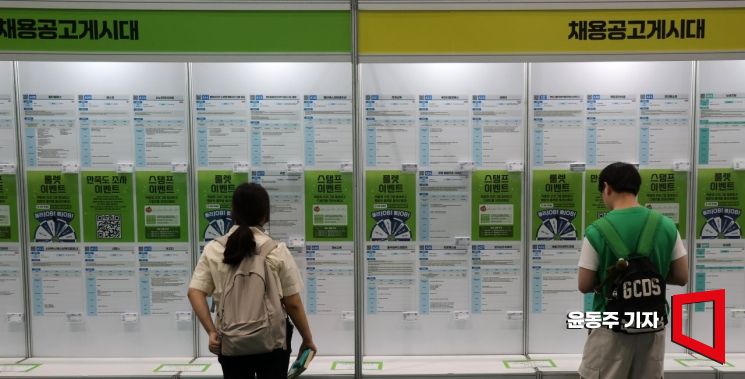 Job seekers visiting the Gangnam-gu Job Fair held at COEX in Gangnam-gu, Seoul on June 5 are checking the job posting board. 2025.06.05 Photo by Yoon Dongju
New administration preparing "Youth Future Savings"
In this situation, the government plans to end the Youth Leap Account within this year and introduce a follow-up program called "Youth Future Savings." However, there are concerns that if the new system does not reflect the actual economic situation of young people, the same problems may be repeated. Unless "income stability" for young people is improved before designing new policies, these initiatives may amount to nothing more than a "numbers game" that only leaves unused budgets behind.
The National Assembly Budget Office pointed out in its "2024 Fiscal Year Settlement Committee Analysis" report that "since the Youth Leap Account is structured so that matching contributions are executed according to the payment performance of subscribers, it is necessary to ensure that matching contributions are provided only within the range of available resources for future execution."
© The Asia Business Daily(www.asiae.co.kr). All rights reserved.
![Clutching a Stolen Dior Bag, Saying "I Hate Being Poor but Real"... The Grotesque Con of a "Human Knockoff" [Slate]](https://cwcontent.asiae.co.kr/asiaresize/183/2026021902243444107_1771435474.jpg)


















