Jung Chungrae's Will for Media Reform and People Power Party's Strategy Intertwined
All-Day Competition Between the Yellow Envelope Act and Priority
Final Decision Made After Speaker and Party Leaders' Luncheon Meeting
The main contentious bill to be addressed at the July extraordinary session of the National Assembly has been determined to be the "Broadcasting Act." Due to the opposition party's filibuster (unlimited debate) and the schedule of the extraordinary session, there was political wrangling over which bill would be prioritized. The top priority shifted from the Broadcasting Act to the Yellow Envelope Act (Trade Union and Labor Relations Adjustment Act), and then back to the Broadcasting Act.
On August 4, political circles were abuzz with speculation over which bill would be prioritized for passage in the plenary session. With this extraordinary session set to end tomorrow, the People Power Party announced that it would respond with a filibuster if any of the following were introduced: the Yellow Envelope Act, the three broadcasting-related bills, or one of the amendments to the Commercial Act that would mandate cumulative voting for corporations with assets of 2 trillion won or more. Given that the filibuster guarantees at least 24 hours of debate (Article 106-2, Paragraph 6) and that the July session ends on the 5th, only one contentious bill could realistically be processed. This led to intense maneuvering over which bill would take precedence.
In this context, the Democratic Party stated that it would make a final decision at the general assembly of its lawmakers scheduled for the afternoon, without disclosing which bill would be prioritized. This led to various predictions. The previous day, the Democratic Party had held a press briefing explaining the Yellow Envelope Act, signaling its intent to process it, which led to speculation that the Yellow Envelope Act would be prioritized. On the other hand, following the stock market crash on the 1st, there was speculation that the Commercial Act would be expedited. However, from the morning, political circles analyzed that the Broadcasting Act would be the first to be processed.
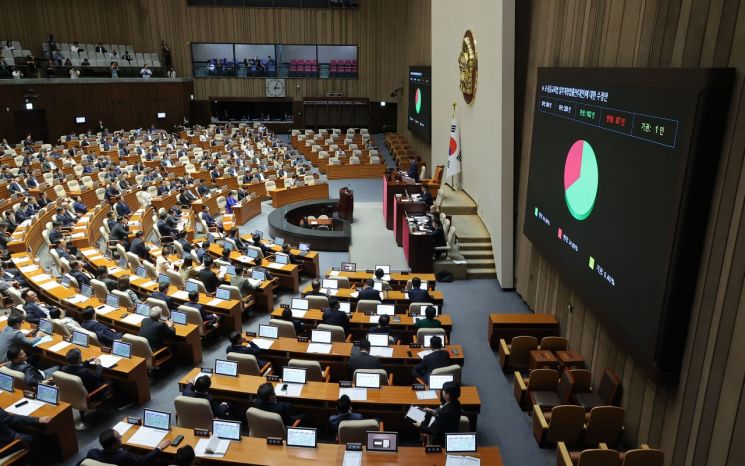 On the 4th, an amendment to the Elementary and Secondary Education Act was passed in the National Assembly plenary session. Photo by Yonhap News
The person who set the tone was Jung Chungrae, the newly elected leader of the Democratic Party. By advocating for media reform and emphasizing the need to process the Broadcasting Act first, Jung strengthened the case for prioritizing the Broadcasting Act. Choi Minhee, chairperson of the National Assembly's Science, ICT, Broadcasting and Communications Committee, also announced on social media in the morning, "The efficacy of party leader Jung Chungrae, prioritizing the three broadcasting-related bills."
However, the atmosphere changed rapidly afterward. It was reported that National Assembly Speaker Woo Wonshik indicated an intention to process the Yellow Envelope Act first, altering the mood. The Democratic Party leadership also stated, "The authority to put items on the agenda rests with the Speaker," and added, "We can make suggestions, but if the Speaker says no, we have no choice but to accept it." Accordingly, after their own general assembly, the People Power Party told reporters, "We understand that the Democratic Party will put the Yellow Envelope Act on the agenda first." This led to discussions about the order of the filibuster response being adjusted to focus on the Yellow Envelope Act.
However, after a luncheon meeting between Speaker Woo and the floor leaders of both parties, the atmosphere shifted again. Moon Jinseok, the Democratic Party's senior deputy floor leader, told reporters after the meeting, "We will process the Broadcasting Act first."
The change in direction appears to be the result of the new party leader's commitment to media reform and the People Power Party's strategic calculations. Baek Seunga, the Democratic Party's floor spokesperson, said after the general assembly, "There was much deliberation about how to proceed strategically between the Broadcasting Act and the Yellow Envelope Act, but with the new leader's commitment to media reform, we decided to process the Broadcasting Act first." In addition, the situation also appears to be related to the People Power Party preparing an amendment to the Yellow Envelope Act. A People Power Party official stated in the morning, "Given the economic impact, our position is that we need to create an alternative and hold further discussions regarding the Yellow Envelope Act," adding, "We will at least try to come up with a revised proposal." For the People Power Party, this seems to be an attempt to delay the amendment of the Yellow Envelope Act, create an alternative, and seek negotiations with the Democratic Party and the government.
Subsequently, at the plenary session, the Democratic Party submitted a motion to change the legislative schedule, replacing the previously prioritized Commercial Act with non-contentious bills, and decided to put the Broadcasting Act to a vote first.
© The Asia Business Daily(www.asiae.co.kr). All rights reserved.
![Clutching a Stolen Dior Bag, Saying "I Hate Being Poor but Real"... The Grotesque Con of a "Human Knockoff" [Slate]](https://cwcontent.asiae.co.kr/asiaresize/183/2026021902243444107_1771435474.jpg)
















