The Wall Street Journal (WSJ) reported on August 3 (local time) that the U.S. mergers and acquisitions (M&A) market, which had been sluggish in the first half of this year, is now heating up, recording its largest scale in four years.
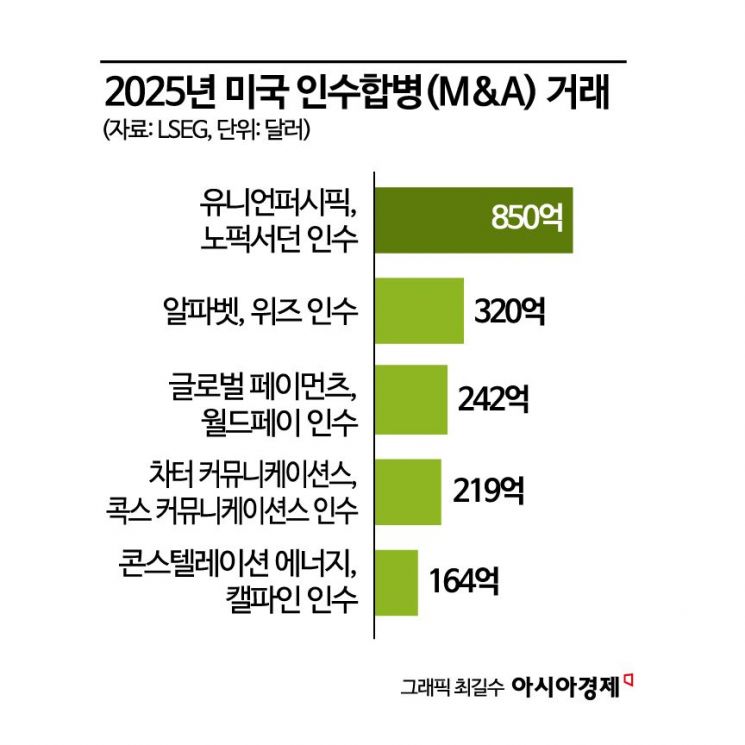
According to market research firm LSEG, as cited by WSJ, the volume of M&A deals announced in the U.S. last week reached its highest level since 2021.
Regarding the revived M&A market, which has become active for the first time in four years, WSJ noted, "Late summer is usually the slowest period for M&A activity, but this year is different." Frank Aquila, senior partner at the major U.S. law firm Sullivan & Cromwell, also commented, "Currently, all the perfect conditions for active M&A activity are in place," and predicted that the market would become even more active after Labor Day next month. This is interpreted as being due to a relatively robust economy and expectations of interest rate cuts.
In particular, Union Pacific, a railroad company, drew attention when it announced on July 29 that it would acquire Norfolk Southern, an Eastern U.S. railroad operator, for $85 billion (approximately 117 trillion won). This acquisition is the largest M&A deal announced this year since Alphabet, Google’s parent company, acquired Israeli security firm Wiz for $32 billion in March.
Union Pacific operates major freight rail networks in the Midwest and West of the U.S. west of the Mississippi River, while Norfolk Southern holds key networks in the East. The merged company is expected to surpass Burlington Northern Santa Fe (BNSF), a subsidiary of Berkshire Hathaway, to become the largest railroad company in the United States. It will also become the first single company to own a rail network spanning the entire U.S., from the West Coast to the East Coast. The two companies stated that this merger "will seamlessly connect more than 50,000 miles (about 80,000 km) of rail lines across 43 states, linking 100 ports and reaching nearly every region in North America, from the East Coast to the West Coast."
Additionally, Baker Hughes, a major U.S. oil drilling company, has agreed to acquire Chart Industries, a liquefied natural gas (LNG) equipment manufacturer, for $13 billion. Baker Hughes stated that this acquisition will "enable the company to meet industrial demand for low-carbon and high-efficiency energy solutions."
Although the final results have not yet been announced, other large M&A deals are also pending. Kraft Heinz, a food company, is considering spinning off its grocery division. It is reported that several Kraft products will be included in the spin-off, while brands such as Heinz Ketchup and the Dijon mustard brand Grey Poupon are expected to remain. In this regard, Kraft Heinz stated, "As announced in May, the company has been evaluating potential strategic transactions to realize shareholder value."
Meanwhile, French luxury group LVMH is reportedly discussing the sale of its luxury brand Marc Jacobs. WSJ estimated that the sale price of this luxury fashion brand, founded by American fashion designer Marc Jacobs, could reach $1 billion (about 1.38 trillion won).
Some analysts suggest that large-scale deals such as the Union Pacific and Norfolk Southern merger could trigger additional M&A activity. Tony Kim, co-CEO of M&A advisory firm Centerview Partners, said that although there is anxiety that makes it difficult to finalize negotiations in large M&A deals, "it is certainly positive that, despite this backdrop, we are seeing more deals being completed."
However, concerns have also been raised that large M&A deals could harm market competition, leading to monopoly issues and other negative views. There are worries that the merger between Union Pacific and Norfolk Southern could increase freight transportation rates and reduce service quality. Scott Jensen, director at the American Chemistry Council, pointed out, "The merger of the largest railroad companies in the U.S. could reduce the options for American manufacturers, farmers, and energy producers who want to transport goods by rail."
© The Asia Business Daily(www.asiae.co.kr). All rights reserved.
![Clutching a Stolen Dior Bag, Saying "I Hate Being Poor but Real"... The Grotesque Con of a "Human Knockoff" [Slate]](https://cwcontent.asiae.co.kr/asiaresize/183/2026021902243444107_1771435474.jpg)
















