Spontaneous Collective Entanglement Achieved Based on "Dark State"
Photon-Based Quantum Information Storage and Quantum Sensor Applications Expected, Published in Nat. Commun.
A team of domestic researchers has successfully demonstrated the experimental realization of spontaneous quantum entanglement based on the "dark state," which had previously remained theoretical.
Entanglement in a dark state is highly resistant to external interference and has a long lifetime, which is expected to contribute to the development of next-generation quantum technologies such as quantum memory and sensors.
On August 4, Professor Kim Jehyeong's team from the Department of Physics at UNIST, together with Dr. Lee Changhyup from the Korea Research Institute of Standards and Science (KRISS) and Dr. Song Jindong from the Korea Institute of Science and Technology (KIST), announced that they had experimentally induced collective quantum entanglement based on the dark state, which has a lifetime approximately 600 times longer than that of the bright state.
 Research team: Professor Jehyung Kim of UNIST, Dr. Kyuyeong Kim of UNIST (first author), Dr. Changhyup Lee of Korea Research Institute of Standards and Science, Dr. Jindong Song of KIST. Provided by UNIST
Quantum entanglement among a large number of indistinguishable quantum structures can appear as either a dark state or a bright state. The dark state emits almost no light, allowing the entanglement to be maintained for a long time. This entanglement protection property is essential for quantum information storage and transmission, but creating and maintaining a dark state has been challenging.
The research team used a nano-optical resonator with a controlled loss rate to induce the dark state by balancing the coupling strength between quantum dots and the resonator with the loss value of the resonator.
First author Dr. Kim Gyuyoung explained, "If the resonator loss is too large, the quantum dots act independently without affecting each other. Conversely, if only the coupling strength is large, collective entanglement is formed by forced external stimulation."
The lifetime of entanglement between quantum dots in the dark state was extended up to 36 nanoseconds (ns). This is about 600 times longer than the lifetime of the bright state, which is 62 picoseconds (ps).
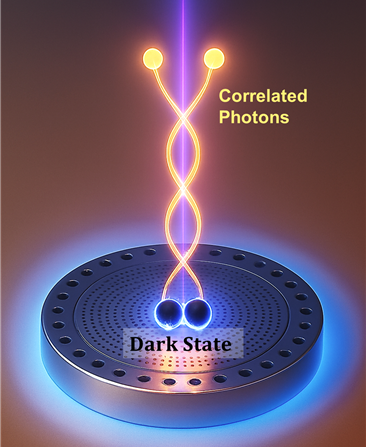
The research team also observed the phenomenon of biphoton emission as experimental evidence of dark state formation. While the dark state generally emits almost no photons, when two or more quantum dots are entangled, non-classical collective emission of two photons simultaneously under specific conditions can occur.
Professor Kim Jehyeong stated, "This research demonstrates, through experiment, the realization of dark state entanglement that had only been theoretical, and shows that with well-designed loss, entanglement can actually be maintained for a longer time. This will be helpful for the development of technologies such as quantum information storage, precision quantum sensors, and quantum-based energy harvesting."
The research results were published online as a breaking news article in the July 9 edition of the world-renowned journal Nature Communications.
The research was supported by the Mid-career Researcher Program of the National Research Foundation of Korea, the Quantum Technology R&D Leading Program, and the International Collaborative Research Program for Digital Innovation Technology of the Institute for Information & Communications Technology Planning & Evaluation.
© The Asia Business Daily(www.asiae.co.kr). All rights reserved.

















