Marc Chagall Special Exhibition at Seoul Arts Center: Beyond Time
Over 100,000 Visitors in Just 50 Days
Seven Original Works Unveiled for the First Time Worldwide
"Striving to Highlight Chagall's New and Diverse Facets"
Exhibition Runs Until September 21
Marc Chagall, born on July 7, 1887, in Vitebsk, then part of the Russian Empire (now Belarus), as the youngest child in a poor Jewish family, would later become known as the magician of color in the 20th century. Although the World Wars, the Russian Revolution, and the Nazi persecution of Jews in Germany left vivid scars on his life, Chagall sublimated these experiences into art, capturing them in his works.
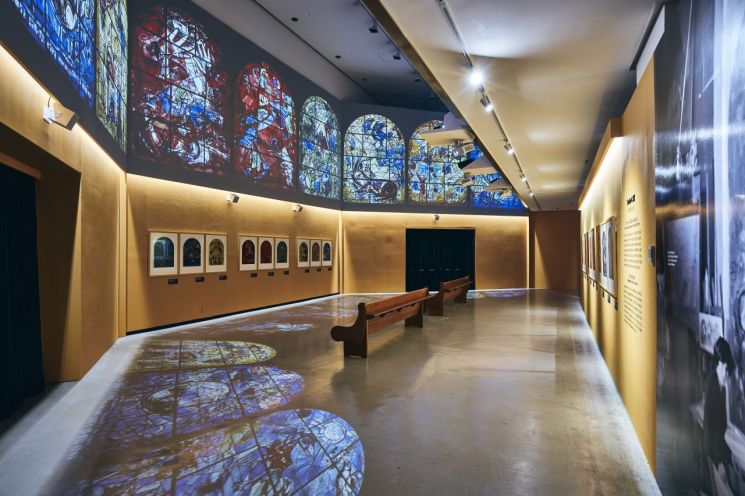 The exhibition hall view of the "Marc Chagall Special Exhibition: Beyond Time," which opened on May 23 at the Hangaram Art Museum, Seoul Arts Center. Seoul Arts Center
For him, painting was a window for communicating with the world. Chagall once said, "All questions and answers are within the painting. Anyone can see and interpret it in their own way. There are words that cannot be spoken, silences, and doubts hidden within the painting." This statement reveals that his works contain multiple implications that are difficult to articulate in words.
Although Chagall is sometimes classified as a surrealist painter, he himself rejected such labels. "There are no fairy tales, fables, or folk legends in my paintings. Everything within us is reality, and perhaps it is even more real than the world that appears on the surface." Art historian Elena Pontigia also emphasized that "What Chagall paints does not actually exist, but we all feel that it is true," highlighting that Chagall's artistic world is closely connected to reality.
Chagall did not restrict his artistic methods. He showcased a variety of artistic techniques, including painting, printmaking, and stained glass, and valued them equally. "If I had not experienced printmaking and lithography in my life, something essential would have been missing. Every time I held a lithographic stone or a copper plate in my hands, I felt as if I was holding a talisman in which I could completely entrust my joys and sorrows."
Returning after seven years, the Seoul Arts Center's "Marc Chagall Special Exhibition: Beyond Time" sheds light on Chagall's timeless artistry and diversity. The emotional impact of works created over a hundred years ago still exerts a powerful force today. Including seven never-before-seen original paintings, approximately 170 works?paintings, drawings, prints, and stained glass?are welcoming visitors at the Hangaram Art Museum in Seoul Arts Center. With an average of 2,000 visitors per day, the exhibition surpassed 100,000 visitors in just over 50 days since opening. When this reporter visited on the 30th, a long line had already formed before opening, and even kindergarten children were spotted among the crowd. At this moment, what significance does the Chagall exhibition add to our society? This question was posed to curator Jang Yoonjin (42), who planned the exhibition.
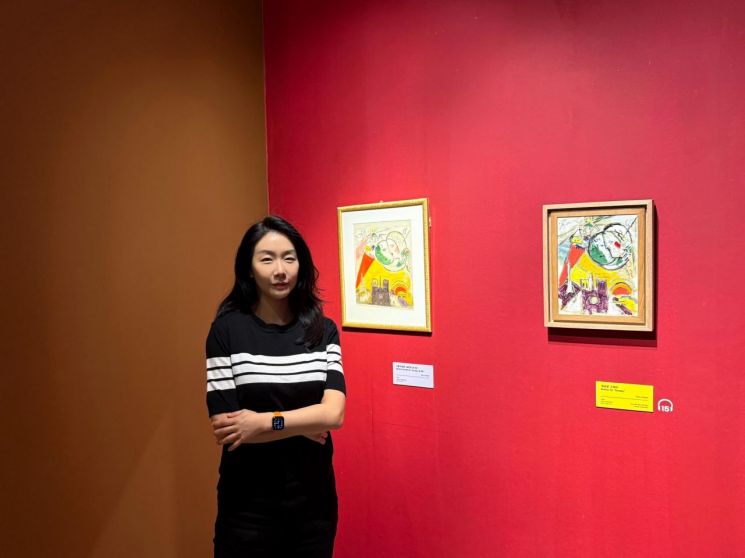 Curator Yoonjin Jang of the Seoul Arts Center, who planned the special exhibition "Marc Chagall: Beyond Time." Seoul Arts Center
-The exhibition has surpassed 100,000 visitors.
▲We aimed to present a new aspect that distinguishes this Chagall exhibition from the many that have previously been held in Korea. We carefully considered how to showcase the vast range of Chagall's artistic realms, and fortunately, it seems the audience has responded positively. We planned a challenging exhibition that presents not only his representative works but also the diverse artistic world Chagall explored. Despite the fact that photography is restricted and there are limited areas for taking commemorative photos, many visitors come to see the works themselves. Visitors of all ages continue to come, with about 2,000 people visiting each day on average.
-Do you think the original intention of the exhibition is being effectively conveyed to the audience?
▲As the title "Beyond Time" suggests, we did not arrange Chagall's artistic world in a linear fashion. Instead, we wanted to focus on the idea that Chagall had his own concept of time, transcending all overlaps and periods, and to draw attention to his inner imagery. I think the fact that we revealed Chagall's artistic world in a more diverse way compared to previous exhibitions in Korea is being well received. There are many positive reviews both by word of mouth and online. (laughs)
-What is the biggest difference from previous Chagall exhibitions?
▲This exhibition not only covers Chagall's paintings, prints, and stained glass works, but also has the great significance of unveiling seven previously unreleased works for the first time in the world. In particular, the painting versions of Chagall's well-known print series "Behind the Mirror" are being shown for the first time at this exhibition. By displaying these works side by side, visitors can enjoy the unique experience of observing how Chagall's works change across different media. The opportunity to understand the depth of Chagall's art through these never-before-seen original paintings is one of the exhibition's greatest attractions.
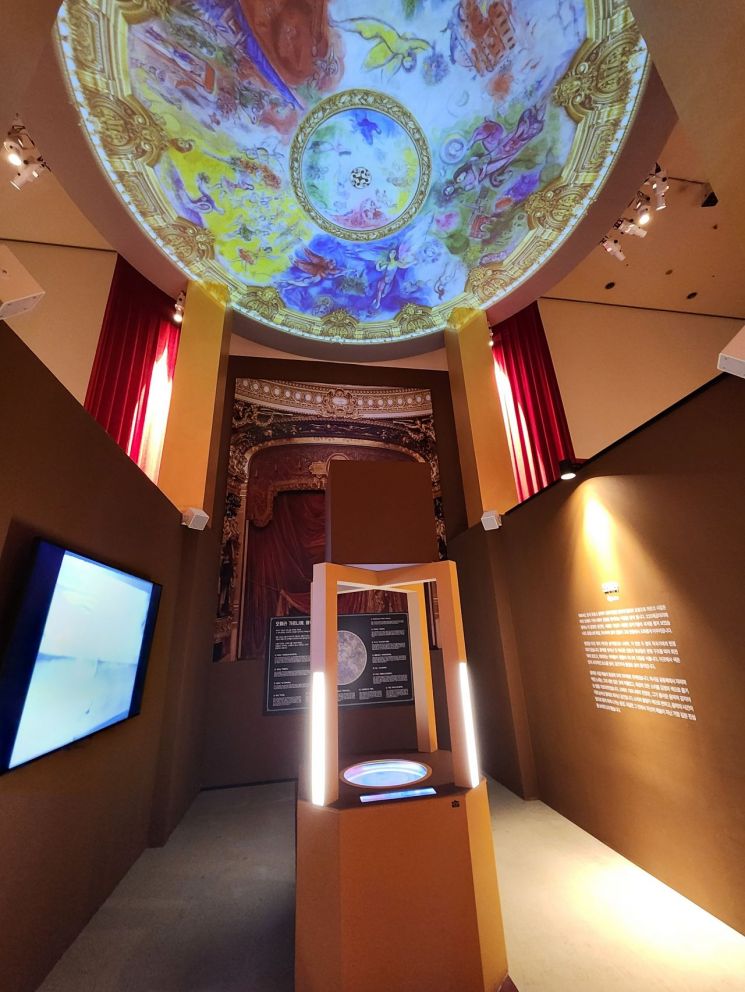 Chagall's ceiling painting at the Paris Opera House was recreated as a media artwork and presented. The painting was enlarged to allow for a detailed examination. Photo by Seomideum
-The exhibition covers not only paintings but also prints and stained glass. The range is diverse.
▲We made efforts to ensure that he would not be defined merely as a painter, so visitors could deeply experience the broad range of his works. We created media spaces focusing on Chagall's ceiling painting at the Paris Garnier Opera House and the stained glass at Hadassah Medical Center, thereby expanding the diversity of the exhibition experience. We actively utilized the high ceilings of the first-floor exhibition hall at Hangaram Art Museum to create a sensuous and immersive exhibition where visitors can feel the feast of color and light with their whole bodies.
-Is there a message you hope visitors will take away from the exhibition?
▲The public image of Chagall may be fragmentary and centered on his paintings. However, Chagall experienced many twists and turns over the years, including the Russian Revolution, World War I and II, exile to the United States, and discrimination as a Jew. His artistic world is as multi-layered as his tumultuous life. He did not limit himself to any particular form, working in painting, printmaking, and stained glass. Based on this, I wanted to convey an attitude and approach toward "understanding people." I hope visitors leave with the question, "How should we view art and artists?"
-What did you pay the most attention to while preparing the exhibition?
▲I spent a lot of time thinking about how to reveal and at the same time conceal the seven works being unveiled for the first time in the world. Those who are knowledgeable about Chagall might approach the works superficially, thinking, "Ah! This is being shown for the first time," or "How much is this worth?" I had to balance my desire to highlight the exhibition with my wish for these works to blend naturally into the flow of the exhibition. (laughs)
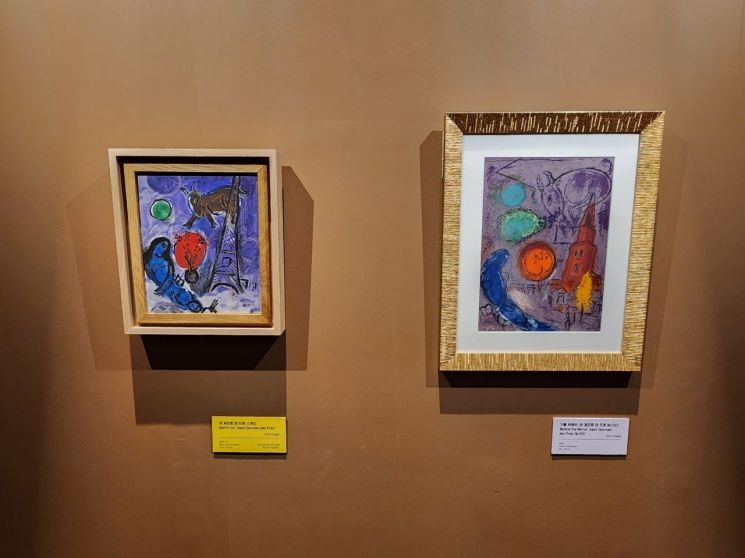 The early sketch work of the print "Saint Germain des Pres" (1952-1953, left in the photo), which is an early sketch of the print "Behind the Mirror: Saint Germain des Pres" (1954), was exhibited side by side. The captions of the works unveiled for the first time in the world in this exhibition are marked in yellow. Photo by Seo Mideum
-Were there any memorable episodes during the preparation process?
▲For this exhibition, I worked with overseas curator Paul Schnaitter and designer Gael Rene, and it was not easy to coordinate opinions during the design process. There were repeated discussions because design requests for the exhibition flow and temporary walls conflicted with Korean fire safety regulations. The overseas collection's leading role in space design allowed us to create a space where visitors could immerse themselves more deeply in Chagall's works. I hope visitors also enjoy the beauty of the space that enhances Chagall's artistic world.
-Is there a particular work you would personally recommend?
▲I hope visitors do not miss the paintings displayed alongside the "Behind the Mirror" print series, published in 1954. The "Behind the Mirror" series is filled with Chagall's affection for Paris. For Chagall, Paris was like a "starting point of art" where he discovered artistic enlightenment. After escaping from Imperial Russia and staying in Paris, Chagall later expressed his gratitude to the city that welcomed him by painting the ceiling of the Garnier Opera House. This project, which lasted from 1953 to 1956, depicted various scenes of Paris?the banks of the Seine, Sunday landscapes, the Eiffel Tower, bridges over the Seine, the Bastille, and the Carrousel of the Louvre?with unique emotions and colors. Especially in this exhibition, visitors can see some of these paintings being shown to the public for the first time, making it even more special.
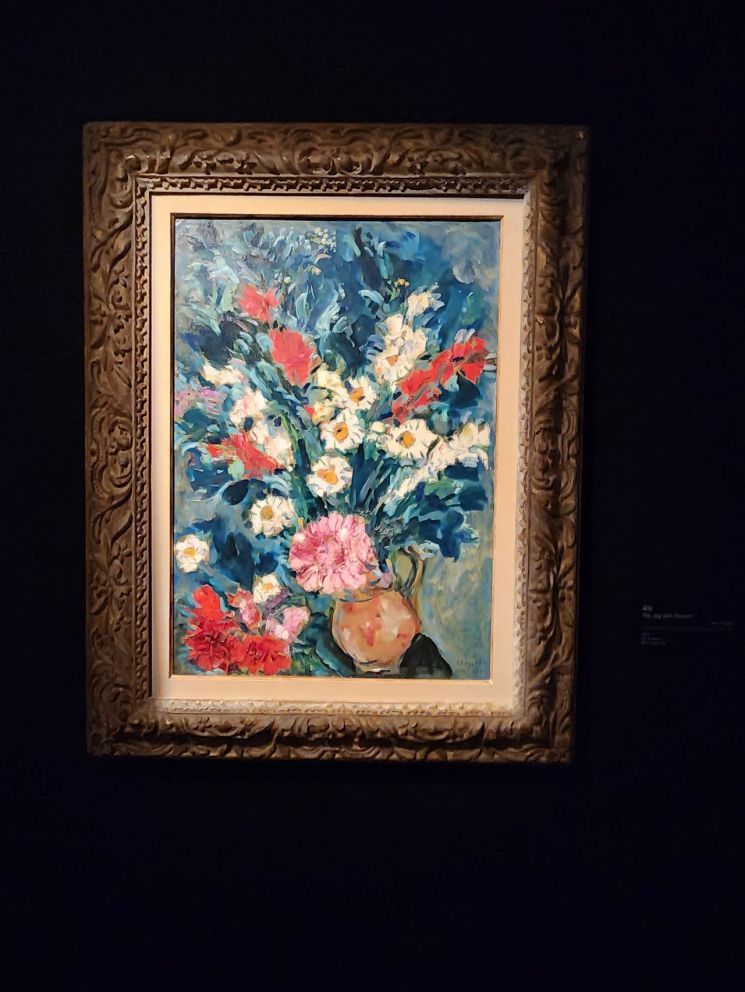
-Many flower-themed works stand out. It seems flowers held special meaning for Chagall.
▲For Chagall, flowers were more than just still lifes; he projected himself and his love onto them. The vibrant flowers in vases may appear splendid at first glance, but they always contain the possibility of being moved, which resonates with Chagall's own life journey?never able to take root, constantly on the move. Although he finally found stability in his later years in Saint-Paul-de-Vence, France, he ultimately never returned to his birthplace. Visitors can appreciate a variety of flower-themed works, from large-scale 160 cm paintings to early flower paintings from 1925, all in one place.
-Is there a recommended way to fully appreciate the meaning and enjoyment of the exhibition?
▲Chagall spent his childhood in poverty and never received formal apprenticeship training in painting. From a technical perspective, such as drawing skills, his works might not seem outstanding. However, his refusal to follow trends and his persistent depiction of his own inner imagery, as well as the way he projected his life onto beautiful subjects, are unique artistic characteristics of Chagall. If visitors try to understand what kind of imagery Chagall held in his mind as he created his works, they will be able to deeply feel his life and artistic world.
© The Asia Business Daily(www.asiae.co.kr). All rights reserved.



















