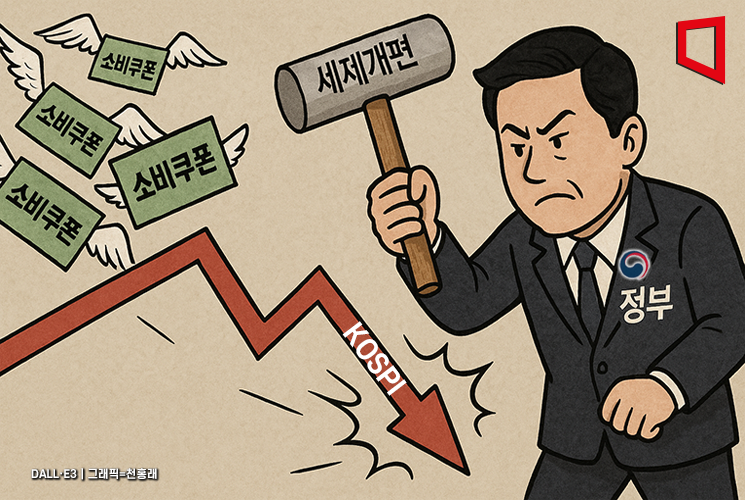
The domestic stock market, which had been reaching new highs, plummeted following the Lee Jaemyung administration's first 'tax reform plan' announcement, leading to a series of warnings from securities analysts that this will act as a short-term downward pressure. In particular, some analysts pointed out that the shock from the controversial 'major shareholder threshold of 1 billion KRW' has completely offset the economic stimulus effect expected from the issuance of consumer coupons for livelihood recovery.
Kim Yonggu, a researcher at Yuanta Securities, released a report on Monday, the 4th, stating, "The implicit shock from lowering the major shareholder threshold to 1 billion KRW offset the explicit benefit of issuing consumer coupons." The tax reform plan, which became the backdrop for the so-called 'Black Friday' market crash, centers on drastically lowering the criteria for determining major shareholders of listed stocks from the current 5 billion KRW to 1 billion KRW. As a result, on the day after the announcement, August 1, the domestic stock market's total market capitalization plunged by approximately 116 trillion KRW. KOSPI lost 99.2 trillion KRW, and KOSDAQ decreased by 16.8 trillion KRW.
Referencing a 'wealth effect comparison' paper by Robert Shiller, Nobel laureate and Yale University professor, which empirically analyzed that a 1 dollar increase in stock prices (based on S&P 500) leads to a 0.03-0.07 dollar increase in consumption, Kim pointed out, "The 116 trillion KRW evaporation in the domestic stock market's capitalization means that potential consumption capacity has decreased by about 8.1 trillion KRW (116 trillion KRW*0.07), which is exactly identical to the 8.1 trillion KRW in national expenditure for the first round of consumer coupons."
He strongly criticized, "Given the current domestic and global economic environment, where the MZ generation is rapidly emerging as the main player in consumer markets and wealthy seniors form the backbone of asset markets, the marginal propensity to consume in relation to stock price fluctuations is likely to have doubled compared to before. This means that the economic impact equivalent to or greater than the consumer coupons was wiped out in just one day."
Kim also evaluated the 2025 tax reform plan as "nominally advocating fair taxation and securing tax revenue, but in reality, for those who are not major shareholders exercising control, it is a forced and unreasonable reform that can be easily circumvented or avoided through year-end selling and repurchasing at the beginning of the year."
He warned that this tax reform plan does not align with the Lee Jaemyung administration's goal of achieving 'KOSPI 5000,' saying, "Even a handful of highly anti-market policy responses, like poisonous mushrooms, will limit the clarity and momentum of future policy responses and make achieving policy goals highly unlikely." He added, "It is important to keep in mind that the increase in tax revenue from revitalizing KOSPI 5000 could overwhelmingly exceed any increase in tax revenue from lowering the major shareholder threshold."
On the same day, Kim Jongyoung, a researcher at NH Investment & Securities, also stated in a report titled 'Evaluation and Impact Outlook of the Tax Reform Plan from a Market Perspective,' "The tax reform plan announced on July 31, 2025, failed to meet market expectations and is highly likely to act as a short-term downward pressure on the domestic stock market." He expressed concern that "the tightening of the major shareholder capital gains tax criteria could trigger year-end selling pressure from individual investors, acting as a destabilizing factor for market supply and demand."
Kim predicted, "If this reform plan is enacted as is, the investment appeal of value and dividend stocks could weaken until the end of the year. There is also a growing possibility that tax-avoidance-driven selling by individual investors at year-end will increase further." He further warned, "As some companies move their dividend record dates to March, institutional and foreign investors' year-end buying demand is also expected to weaken, which could restrict the traditional December rally." Typically, the average December returns for KOSPI and KOSDAQ have been positive as institutional and foreign investors' year-end dividend collections and book closings absorb individual investor selling, but this year, the situation could be different.
The tax reform plan will be finalized at a Cabinet meeting in August. Afterward, it is expected to be finalized through passage in the National Assembly's Tax Subcommittee and the Planning and Finance Committee in November, and the main session of the National Assembly in December. Currently, opposition within the Democratic Party of Korea is mounting, raising the possibility of reconsideration during the parliamentary review process.
As of 7 a.m. on this day, the number of consents on the National Assembly's public petition board for the petition against lowering the major shareholder capital gains tax threshold surpassed 112,990.
© The Asia Business Daily(www.asiae.co.kr). All rights reserved.

















