Gas Emitted During Rocket Separation
Chinese Rocket Passes Over Australia
A mysterious luminous object was spotted in the skies above the eastern coast of Australia, sparking speculation that it might be an unidentified flying object (UFO) belonging to extraterrestrials. However, it was later confirmed that the object was actually a Chinese rocket passing over Australia.
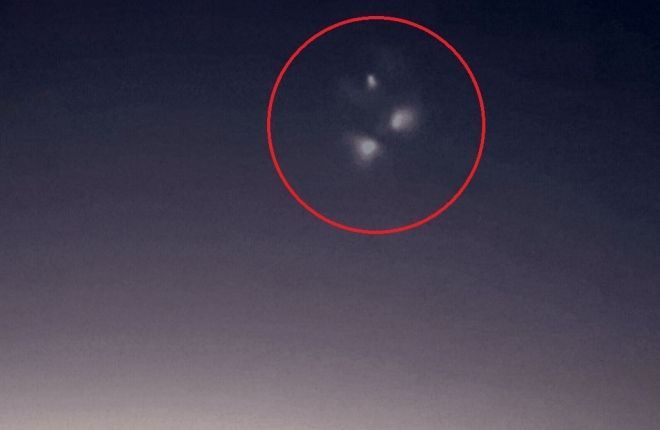 Three white luminous objects captured around midnight local time on the 30th over Queensland and New South Wales, Australia. Screenshot from X (formerly Twitter)
According to 7 News Australia, around midnight on July 30, three white luminous objects were observed hovering for a while before disappearing over Queensland and New South Wales. Residents captured this strange scene and shared it on social media, speculating that it might be a UFO. Local internet users commented, "It looked like three UFOs," "It was so bright that it woke me up," and "It was probably an asteroid."
However, it was confirmed that this mysterious phenomenon was caused by the exhaust gases of a rocket. Brad Tucker, an astrophysicist at the Australian National University, explained, "This light was caused by China's Chang Zheng 8 rocket, which was launched at 6:15 p.m. on July 30," adding, "The trajectory matches perfectly." Dr. Tucker added that the rocket was launched southeastward and passed over the waters off the coast of Queensland. He further explained, "The rocket has a multi-stage structure, and when each stage separates, the boosters and gases are released," describing this as a "rocket plume" phenomenon.
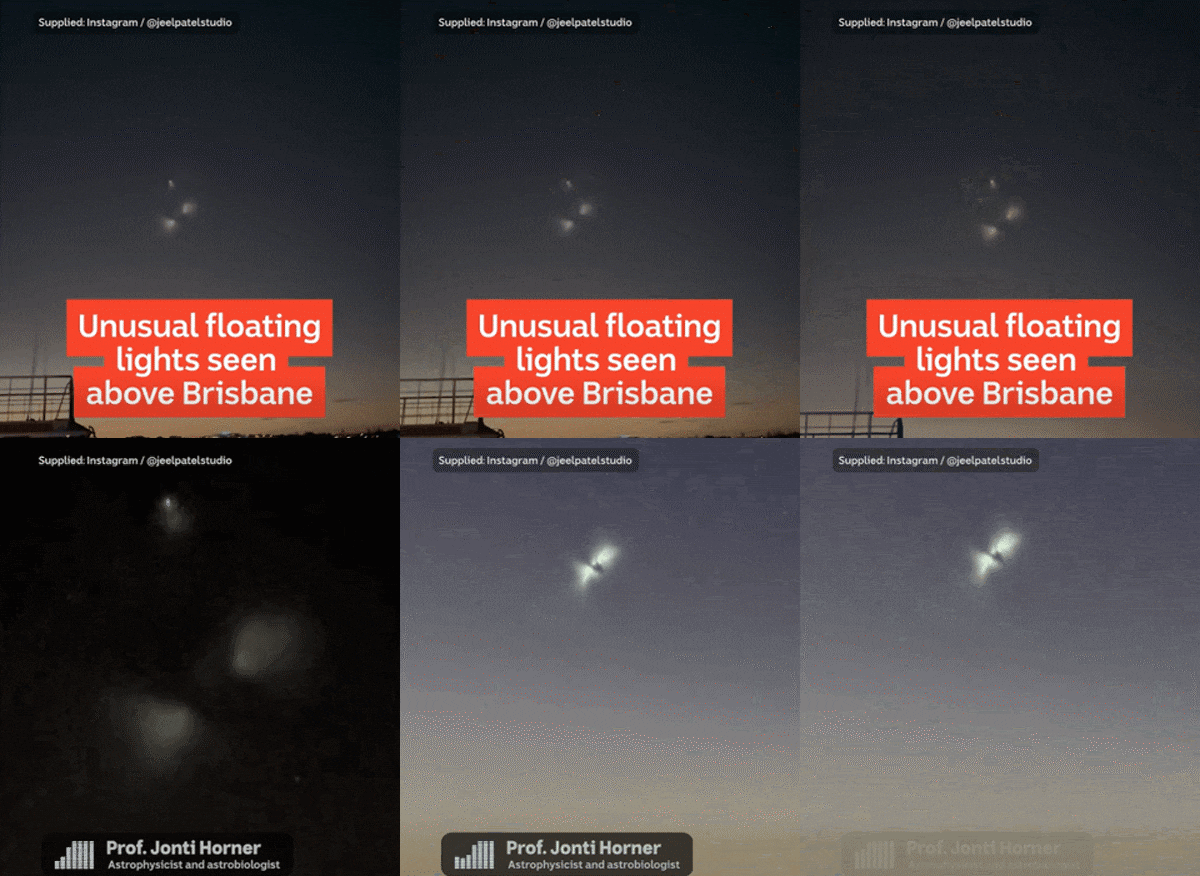 Three white luminous objects captured around midnight local time on the 30th over Queensland and New South Wales, Australia. ABC Radio
When the rocket components separate, small boosters and exhaust gases are ejected, and at this time, the gas appears in a unique spherical shape. Dr. Tucker said, "Because of the strange shape and the parts that look like tentacles, this phenomenon is sometimes called a 'space jellyfish'." Regarding the phenomenon where the spherical objects appear to be stationary in the sky, he explained, "It is due to the exhaust gases lingering in the upper atmosphere," and compared it to "the way a cloud of dust remains when a car accelerates rapidly."
Dr. Tucker stated, "It takes quite some time for a rocket to enter space. If anything falls off during separation, it is designed to fall into the ocean," and added, "The gas remaining in the separated part of the rocket will gradually dissipate into the atmosphere over time."
Meanwhile, this rocket was launched at 5:49 p.m. (Australian Eastern Standard Time) on July 30 from the Hainan Commercial Space Launch Site in China. As planned, the rocket successfully placed low Earth orbit internet satellites into orbit. The Chang Zheng 8 rocket, developed by the China Aerospace Science and Technology Corporation (CASC), is China's next-generation medium-sized two-stage liquid-fueled rocket. It is known to be suitable for sun-synchronous orbit and low Earth orbit large satellite network deployment missions, capable of launching single or multiple satellites. Currently, China is developing the Chang Zheng 8A, an upgraded model of the Chang Zheng 8, with its first flight scheduled for January next year.
© The Asia Business Daily(www.asiae.co.kr). All rights reserved.
![Clutching a Stolen Dior Bag, Saying "I Hate Being Poor but Real"... The Grotesque Con of a "Human Knockoff" [Slate]](https://cwcontent.asiae.co.kr/asiaresize/183/2026021902243444107_1771435474.jpg)

















