Shipbuilding Cooperation Project Inspired by Trump's Campaign Slogan
"Took 10 Hats... Always Considered the Possibility of Breakdown Until the End"
Kim Yongbeom, the Chief Presidential Secretary for Policy who led the Korea-US customs negotiations, revealed that cooperation in the shipbuilding sector played a crucial role in reaching an agreement and unveiled the actual MASGA (Make America shipbuilding Great Again) project hat.
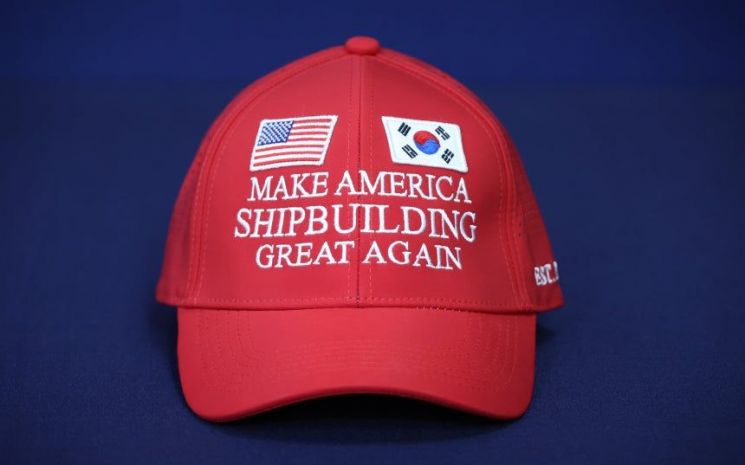 The presidential office revealed the 'Masga' (MASGA·Make American Shipbuilding Great Again) cap on the 3rd. 'Masga' is a slogan created by the Ministry of Trade, Industry and Energy to concisely convey the shipbuilding cooperation content during the recent Korea-US tariff negotiations. The Korean negotiation team prepared this cap along with large panels. Yonhap News
On the 3rd, during an appearance on KBS's "Sunday Diagnosis," Kim stated, "The United States probably never imagined that Korea had conducted so much research and made so many proposals in the shipbuilding field across various areas," adding, "In fact, without shipbuilding, the negotiations would have remained at a standstill." He then presented the MASGA hat, which he said was made to win over the US side.
The red hat features the Korean and American flags embroidered side by side, with "Make America shipbuilding Great Again" written below. The name of the negotiation project was inspired by former President Donald Trump's campaign slogan "MAGA" (Make America Great Again), with "Shipbuilding" added to signify the shipbuilding industry.
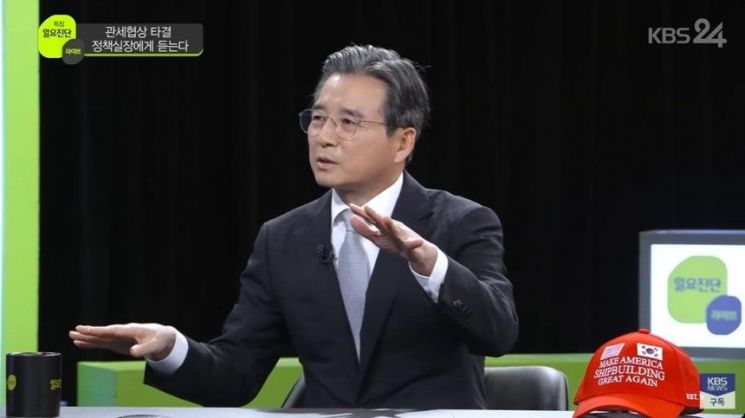 Masuga hat brought to the studio by Policy Chief Kim Yongbeom. KBS Sunday Diagnosis broadcast screen
Industry Minister Kim Jeonggwan brought the hat and a large panel to his meeting with US Secretary of Commerce Howard Lutnick to explain the shipbuilding cooperation investment package, MASGA. According to reports, Secretary Lutnick responded positively, calling it a "Great Idea."
When Secretary Lutnick traveled to Scotland to accompany President Donald Trump during the negotiations, the Korean delegation followed him there as well. Kim recalled, "The meeting held in Scotland was the most substantive," and added, "We saw a 'landing zone' where an agreement could be reached." Kim further explained, "There was a lot of internal debate about following the delegation to Scotland, with differing opinions, raised voices, and both support and opposition," and noted, "Some argued that appearing too eager could actually be disadvantageous in the negotiations."
The Korean government reportedly always considered the possibility that the negotiations could break down. This was because President Trump could change the terms of the deal at the last minute. Kim said, "If he had made unreasonable demands that we could not accept, we would have had to simply walk out of the White House," and added, "How could anyone agree to change the terms right in front of him?"
Not only the government but also efforts from the private sector, including business leaders, greatly contributed to the negotiations. Kim Dongkwan, Vice Chairman of Hanwha Group; Lee Jaeyong, Chairman of Samsung Electronics; Chung Euisun, Chairman of Hyundai Motor Group; and Ryu Jin, Chairman of the Federation of Korean Industries, all visited the US during the negotiation period. Kim emphasized, "Through private channels, we sufficiently conveyed that the Republic of Korea proposed the best possible solution."
© The Asia Business Daily(www.asiae.co.kr). All rights reserved.


















