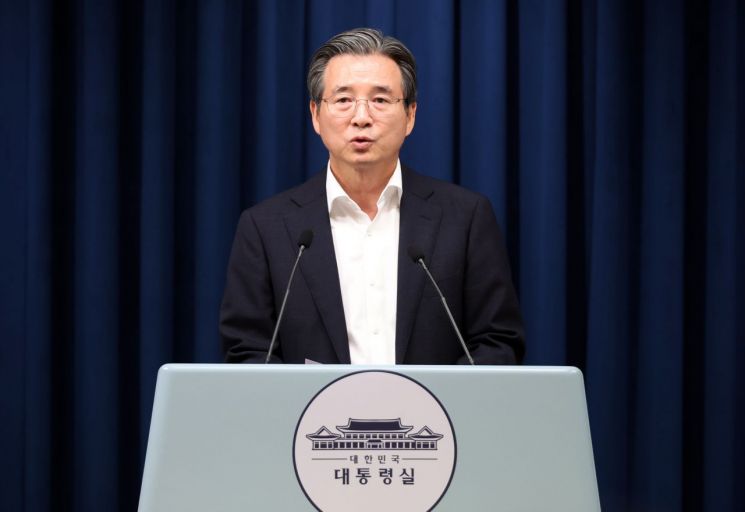
Kim Yongbeom, the Chief of Policy at the Presidential Office, stated on August 3 that the $350 billion investment in the United States, which is a key part of the Korea-US tariff negotiations, "is not a structure where we are unconditionally required to provide the funds according to a predetermined plan."
Appearing on KBS's 'Sunday Diagnosis' program that morning, Kim explained, "The United States claims it will decide on all investment destinations, but that is merely a political statement." He added, "This is a promise made between sovereign nations, and there is no country that would simply provide funding just because the other party demands it."
Previously, the Korean government agreed to lower the mutual tariff rate imposed by the United States to 15%. In exchange, Korea would establish a $350 billion investment fund for the US and purchase $100 billion worth of liquefied natural gas (LNG) and energy.
Kim stated, "Investments made without knowing which businesses will be targeted will account for less than 5%, which is a very small proportion." He further explained, "The remainder will not be invested unconditionally, but will be directed toward commercially meaningful projects."
Kim continued, "If we determine that a project is appropriate from our own perspective, institutions such as the Korea Trade Insurance Corporation or the Export-Import Bank of Korea will provide guarantees or loans." He added, "Ultimately, the establishment of a $350 billion investment fund should be most accurately interpreted as setting the guarantee limit at $350 billion."
Regarding concerns that rice and agricultural products may be further opened to imports after the negotiations, Kim firmly stated, "There will be no additional opening for rice or beef. That is a clear fact."
Kim also said, "There may be technical discussions, such as streamlining quarantine procedures," but emphasized, "There will be no additional costs incurred for rice, beef, or other items of public concern."
Additionally, Kim described the 15% automobile tariff rate as "a painful point," and analyzed, "The Korea-US Free Trade Agreement (FTA) has become a half-measure."
© The Asia Business Daily(www.asiae.co.kr). All rights reserved.
![Clutching a Stolen Dior Bag, Saying "I Hate Being Poor but Real"... The Grotesque Con of a "Human Knockoff" [Slate]](https://cwcontent.asiae.co.kr/asiaresize/183/2026021902243444107_1771435474.jpg)
















