Scheduled for Plenary Session at the National Assembly on the 4th
Concerns Over Expanded Definition of "Employer" and Scope of Strikes
"Orders Will Be Shifted to Replaceable Companies"
Lee, who operates an automotive surface treatment company in Busan, feels overwhelmed by the news of the impending "Yellow Envelope Act." Lee's company is a small to medium-sized enterprise with just over 30 employees. After the initial processes such as pressing (the process of stamping car bodies) and assembly are completed for the production volume ordered by the finished car manufacturer, the company is responsible for the final step of coating a thin layer of metal on the car surface before delivery. If there is any operational disruption caused by a strike at the primary contractor or other higher-tier companies, Lee's business comes to a complete halt. During such periods, fixed costs such as labor expenses continue to snowball, resulting in direct losses.
Lee said, "The problem is not just the prolonged work stoppages due to the Yellow Envelope Act, but even if labor negotiations are concluded, it is difficult to meet delivery deadlines under the 52-hour workweek system." He added, "There's a saying that 'when a conglomerate sneezes, subcontractors catch a severe cold.' If the Yellow Envelope Act is implemented, small and medium-sized companies like ours will be hit harder and more frequently."

As the introduction of the Yellow Envelope Act draws near, anxiety is mounting among numerous small and medium-sized partner companies. Beyond production disruptions and stoppages caused by strikes, there is now a real fear that business relationships with primary contractors could be severed altogether.
According to industry sources on the 4th, the SME sector is closely monitoring the passage of the Yellow Envelope Act (amendments to Articles 2 and 3 of the Trade Union Act), which is scheduled to be presented at the National Assembly plenary session that day. On the 1st, the National Assembly's Legislation and Judiciary Committee held a full meeting and passed the Yellow Envelope Act, the Broadcasting Three Laws, and the Grain Management Act. The core of the Yellow Envelope Act is to expand the definition of "employer" and the scope of labor disputes, while restricting companies from claiming damages against striking workers.
The aspect that concerns the SME sector the most is the expansion of the definition of "employer" to include "those who exercise direct and substantial influence." Previously, the definition was limited to "those who directly employ workers," but if a primary contractor exerts substantial influence over the working conditions of subcontracted workers, the primary contractor could also become a party to negotiations with the subcontractors' union. In this case, the industry fears that primary contractors may sever contracts with small and medium-sized partners that have unions, in order to preempt the possibility of strikes.
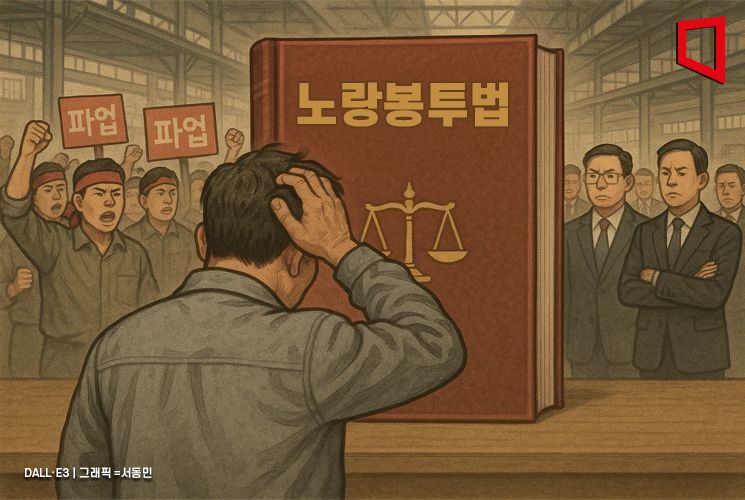
Han, who operates a plastic manufacturing business in Yangju, Gyeonggi Province, said, "From the perspective of a primary contractor, they have contracts with multiple subcontractors, so they might shift orders to other companies to reduce the risk of strikes. For small and medium-sized businesses, this means we are constantly exposed to the risk of having to shut down."
Even companies without unions cannot feel secure. This is because the scope of strikes now includes "disagreements over business decisions that affect working conditions." As business decisions are now recognized as legitimate subjects of labor disputes, strikes at primary contractors may become more frequent than before. Small and medium-sized companies that rely on supplying large corporations are likely to suffer more frequent damages such as production stoppages and wage arrears. Even companies without unions are thus subject to direct and indirect damages resulting from strikes at primary contractors.
The SME sector is closely monitoring the legislative process and seeking joint response measures. Lee Myungro, Director of the Human Resources Policy Division at the Korea Federation of SMEs, said, "The Yellow Envelope Act is far more fatal to the countless small and medium-sized companies that operate as subcontractors," adding, "We will make every possible effort, including joint action with major economic organizations."
© The Asia Business Daily(www.asiae.co.kr). All rights reserved.


















