Direction for the "National Responsibility for Care" Policy Presented
Proposal for Nationwide Expansion
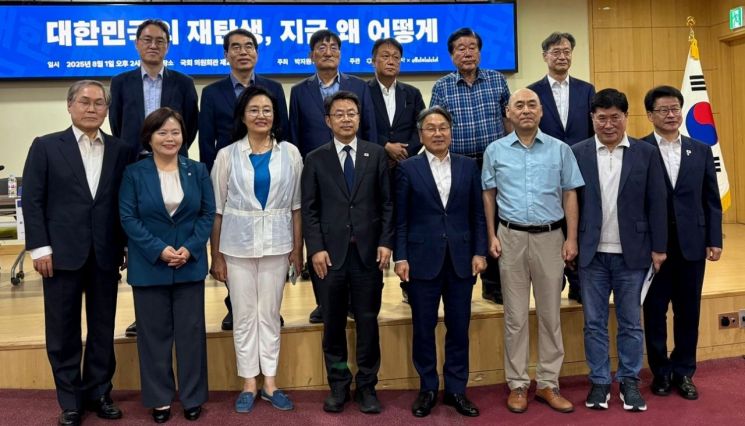 Gwangju Mayor Kang Gijeong attended a forum held at the National Assembly on the 1st, presented the direction of the 'National Responsibility for Care System,' and took a commemorative photo with the attendees. Provided by Gwangju City
As Gwangju's "Gwangju-style Integrated Care" initiative is emerging as a new standard for nationwide care policy, Mayor Kang Gijung presented a direction for President Lee Jaemyung's proposed "National Responsibility for Care" policy at a National Assembly forum.
On August 1, during a presentation at the National Assembly forum titled "The Rebirth of the Republic of Korea: Why and How Now," Mayor Kang emphasized, "The state should provide funding and personnel for care, while local governments, which are closer to citizens' daily lives, should take the lead in providing care."
He outlined the achievements of the Gwangju-style Integrated Care over the past two years. Through this program, which offers universal care regardless of income, the city conducted approximately 56,000 home visits (33,000 by request and 22,000 mandatory visits), and a total of 23,000 individuals received care services.
Notably, without government support, the city allocated 10 billion KRW annually from its own budget to fill gaps left by existing government care policies, introducing 13 new services, including household support, home bathing, hospital accompaniment, meal delivery, nurse home visits, deep cleaning, and pest control.
The Gwangju-style Integrated Care model has been recognized both domestically and internationally. It has been benchmarked 47 times by other local governments such as Seoul, Busan, and Jeju, as well as by National Assembly research groups and the Ministry of Health and Welfare. It has also been selected as a research topic 34 times by organizations such as the Japan Care Management Society and the Korean Association of Social Welfare. In 2023, it was honored with the International Urban Innovation Award from the United Cities and Local Governments (UCLG). Building on these achievements, the Regional Integrated Care Support Act was passed last year and is set to take effect in March next year.
Mayor Kang stated, "Care is another name for democracy, and that is why I believe Gwangju, as a city of democracy, is best suited to lead in this area. Protecting freedom and rights, and upholding human dignity, fundamentally begins with care. Today, citizens' freedoms are safeguarded through care. Investment in care is an investment in both democracy and the economy."
Meanwhile, Mayor Kang announced, "Ahead of the implementation of the Regional Integrated Care Support Act in March next year, we plan to host a 'Care Era Proclamation Ceremony' (tentative name) in November, inviting care officials from the government and all 243 local governments nationwide," and requested, "We ask for the government's support as well."
© The Asia Business Daily(www.asiae.co.kr). All rights reserved.
![Clutching a Stolen Dior Bag, Saying "I Hate Being Poor but Real"... The Grotesque Con of a "Human Knockoff" [Slate]](https://cwcontent.asiae.co.kr/asiaresize/183/2026021902243444107_1771435474.jpg)
















