On this day, the KOSPI ended at 3,119.41, down 126.03 points (3.88%) from the previous session. This marks the largest drop of the year since April 7, when US President Donald Trump announced a 25% reciprocal tariff executive order and the index fell by 5.57%. The index opened at 3,210.32, down 35.12 points (1.08%) from the previous session, and the decline deepened as the day progressed. While individual investors made net purchases totaling 1.6319 trillion won, foreign investors and institutions led the decline by selling 660.3 billion won and 1.0716 trillion won, respectively.
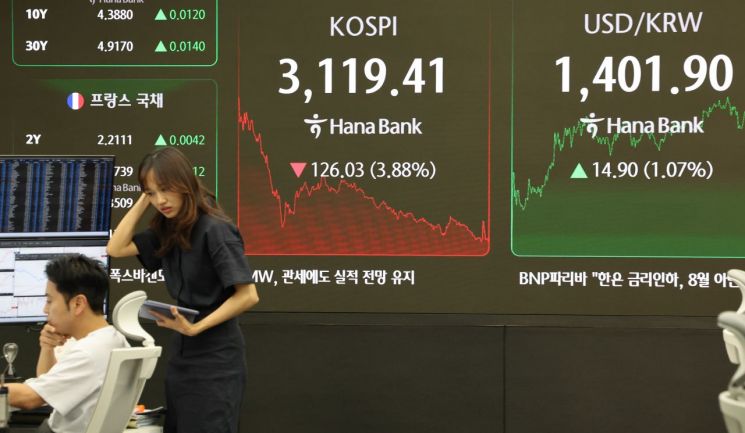
According to the Korea Exchange, out of 935 listed stocks, 885 closed lower. Most of the top market cap stocks also slumped. Doosan Enerbility (-6.40%), Hanwha Aerospace (-5.72%), SK Hynix (-5.67%), KB Financial Group (-4.42%), NAVER (-4.26%), Shinhan Financial Group (-4.26%), Celltrion (-4.25%), and Samsung Electronics (-3.50%) all declined. In contrast, Hanwha Ocean, considered one of the biggest beneficiaries of the Korea-US trade negotiations, surged 4.54%, climbing to 12th in market capitalization.
The KOSDAQ index finished at 772.79, down 32.45 points (4.03%) from the previous session. Individual investors bought 250.5 billion won, but foreign investors and institutions recorded net sales of 112.6 billion won and 141 billion won, respectively.
Among the top market cap stocks, Alteogen stood out with a drop of over 7%. Samchundang Pharm (-6.97%), Rainbow Robotics (-6.14%), LIG ChemBio (-5.36%), LIG Nex1 (-5.35%), Classys (-5.02%), ABL Bio (-5.01%), Hugel (-4.75%), Peptron (-4.60%), and HLB (-4.06%) followed suit.
Investor sentiment appeared to freeze as expectations for policy changes, such as the Commercial Act amendment that had previously supported stock price gains, were largely dashed by disappointment over the tax reform plan. In fact, the KOSDAQ, which has a higher proportion of individual investors compared to the KOSPI, where export stocks sensitive to tariffs are concentrated, saw a steeper decline. There are growing concerns about the government's commitment to supporting the stock market, as the benefits of separate taxation on dividend income have been reduced, while corporate and securities transaction taxes have been raised.
Seo Sangyoung, a researcher at Mirae Asset Securities, explained, "As the government's push for the Commercial Act amendment has effectively been rolled back, stocks that had risen on policy expectations saw a massive sell-off by foreign investors and institutions. Multiple factors contributed to the intensified selling by foreigners, including the official start of US external tariffs and weakening expectations for US Federal Reserve rate cuts."
Kim Dooun, a researcher at Hana Securities, commented, "The first tax reform of the Lee Jaemyung administration is based on 'reversion,' but its impact on the stock market is likely to be limited to a short-term adjustment. However, due to the increase in corporate tax rates and stricter criteria for major shareholder capital gains tax, market volatility is expected to increase in August." He added, "Historically, the Korean stock market's response to domestic issues has been temporary, and the overall trend is determined by the global macroeconomic environment. Currently, liquidity is abundant, creating a favorable environment for the stock market. Considering that the average correction in past bull markets was around 7%, this adjustment should be viewed as an opportunity for a rebound."
© The Asia Business Daily(www.asiae.co.kr). All rights reserved.

















