Plenary Session of the Legislation and Judiciary Committee on August 1
Expansion of Cumulative Voting and Separate Election of Audit Committee Members
Strong Opposition from the Opposition Party... "A Populist Approach"
The second amendment to the Commercial Act, which includes the expansion of cumulative voting and the separate election of audit committee members, has passed the National Assembly Legislation and Judiciary Committee, led by the ruling party.
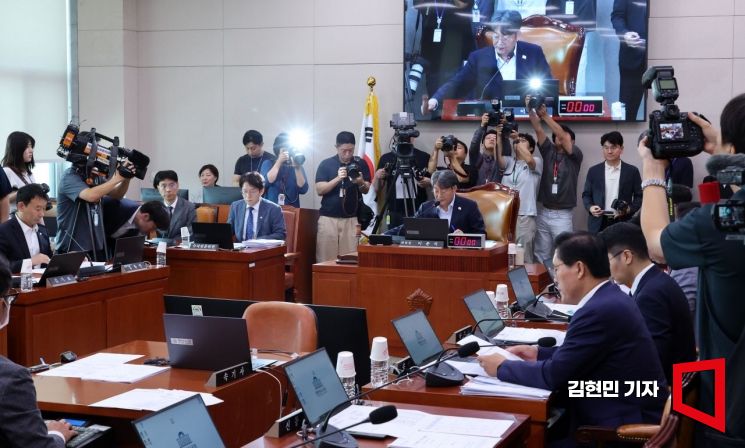 On August 1, 2025, at the National Assembly, Chairman Lee Chunseok is striking the gavel during the plenary session of the Legislation and Judiciary Committee held to deliberate on the three broadcasting laws, the Yellow Envelope Act, and the Commercial Act. Photo by Kim Hyunmin
On August 1, the Legislation and Judiciary Committee held a plenary session and approved the amendment to the Commercial Act with 10 votes in favor and 6 against out of 16 members present. The amendment includes the mandatory introduction of cumulative voting for listed companies with assets of 2 trillion won or more, and the expansion of the number of audit committee members to be elected separately.
Before the vote, the ruling party and the government shared the same opinion on the passage of the amendment. When Park Ji-won, a Democratic Party lawmaker, asked, "Will the passage of this reform legislation, the Commercial Act, cause disorder in the country's economy or society?" Minister of Justice Jeong Seong-ho replied, "I do not think there is such a possibility."
Minister Jeong emphasized, "The amendment to the Commercial Act can prevent the abuse of power by minority controlling shareholders and is expected to invigorate investments by small investors, so-called 'ant' investors."
On the other hand, the People Power Party opposed the amendment, arguing that more discussion was needed. Park Hyung-soo, a People Power Party lawmaker and the opposition secretary of the committee, said, "The Minister said that the additional amendment to the Commercial Act would not have a significant impact on the industry and the economy, but I believe that is a very complacent view. While it may not immediately cause companies to collapse or go bankrupt, the accumulated effects of the amendment could eventually damage the economy."
Park also stated, "Many companies are concerned about the risk of management rights being taken over due to the expansion of cumulative voting. The United States and Japan adopted this system but later reverted to voluntary adoption. We need to examine whether it meets global standards." Regarding the expansion of the separate election of audit committee members, he pointed out, "It violates the principle of one share, one vote."
Shin Dong-wook, another People Power Party lawmaker, also commented, "This amendment to the Commercial Act has been approached in a highly populist manner. I believe it is very dangerous to push this law through under the pretext of protecting shareholders' interests."
Previously, on July 3, the National Assembly passed the first amendment to the Commercial Act with bipartisan agreement. The first amendment included the codification of directors' duty of loyalty to shareholders, the introduction of electronic general meetings of shareholders, and the 3% rule, which limits the voting rights of major shareholders and related parties to 3% when electing independent audit committee members.
The business community is concerned that if the second amendment to the Commercial Act also passes the National Assembly, it could lead to an increase in breach of trust lawsuits and the risk of infringement on management rights. The Democratic Party has announced its intention to promptly revise related regulations to ease the burden on companies regarding breach of trust issues.
Meanwhile, the Broadcasting Three Laws, the Yellow Envelope Act (amendments to Articles 2 and 3 of the Trade Union Act), and the amendment to the Commercial Act, all passed by the Legislation and Judiciary Committee under the leadership of the ruling party on this day, are expected to be submitted to the plenary session scheduled for August 4. The People Power Party has announced a filibuster (unlimited debate) to block the passage of these bills.
© The Asia Business Daily(www.asiae.co.kr). All rights reserved.

















