One-Man Protest in Front of Yongsan Presidential Office
"Industrial Electricity Rates Must Be Cut in Half"
Park Yongseon, a member of the North Gyeongsang Provincial Council (People Power Party, Pohang), staged a solo protest in front of the Presidential Office in Yongsan, Seoul, on the morning of August 1, strongly urging a 50% reduction in industrial electricity rates. Through this protest, Park demanded a fundamental shift in national policy regarding industrial electricity fees, not only for the domestic steel industry but also for the entire local manufacturing sector.
In a statement read at the site, Park said, "Right now, the blast furnaces in Pohang's steel mills are growing cold. Not only are low-priced steel products from China and Japan undermining the steel industry, but high industrial electricity rates are also destroying it. With high tariffs (50% for the steel industry) and industrial electricity rates higher than those in the United States, how can the steel industry remain competitive?" He raised his voice, saying, "If we do not resolve the issue of expensive industrial electricity, not only steel companies but the entire domestic manufacturing industry could lose its foundation."
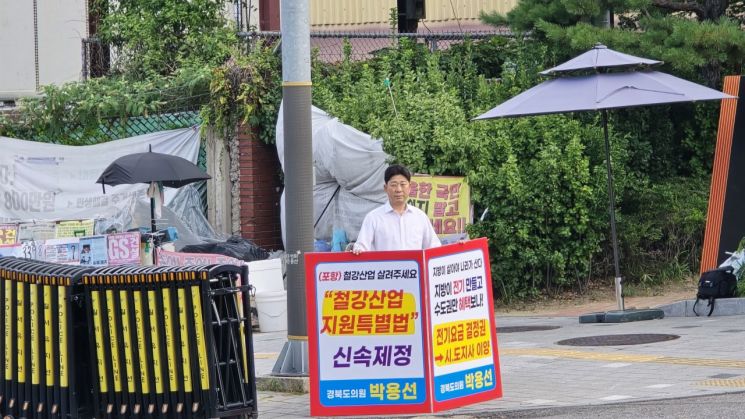 Park Yongseon, a member of the Gyeongbuk Provincial Assembly, is holding a solo protest in front of the presidential office in Yongsan, Seoul.
Park Yongseon especially pointed out that industrial electricity rates have nearly doubled over the past two years. He strongly criticized the structure in which, despite all power generation facilities such as nuclear plants being located in local regions, there are no benefits in terms of electricity rates for these production sites, while only the Seoul metropolitan area enjoys such advantages. He stated, "We must secure the competitiveness of local small and medium-sized enterprises by lowering industrial electricity rates."
To this end, Park called for a reduction of industrial electricity rates by at least half, the transfer of electricity rate decision-making authority to provincial governors, the immediate implementation of regionally differentiated electricity rates and designation of specialized complexes under the 'Special Act on Distributed Energy', priority in fiscal and tax infrastructure for power production sites, and the enactment of a 'Special Act to Support the Steel Industry'.
He also emphasized, "The Special Act to Support the Steel Industry is only one pillar. The essential task for preserving the survival of local regions and the sustainability of national industry is the reform of industrial electricity rates." He further argued, "Companies naturally go where cheap energy is available. If major manufacturers such as semiconductor companies, currently concentrated in the Seoul metropolitan area, relocate to local regions, and jobs for young people and others are created, this could be the best way to prevent the national crisis of regional extinction."
Park Yongseon stressed that this protest is not a one-off political event but the starting point for real institutional change. He said, "This demand must be pursued to the end. Both the President and the National Assembly must be compelled to act. Not only Pohang, but also Gwangyang, Dangjin, Ulsan, and Changwon are suffering from the same hardship," indicating solidarity with manufacturing cities nationwide.
Park Yongseon further emphasized, "If local regions collapse like this, the Seoul metropolitan area will not last long either. South Korea's manufacturing industry cannot stand on the metropolitan area alone. Local regions must protect the positions neglected by the state themselves, and now is the last opportunity."
© The Asia Business Daily(www.asiae.co.kr). All rights reserved.

















