Democratic Party Pushes Through Bills After Request to End Debate
Grain Management Act and Agricultural Products Act Passed by Consensus
Commercial Act Amendments to Be Discussed in the Afternoon
On August 1, the Legislation and Judiciary Committee of the National Assembly passed the amendments to the three Broadcasting Acts and the Trade Union Act. Lawmakers from the People Power Party protested the forced processing of the bills, but the legislation was passed through a vote. The Grain Management Act and the Agricultural and Fishery Products Distribution and Price Stabilization Act (the Agricultural Products Act) were passed without any objections.
On this day, the committee held a plenary session and approved the three Broadcasting Acts and the so-called Yellow Envelope Act (amendments to Articles 2 and 3 of the Trade Union and Labor Relations Adjustment Act). Lawmakers from the People Power Party requested a debate on these bills, but their request was not accepted.
The Yellow Envelope Act, which passed the Environment and Labor Committee on July 28, includes not only provisions to limit claims for damages arising from legitimate labor disputes, but also expands the definition of employer to include those who have substantial control or decision-making power over working conditions, even if they are not a direct party to the employment contract. The business community and others have expressed concerns that continued labor disputes and increased bargaining burdens may result from this change.
The three Broadcasting Acts, which passed the Science, ICT, Broadcasting and Communications Committee on July 7, include provisions to expand the boards of directors of public broadcasters, diversify the authority to recommend board members, and require the establishment of programming committees with equal representation of labor and management at terrestrial broadcasters, general programming channels, and news channels. The People Power Party has objected to these bills, claiming that the Democratic Party and labor unions are attempting to seize control of broadcasting.
Lee Choon-sik: "Even if we must endure criticism, we should finish this process and operate the committee normally"
Lee Choon-sik, chair of the Legislation and Judiciary Committee (affiliated with the Democratic Party), responded to the opposition's protest over the lack of debate by stating, "The longer we hold onto these bills, the more likely it is that the committee will become embroiled in political strife. I believed it was desirable to accept a certain amount of criticism, process the bills, bring them to a close, and return the committee to normal operation."
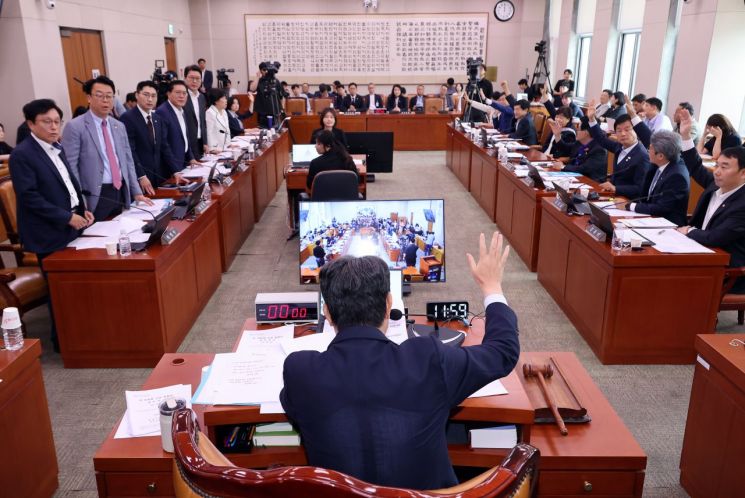 On the 1st, at the National Assembly in Yeouido, Seoul, during the plenary meeting of the Legislation and Judiciary Committee held to review and decide on the Broadcasting Three Acts, the Yellow Envelope Act, and the Commercial Act, the Broadcasting Three Acts were passed. Meanwhile, committee members, including Park Hyungsu, the floor leader of the People Power Party in the Legislation and Judiciary Committee, protested to Chairman Lee Chunseok regarding the conclusion of the debate and the operation of the committee. Photo by Yonhap News
Although the committee reviewed the bills on this day, when the Democratic Party requested an end to the debate, Chair Lee accepted the request. In response, lawmakers from the People Power Party protested, saying, "How can you end the debate like this?"
The Grain Management Act and the Agricultural Products Act were passed by consensus. The Grain Management Act stipulates that if the price of rice falls below the average level, the government will compensate farmers for the difference and is required to purchase any surplus rice. The Agricultural Products Act states that if the market price of major agricultural and fishery products, including rice, falls below a certain standard, the government will compensate for part of the difference.
In addition, the committee approved amendments to the Local Education Finance Grant Act, which extend the period for central government support for free high school education by three years, until 2027.
The committee plans to reconvene in the afternoon to discuss amendments to the Commercial Act. The Commercial Act passed the first subcommittee of the Legislation and Judiciary Committee on July 28, and includes provisions to make cumulative voting mandatory for listed companies with assets of 2 trillion won or more, and to increase the number of separately elected audit committee members from one to at least two. The Democratic Party explains this as part of a value-up initiative to raise the value of the domestic stock market, but the business community and others have expressed concerns that management rights could be threatened.
© The Asia Business Daily(www.asiae.co.kr). All rights reserved.
![Clutching a Stolen Dior Bag, Saying "I Hate Being Poor but Real"... The Grotesque Con of a "Human Knockoff" [Slate]](https://cwcontent.asiae.co.kr/asiaresize/183/2026021902243444107_1771435474.jpg)
















