"Trump May Demand Increase in Defense Cost-Sharing"
"Negotiations from a Disadvantaged Position... Likely Considered the Korea-US Alliance"
Cutler, ASPI Vice President: "Successfully Defended Sensitive Sectors"
With the signing of the Korea-US trade agreement and a summit scheduled to take place within two weeks, there are expectations that US President Donald Trump will push President Lee Jaemyung for additional trade concessions. There are also projections that Trump may make further demands on non-trade issues, such as the Special Measures Agreement on the cost-sharing for US Forces Korea.
On July 31 (local time), Victor Cha, Korea Chair at the Center for Strategic and International Studies (CSIS), and Andy Lim, Deputy Director, stated in a report on the Korea-US trade agreement that "President Trump will not let this White House visit be simply an occasion to celebrate the trade agreement." They expressed these views in their report.
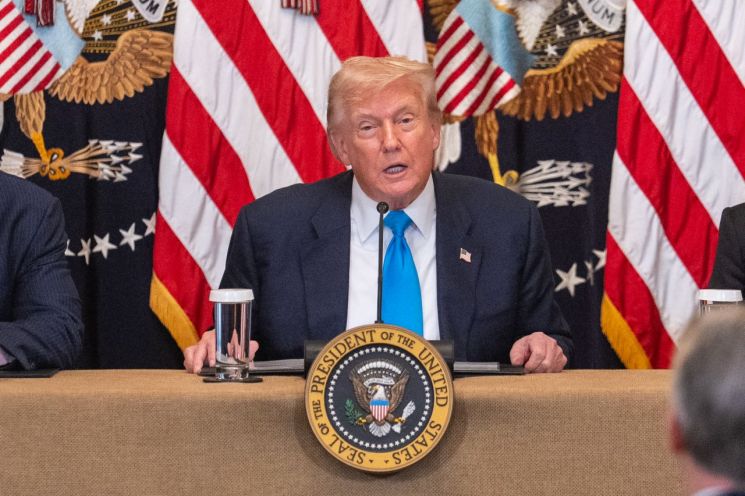
Cha and Lim commented on the upcoming summit, saying, "It will be used as leverage to extract further concessions from Korea on issues such as investment, non-tariff barriers, and currency manipulation." They added, "The two leaders are also highly likely to discuss issues that are not directly related to trade but are nonetheless associated. One of these is the cost-sharing negotiations for US Forces Korea, where the United States wants Korea to significantly increase its contribution, far exceeding the current level of about $1 billion (approximately 1.3966 trillion won)." President Trump has publicly stated that the cost-sharing for US Forces Korea should be raised to $10 billion per year.
They assessed the agreement by saying, "There are still many details that need to be worked out." This is because specific information has not been released regarding the $35 billion in new investment in the US and the $10 billion purchase of US-produced liquefied natural gas (LNG). It also remains unclear whether Korea will participate in the Alaska LNG project promoted by President Trump.
Additionally, they pointed out that negotiations have not yet taken place on areas the US considers important, such as Korea's digital service regulations regarding the export of precision maps, currency manipulation, and supply chain restrictions on China.
In their overall assessment of the agreement, they stated, "In theory, there is always a better deal." They added, "Korea gave up all leverage in the negotiations by not imposing retaliatory tariffs on US goods, as the European Union or Canada did, before entering talks with the Trump administration over reciprocal tariffs." They further explained, "Korea negotiated when tariffs on US products were virtually zero due to the free trade agreement (FTA). Although this put Korea in a disadvantageous position, considering the security relationship within the Korea-US alliance, it may have been the only realistic strategy."
However, some observers have given positive evaluations, noting that Korea successfully defended its position against US demands for market opening in sensitive sectors such as beef and rice.
According to US business media outlet CNBC, Wendy Cutler, Vice President of the Asia Society Policy Institute (ASPI), commented that "After the US finalized its trade agreement with Japan, the Korean negotiating team was in a situation where they had to secure a deal to avoid being placed at a disadvantage in the US market." She noted that while Korea did not secure any concessions in the steel and semiconductor sectors, it successfully blocked further US demands for market opening in the highly sensitive beef and rice sectors. Cutler is a trade expert who previously served as Deputy US Trade Representative (USTR) and was involved in the negotiation of the Korea-US FTA.
Cutler added, "This agreement undermines the value of the Korea-US FTA, under which both countries have eliminated nearly all tariffs." She continued, "Although Korea is an FTA partner, unfortunately, it appears to have received no special treatment whatsoever."
© The Asia Business Daily(www.asiae.co.kr). All rights reserved.
![Clutching a Stolen Dior Bag, Saying "I Hate Being Poor but Real"... The Grotesque Con of a "Human Knockoff" [Slate]](https://cwcontent.asiae.co.kr/asiaresize/183/2026021902243444107_1771435474.jpg)
















