Imminent Mutual Tariff Implementation on August 1
Market Turns Lower After "Surprise Earnings" Rally Led by Microsoft and Meta
Microsoft Joins Nvidia in Surpassing $4 Trillion Market Cap During Session
June PCE Inflation Rises 2.6% Year-on-Year, Exceeding Expectations
Probability of Rate Hold in September Rises to Over 60%
All three major indices on the New York Stock Exchange closed lower on July 31 (local time). Investor sentiment weakened a day before the expiration of the mutual tariff suspension, which ends on August 1. The market initially rose in early trading, buoyed by the surprise earnings results from Microsoft (MS) and Meta Platforms, the parent company of Facebook, but as the tariff implementation date approached, gains were erased and the indices turned downward.
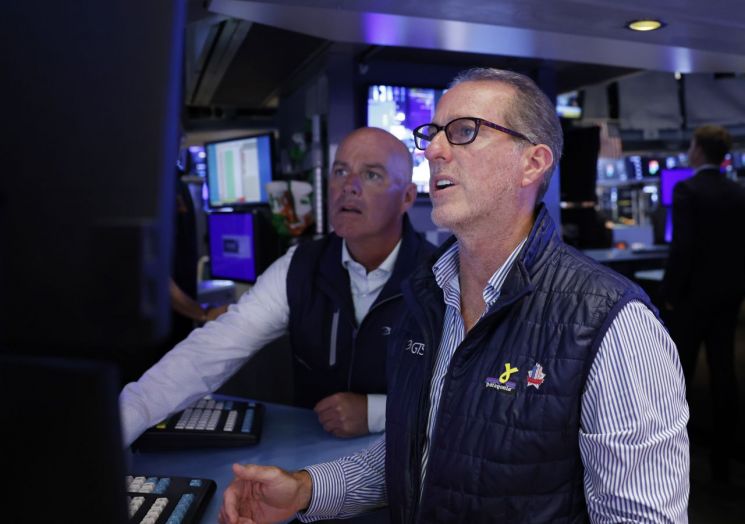
On this day, the Dow Jones Industrial Average, which focuses on blue-chip stocks, closed at 44,130.98, down 330.3 points (0.74%) from the previous session. The S&P 500 Index, which tracks large-cap stocks, fell by 23.51 points (0.37%) to 6,339.39, while the tech-heavy Nasdaq Index dropped by 7.23 points (0.03%) to close at 21,122.45.
Investors grew increasingly cautious ahead of the mutual tariff measures set to take effect the following day. The White House announced that President Donald Trump would sign an executive order on August 1 to implement the new mutual tariffs. White House spokesperson Karoline Leavitt stated, "The signing is expected to take place this afternoon or evening (July 31)," and added, "The tariffs will take effect from August 1."
President Trump had postponed the implementation of mutual tariffs twice before, but with the suspension ending, tariffs are scheduled to be imposed starting at 12:01 a.m. on August 1. Countries that reached trade agreements with the United States during the tariff suspension period, including South Korea, will have the agreed tariff rates applied. In contrast, countries that have not concluded trade agreements with the United States will face tariffs unilaterally set by the U.S. For India, a 25% tariff has been announced.
Rising inflation indicators and diminished expectations for a rate cut in September also weighed on the stock market. According to the U.S. Department of Commerce, the Personal Consumption Expenditures (PCE) price index for June rose by 2.6% compared to the same period last year. This exceeded both the market expectation of 2.4% and the May figure of 2.5%. The core PCE price index, which excludes volatile energy and food prices, also rose by 2.8% year-on-year, surpassing the expected 2.7%. The tariff increase policy is believed to have contributed to the acceleration of inflation by raising the prices of certain goods.
This indicator was released just one day after the Federal Reserve (Fed) decided to keep the benchmark interest rate unchanged at 4.25-4.5% per year. Fed Chair Jerome Powell said at a press conference following the Federal Open Market Committee (FOMC) meeting the previous day, "The impact of tariffs is starting to be reflected more clearly in the prices of certain goods," and added, "We need to continue monitoring the overall impact on economic activity and inflation." Regarding the rate path for September, he stated, "No decision has been made yet," which the market interpreted as a hawkish (preference for monetary tightening) remark.
According to the CME FedWatch Tool, the probability of a rate hold in September currently stands at 61%. This has risen from 39.2% a week ago, reached 52.4% the previous day, and increased further after the release of the PCE price index.
Clark Bellin, CEO and Chief Investment Officer (CIO) of Bellwether Wealth, commented, "Inflation remains persistent, so the Fed's decision to hold rates was justified." He added, "A rate cut is not necessary for the stock market to rise," and pointed out, "So far this year, the market has shown significant gains even without a rate cut."
Labor market indicators also remained strong. According to the U.S. Department of Labor, initial jobless claims for the week of July 20-26 totaled 218,000. This was an increase of 1,000 from the previous week (217,000), marking the first uptick in seven weeks, but the figure remains low. It was also 4,000 fewer than the market expectation of 222,000.
U.S. Treasury yields were steady. The yield on the 10-year U.S. Treasury note, a global benchmark, remained at the previous day's level of 4.38%, while the yield on the 2-year Treasury note, which is sensitive to monetary policy, rose by 2 basis points (1bp=0.01 percentage point) to 3.96%.
By stock, Microsoft, which reported earnings that surpassed market expectations the previous day, rose by 3.95%. At one point during the session, its market capitalization exceeded $4 trillion, making new history following Nvidia's entry into the $4 trillion club earlier this month, but it later gave back gains and failed to close above the $4 trillion mark. Meta also soared by 11.25% on the back of its surprise earnings report the previous day. After the market closed, Apple and Amazon, which announced their earnings, posted a decline of 0.71% and a gain of 1.7%, respectively, during regular trading.
© The Asia Business Daily(www.asiae.co.kr). All rights reserved.

















