"Did South Korea Negotiate Better?"
Social Media Buzzes with Reactions
On July 31, in response to the conclusion of the South Korea-US tariff negotiations, there was a mix of surprise and bewilderment in Japan over the fact that the outcome was reached under conditions similar to those for Japan. Comparative analyses of the results for both countries are also ongoing.
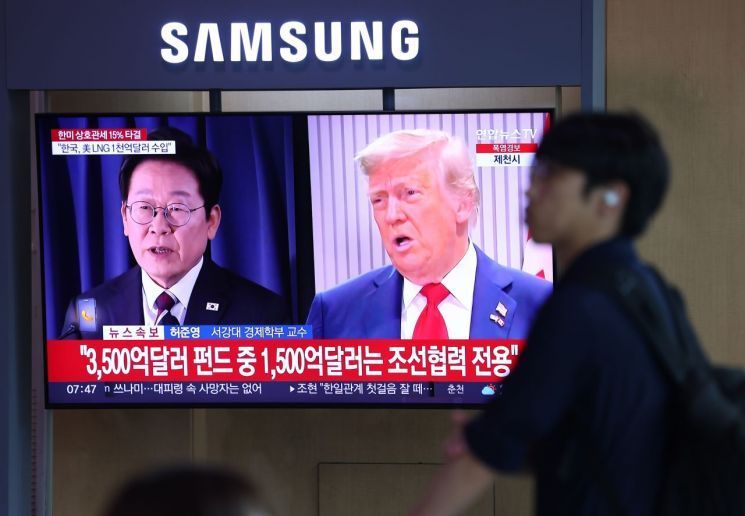 Amid the conclusion of the Korea-US tariff negotiations on the 31st, attention is also being focused in Japan. Photo by Yonhap News
Previously, the South Korean government succeeded in partially adjusting high tariffs through negotiations with the United States. The mutual tariff rate was reduced from 25% to 15%, and, in return, South Korea agreed to establish an investment fund worth approximately $350 billion for the United States. Automobile tariffs were also agreed upon at an equivalent level. Notably, the additional opening of the agricultural and livestock markets, which had been requested by the US side, was not included.
As news of the conclusion of the South Korea-US negotiations spread, major Japanese media outlets such as NHK, Nihon Keizai Shimbun, and Asahi Shimbun quickly reported on the developments. Local social media also saw ongoing reactions from users. Some users expressed surprise, saying, "It’s surprising that South Korea also has a 15% tariff just like Japan," while others voiced dissatisfaction with their own government.
One Japanese netizen commented, "Does this mean we’ve ended up in the same situation as South Korea?" Other reactions included, "It’s absurd that we’re the same as South Korea," "South Korea is spending less money yet has the same tariff rate?doesn’t this mean Japan’s diplomacy has failed?" "It’s annoying that we’re under the same conditions as South Korea," "Why do only we have to make such large concessions?" and "Only South Korea succeeded in the negotiations. What did Japan do?"
The greatest dissatisfaction centered on the difference in investment amounts. Previously, Japan had pledged approximately $550 billion in investments in the United States as part of its negotiations. This is significantly higher compared to South Korea’s approximately $350 billion.
Some argued that a simple comparison is difficult. They pointed out, "Considering the size of GDP, South Korea was pressured to invest more than Japan," "Given that South Korea’s GDP is half that of Japan, a $350 billion investment is quite a burden," and "Although Japan invested more in absolute terms, South Korea’s burden is higher when viewed as a percentage of GDP."
Meanwhile, President Lee Jaemyung stated on Facebook that morning, "We have finally concluded the tariff negotiations," adding, "The government has eliminated uncertainties in the export environment and set US tariffs at a level lower than or equal to those of major export competitors, thereby creating conditions that allow us to compete on equal or superior terms with major countries."
© The Asia Business Daily(www.asiae.co.kr). All rights reserved.

















