Policy Seminar with Local Governments, National Assembly, Related Agencies, and Industry-Academia Experts
Strengthening Infrastructure Centered on Three Main Strategies, Including Port Function Advancement
Kim Yungrok: "We Will Do Our Best to Provide Policy Support and Establish Institutional Foundations"
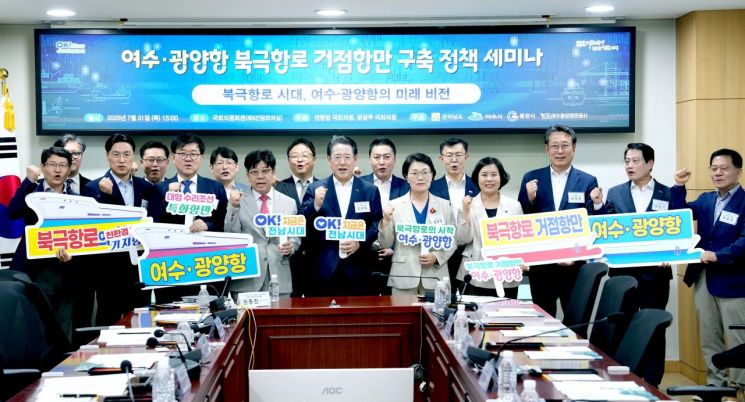 Jeollanam-do Governor Kim Youngrok is taking a commemorative photo with key guests at the "Yeosu-Gwangyang Port Arctic Route Hub Port Construction Policy Seminar" held on the afternoon of the 31st at the National Assembly Members' Office Building in Seoul. Provided by Jeonnam Province
On July 31, a policy seminar titled "Establishment of Yeosu-Gwangyang Port as a Strategic Hub for the Arctic Route" was held at the National Assembly, where discussions were held on the future vision for Yeosu-Gwangyang Port and policy support measures.
The seminar was organized to re-examine the strategic importance of Yeosu-Gwangyang Port amid rapidly changing global maritime logistics conditions surrounding the Arctic Route, and to identify practical policy directions and implementation tasks in order to strengthen cooperation with the National Assembly and the government.
The event was co-hosted by Jeollanam-do Province, Yeosu City, Gwangyang City, and Yeosu Gwangyang Port Authority, and co-organized by National Assembly members Kwon Hyangyeop and Moon Geumjoo.
Numerous participants attended, including National Assembly members representing the Jeollanam-do region, officials from related organizations, as well as experts from industry and academia, who engaged in in-depth discussions on the future vision for Yeosu-Gwangyang Port and policy support measures.
Yeosu-Gwangyang Port is specialized in handling non-container cargo such as crude oil, petrochemicals, and iron ore, which accounts for approximately 89% of its cargo. This is closely linked to the industrial structure and cargo types mainly transported by vessels operating on the Arctic Route (as of 2023, 99% non-container cargo and 1% container cargo).
Thanks to these characteristics, Yeosu-Gwangyang Port is attracting significant attention as a uniquely competitive hub for Arctic Route logistics.
Accordingly, Jeollanam-do Province is continuously strengthening various industrial bases and port infrastructure centered on three main strategies to foster Yeosu-Gwangyang Port as a strategic hub for the Arctic Route.
In particular, the province is upgrading port functions by establishing an energy hub port, so that Yeosu-Gwangyang Port can serve as both the starting and ending point for Arctic resources, as well as a transshipment port.
Additionally, by establishing an eco-friendly bunkering base, the province is laying the foundation for stable supply of clean fuels such as LNG and ammonia, aiming to develop the port as a key fueling hub for vessels operating on the Arctic Route.
The province also plans to specialize in the ship repair and maintenance industry by establishing a system capable of servicing large vessels, and to actively respond to maintenance demands for icebreakers and ice-class ships operating on the Arctic Route, thereby enhancing the competitiveness of related industries.
Alongside these efforts, Jeollanam-do Province is systematically promoting key foundational projects, including the construction of an automated container terminal, the establishment of the Yulchon Convergence Logistics Complex, the opening of an undersea tunnel between Gwangyang Port and Yulchon Industrial Complex, the dredging of the main navigation channel in front of the Gwangyang Port container terminal, and the establishment of a smart port MRO workforce training center, thereby accelerating the transition to a next-generation integrated port.
Kim Yungrok, Governor of Jeollanam-do Province, stated, "Yeosu-Gwangyang Port has ample potential and well-prepared capabilities to lead the era of the Arctic Route as a maritime logistics hub," and emphasized, "We will do our utmost to provide policy support and establish institutional foundations so that the port can become a strategic hub for the Arctic Route, working closely with the National Assembly, the government, local governments, industry, and academia."
This seminar, held as a follow-up to the first policy seminar held at the Jeollanam-do Provincial Government Office on July 11, is expected to serve as an important turning point for securing practical momentum and for full-scale discussions on the national-level systematization of Arctic Route-related policies.
© The Asia Business Daily(www.asiae.co.kr). All rights reserved.

















